

We use cookies to ensure our website works properly and to personalise your experience. Cookies policy
JES’s S.N.D.College of Pharmacy, Babhulgaon, Yeola
Pharmacovigilance plays a vital role identifying, assessing, understanding, and preventing adverse drug reactions (ADRs) to ensure the safe and effective use of medicines. However, traditional pharmacovigilance methods face several limitations, including underreporting of adverse events, incomplete data, manual processing, and delays in detecting potential safety signals. This review article explores the contribution of artificial intelligence (AI) and emerging technologies to improving drug safety monitoring. It discusses the applications of machine learning, natural language processing (NLP), automated database systems, electronic health records (EHRs), and real-world data (RWD) in adverse drug reaction detection, signal identification, and case processing. The role of established pharmacovigilance systems, including FAERS and VigiBase, along with relevant regulatory frameworks, is also reviewed. Furthermore, the article highlights emerging technologies such as generative AI and blockchain that may support efficient data analysis, transparency, and secure information sharing. Despite these advantages, challenges related to data quality, algorithmic bias, patient privacy, and regulatory compliance remain important concerns. Overall, the integration of AI with conventional pharmacovigilance practices offers promising opportunities for earlier safety signal detection, improved monitoring, and enhanced patient safety.
Pharmacovigilance combines the Greek word pharmakon, meaning “drug,” with the Latin vigilare, meaning “to keep watch” or “remain alert.” It refers to the ongoing, careful monitoring of medicines to identify risks and ensure safe use [1,3]. According to the World Health Organization, pharmacovigilance is the science and associated activities concerned with detecting, evaluating, understanding, and preventing adverse effects or other potential problems related to medicines [1,2].
Its scope has expanded beyond conventional drugs to include herbal and traditional remedies, complementary therapies, blood products, biologics, vaccines, and medical devices [2,4]. AI has progressed from early, experimental use in pharmacovigilance to being increasingly evaluated for integration into everyday pharmacovigilance operations. The use of artificial intelligence in pharmacovigilance has grown considerably, offering the potential to make adverse event identification faster and more accurate [17,26,30]. Drug development and post-market monitoring have become increasingly complex, fueled by vast amounts of data, intricate drug–drug interactions, and differences among patients [21,24,28].
Underreporting within pharmacovigilance can compromise patient safety because it conceals the actual frequency and characteristics of adverse drug reactions. With a median underreporting rate of roughly 94%, the ability to identify safety signals and support sound public-health decisions is substantially weakened [15]. Adverse drug reactions are also an important cause of hospital admissions and healthcare costs, reinforcing the need for effective safety surveillance [16]. Traditionally, the field has relied on clinical judgment, manual review, and retrospective analysis of individual case reports, epidemiological research, and clinical-trial data; however, these approaches face challenges related to scalability, efficiency, human error, and bias [3,15,17].
Conventional approaches, which depend on spontaneous reporting and manual signal detection, often cannot manage the enormous volume and complexity of global safety data. Artificial intelligence and machine learning are reshaping the field by supporting faster, more accurate, and more proactive drug-safety surveillance [17,18,22,24]. Pharmacovigilance developed into a formal discipline after major drug-safety tragedies, most notably the thalidomide crisis of the early 1960s; the WHO Programme for International Drug Monitoring was subsequently established to coordinate international safety monitoring [1,3].
Before a drug reaches the market, pharmacovigilance mainly depends on structured information generated through clinical trials. After approval, surveillance draws on both structured and unstructured data from sources including individual case safety reports, regulatory databases such as the FDA Adverse Event Reporting System (FAERS) and WHO VigiBase, electronic health records, insurance claims, social media content, and biomedical publications [5,6,8,25]. Together, these sources provide valuable real-world evidence on medication safety and can reveal complex patterns that structured reporting systems may overlook [7,23,25]
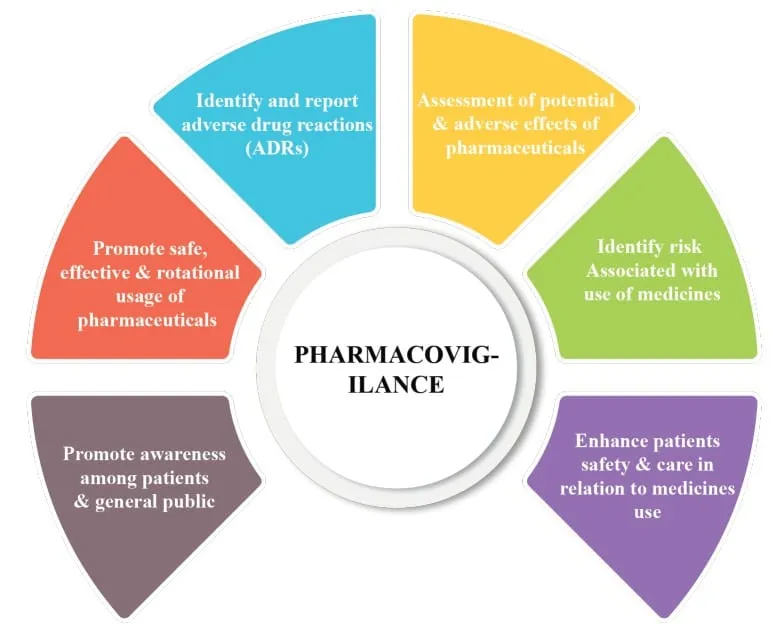
Fig. Pharmacovigilance
As technology continues to transform industries, pharmacovigilance is also experiencing significant change. By analyzing large volumes of data, identifying meaningful patterns, and supporting rapid, evidence-based decisions, AI offers considerable promise for strengthening pharmacovigilance activities [17,21,24,27]. Adverse drug reactions also place a substantial financial burden on healthcare systems, arising from both the direct cost of treating adverse events and indirect losses such as reduced productivity; therefore, proactive pharmacovigilance is essential for improving healthcare-resource use and patient outcomes [16,24].
METHODOLOGY
Pharmacovigilance uses several systematic approaches to detect, evaluate, and reduce risks linked to medicinal products. These include spontaneous reporting systems, cohort and case-control studies, automated database analysis, real-world evidence, and artificial intelligence to process large amounts of adverse drug reaction data [3,7,8,17,26].
Voluntary Adverse Event Reporting Systems
Spontaneous reporting is among the oldest and most commonly used methods in pharmacovigilance. Healthcare professionals and, in some cases, patients voluntarily submit reports of suspected adverse drug reactions to regulatory authorities [3,15]. National databases, including the U.S. FDA Adverse Event Reporting System (FAERS) and the WHO global database VigiBase, have greatly improved ADR surveillance by serving as centralized sources of safety data collected worldwide [5,6]. Although spontaneous reporting plays a key role in identifying early safety signals, it has notable limitations, including incomplete reporting, biased submissions, and limited ability to establish causality [15,17].
Cohort and Case-Control Study Designs
Epidemiological approaches, such as cohort and case-control studies, are applied in pharmacovigilance to examine possible adverse drug reactions and determine whether causal associations exist [3,16]. In cohort studies, researchers track groups of patients who have and have not been exposed to a medication over time to determine how frequently adverse drug reactions occur; this approach is especially useful for detecting reactions that develop after prolonged use [3,16]. In contrast, case-control studies compare individuals who experienced an adverse reaction with those who did not, making them valuable for investigating uncommon or delayed effects [3,16]. Together, these designs help confirm signals identified through spontaneous reporting and improve the dependability of pharmacovigilance evidence [3,16].
Automated Database System
The growth of electronic health records and digital data management has made automated database systems highly valuable for pharmacovigilance. Platforms such as the FDA Sentinel System and the European Union EudraVigilance support large-scale collection and analysis of adverse drug reaction data, helping reveal patterns that may be missed in individual case reports [7,8]. These systems use data-mining methods, including disproportionality analysis, to identify possible safety signals and improve both the speed and precision of safety monitoring [22,28,29]. By enabling near real-time surveillance, automated databases are increasingly important in post-marketing evaluation of newly approved medicines [7,8,21].
Real-World Evidence and Real-World Data
Real-world evidence and real-world data are being used more frequently in pharmacovigilance to generate insights from sources beyond clinical trials, including patient registries and insurance claims data [7,8,28]. RWE supports conventional safety-monitoring methods by capturing adverse drug reactions in routine and more varied clinical environments [7,23,28]. Observational studies based on RWD enable researchers to assess the long-term effects of medicines, particularly among patient groups that may have been underrepresented in original clinical trials [7,23,28]. RWE is especially valuable for examining medication safety in everyday use and offers a more complete understanding of a drug’s overall risk profile [7,23,28].
Signal Detection and Data Mining
Signal detection is a core component of pharmacovigilance and focuses on recognizing previously unknown or unexpected adverse drug reactions within large collections of safety data [22,28,29]. Methods such as disproportionality analysis, including the proportional reporting ratio and Bayesian data-mining approaches, are widely applied to detect potential safety signals in pharmacovigilance databases [22,28,29]. By comparing how often a particular ADR is reported with the frequency expected based on overall reporting patterns, PRR can identify associations that may warrant closer evaluation [29]. These signals help regulatory agencies take timely action to protect public health and ensure medication safety [5,6,8,22].
Regulatory Frameworks and Guidelines
Pharmacovigilance is governed by a diverse but interconnected set of national and international regulations designed to protect patients and ensure medicines are used safely. Major authorities and standards, including the FDA, EMA, WHO, and ICH, provide foundational guidelines that shape global pharmacovigilance practice [1,6,8,9,10].
The U.S. Food and Drug Administration
In the United States, the FDA is central to pharmacovigilance, mainly through the Center for Drug Evaluation and Research. CDER monitors drug safety throughout a product’s life cycle, beginning with clinical trials before approval and continuing with surveillance after the drug reaches the market [6,7]. Its Adverse Event Reporting System gathers and evaluates adverse drug reaction reports to detect emerging safety concerns, while the Sentinel System uses real-world data on medication usage and medical diagnoses to generate evidence about adverse drug reactions [6,7]. The FDA also requires manufacturers to carry out post-marketing safety studies and submit adverse drug reaction reports to FAERS, creating a structured process for ongoing safety surveillance [6,7].
United States: AI Regulation
In the United States, there is currently no dedicated regulatory pathway specifically for AI-based technologies. Instead, the FDA assesses them within its established framework for medical devices [11,31]. In April 2019, the agency introduced a proposed framework for modifications to AI/ML-based software as a medical device, placing responsibility on developers to ensure their systems perform reliably in real-world settings and to notify the FDA of significant changes in performance or inputs [11]. The FDA has also described a framework for using real-world evidence to support regulatory decision-making [32].
World Health Organization
The WHO works with national pharmacovigilance centers and maintains VigiBase, a worldwide adverse drug reaction database administered by the Uppsala Monitoring Centre in Sweden [1,5]. By gathering reports from more than 150 countries, VigiBase helps the WHO detect global safety signals and respond to emerging drug-safety concerns [1,5]. Through its International Drug Monitoring Programme, the WHO also supports countries in building pharmacovigilance systems by sharing best practices, training, and resources [1,2,3].
United Kingdom
In the United Kingdom, NICE worked with NHS England to publish the Evidence Standards Framework for Digital Health Technologies in 2019, setting evidence requirements for digital health products [13]. The UK Regulatory Horizons Council issued The Regulation of AI as a Medical Device in November 2022, addressing AI-based medical devices throughout their life cycle [14]. In September 2021, the MHRA launched the Software and AI as a Medical Device Change Programme to strengthen oversight of AI-based medical devices, including cybersecurity, data privacy, post-market evaluation, changing algorithms, bias, and explainability [12].
European Medicines Agency
The European Medicines Agency operates EudraVigilance, a system for collecting and analysing reports of suspected adverse reactions to medicines authorized in the European Economic Area [8]. EudraVigilance supports early detection of possible safety signals and enables regulators, marketing authorization holders, and healthcare professionals to access relevant safety information [8]. The European framework emphasizes continuous pharmacovigilance, risk management, and post-authorisation safety studies [8,10].
International Council for Harmonisation Guidelines
The International Council for Harmonisation has developed guidelines that promote consistent pharmacovigilance practices across countries and support a shared approach to drug safety [9,10]. ICH E2E provides direction on pharmacovigilance planning, covering the collection and analysis of safety data both before and after a product is marketed [9]. ICH E2D sets expectations for managing post-approval safety information, with particular emphasis on the rapid reporting of serious and unexpected adverse drug reactions [10]. By standardizing terminology and procedures, these guidelines enable regulators and pharmaceutical companies to coordinate safety monitoring across regions [9,10].
Challenges in Pharmacovigilance
Although pharmacovigilance is essential for protecting patients, several obstacles can limit its effectiveness, including insufficient reporting of adverse drug reactions, incomplete or poor-quality safety data, constrained resources in low- and middle-income countries, and difficulty aligning pharmacovigilance practices across regions [1,3,15,16].
Engaging the Public
Pharmacovigilance ultimately exists to protect patients and support the healthcare professionals who treat them. As drug-safety surveillance evolves, systems must continue to incorporate the perspectives of patients and clinicians while delivering clear, practical guidance on medication safety and appropriate use [1,3]. Spontaneous reports of suspected adverse drug reactions from patients and healthcare professionals have long formed the basis of drug-safety surveillance, relying on careful clinical observation and reasoning [3,15].
Data Quality and Completeness
In pharmacovigilance, the quality and completeness of data are essential because they directly affect the reliability of safety-signal detection and risk evaluation [3,15,17]. Safety databases frequently include missing, incorrect, or duplicated records, which can reduce their value for meaningful analysis [15,17,23]. Improving data quality requires standardized methods for collecting safety information and stronger reporting systems; although integrating electronic health records could make pharmacovigilance data more complete, technical limitations and regulatory challenges continue to restrict broad implementation [23,25,28].
Collaboration and Partnerships
Pharmacovigilance depends on collaboration across organizations. Because its scope is wide, safety systems need partnerships that combine complementary skills and enable thorough monitoring and investigation of medicine safety [1,2,3]. Pharmacovigilance is also increasingly addressing concerns related to product quality, including substandard, falsely labelled, falsified, and counterfeit medical products [1,4].
Integrating Real-World Evidence
Although real-world evidence can strengthen pharmacovigilance, incorporating it into practice is difficult because real-world data come from varied and complex sources [7,28,32]. Information from electronic health records, insurance claims, and social media is often inconsistent and lacks standardization, requiring substantial cleaning and validation before it can be reliably used for safety analysis [19,23,25].
Assessing Impact
Pharmacovigilance requires significant resources and is intended to safeguard and improve public health. Although pharmacovigilance activities have advanced considerably worldwide over the past decade, relatively little attention has been given to measuring their actual impact and workload [1,3]. As databases of suspected adverse drug reactions expand, timely analysis is needed to identify meaningful adverse drug reactions quickly while filtering out unsupported safety signals; however, this work demands trained staff, time, and funding [3,15,17].
Harmonization and Pharmacovigilance Practice
Differences in pharmacovigilance regulations and reporting practices across countries create difficulties for multinational pharmaceutical companies and regulators [9,10,12]. Although the International Council for Harmonisation offers guidelines to align safety activities globally, national requirements still vary, adding complexity to compliance and reporting [9,10,12]
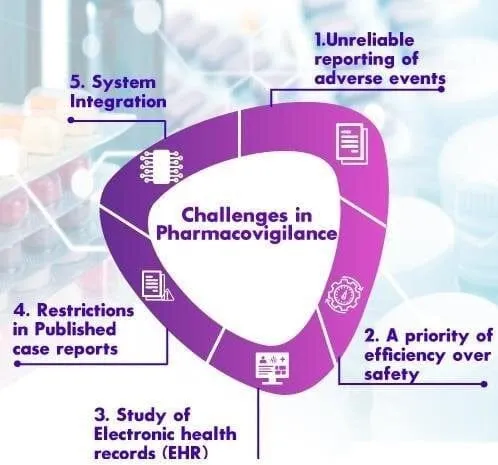
Fig. Challenges in Pharmacovigilance
Future Directions in Pharmacovigilance
Pharmacovigilance is expected to change significantly as it responds to new technologies, greater patient participation, and increasingly interconnected healthcare systems. Future efforts are likely to emphasize personalized medicine, updated regulatory approaches, and stronger international cooperation, with the shared goal of improving medicine safety and effectiveness worldwide [11,12,21,31]. AI is already showing meaningful potential to improve drug safety monitoring and surveillance; advances in generative AI and related technologies could further strengthen the field by making safety processes more efficient, proactive, and streamlined [24,27,29].
Under-Reporting in Pharmacovigilance
A major weakness of voluntary adverse drug reaction reporting is underreporting. Spontaneous reporting systems often identify only about 6–10% of ADR cases, which can delay safety warnings and make it difficult to estimate the true frequency of reactions [15]. Underreporting commonly results from inadequate reporting systems, limited awareness among healthcare professionals, large patient populations, insufficient doctor-to-patient ratios, and high levels of self-medication [3,15,16]. Research consistently emphasizes the need for education, simplified reporting processes, reporter feedback, stronger enforcement, incentives, collaboration, and targeted training programmes [1,3,15].
Data Quality and Completeness
In pharmacovigilance, complete and high-quality data are essential for accurately identifying safety signals and assessing risks. However, safety databases often contain missing, incorrect, or duplicated information, which can reduce their usefulness for meaningful analysis [3,15,17,23].
Simplified Case Processing and Reporting
AI-driven tools could significantly improve the efficiency of pharmacovigilance teams by automating routine activities such as data entry, case prioritization, and causality assessment [18,22,24,26]. These systems can also generate standardized reports that support regulatory compliance, making the reporting process more streamlined [18,22,27]. By reducing manual workload, AI can allow drug safety professionals to focus more on complex tasks that require critical thinking and expert judgement [18,24,26].
To make pharmacovigilance data more reliable and traceable, researchers are investigating secure and transparent systems for documenting and evaluating adverse drug reactions and safety signals. Blockchain is one possible approach, as it creates a shared, tamper-evident record of information that could improve the dependability of ADR and safety-signal detection while enabling greater transparency and collaboration [33].
Ethical and Privacy Considerations
As pharmacovigilance relies more heavily on data, ethical and privacy issues will become increasingly important. Safeguarding patient confidentiality while sharing information across countries is difficult because privacy laws differ from one nation to another, making international data exchange more complicated [11,12,24,27]. Blockchain technology is being considered as a way to build secure, decentralized databases that protect patient information while still allowing transparent data sharing [33].
Interdisciplinary Research
Collaboration across disciplines is vital for advancing pharmacovigilance. Pharmacologists, data scientists, ethicists, and policy-makers can help create more advanced tools for monitoring drug safety, while involving patients in designing these tools ensures that their experiences and needs are considered [1,17,26,31].
Expanding AI Capabilities
Advances in AI, such as reinforcement learning and the integration of multiple data types, are expected to improve the analysis of complex pharmacovigilance information [17,22,26,28]. These approaches can help identify meaningful patterns within diverse datasets [19,23,25,28]. Large language models may also support ADR extraction, triage, literature screening, and documentation, although human oversight and validation remain essential [27,29]. Blockchain technology may further support safer and more transparent data sharing by maintaining the integrity and traceability of safety data across different systems [33].
CONCLUSION
Artificial intelligence and emerging technologies have significant potential to improve pharmacovigilance and drug safety monitoring. Traditional pharmacovigilance methods face several challenges, including underreporting of adverse drug reactions, incomplete data, manual processing, and delays in identifying safety signals. AI and machine learning can help overcome these limitations by analysing large volumes of structured and unstructured data, automating case processing, detecting potential adverse drug reactions at an early stage, and supporting faster, evidence-based decision-making. The integration of electronic health records, real-world data, natural language processing, and advanced data-mining techniques can further strengthen drug safety surveillance.Emerging technologies such as generative AI and blockchain may also improve efficiency, data transparency, and secure information sharing .However, challenges related to data quality, algorithmic bias, patient privacy, regulatory compliance, and the reliability of AI-generated results must be carefully addressed. Therefore, AI should complement, rather than completely replace, the expertise of healthcare professionals and pharmacovigilance specialists. In conclusion, the responsible integration of artificial intelligence with conventional pharmacovigilance practices can contribute to earlier risk identification, improved medication safety, and better patient outcomes.
REFERENCES


Akanksha Dare, Rohan Kherud, Monika Valvi, Prachi Chaudhari, Aditi Dhepe, Ashwini Bornare, Jay Gaikwad, The Contribution of Artificial Intelligence and New Technologies to Improving Pharmacovigilance and Drug Safety Monitoring, Int. J. Sci. R. Tech., 2026, 3 (11), 1404-1411. https://doi.org/10.5281/zenodo.24556711
 10.5281/zenodo.24556711