

We use cookies to ensure our website works properly and to personalise your experience. Cookies policy
1Magister Program of Energy, School of Postgraduate Studies, Diponegoro University.
2Department of Electrical Engineering, Diponegoro University.
3Department of Physics, Diponegoro University.
Coal-fired power plants contribute to CO? emissions, highlighting the need for strategies to reduce fossil carbon emissions. This study investigated the effects of coal and wood chip co-firing on thermal efficiency and fossil CO? emission intensity at the Timor-1 Power Plant using Cycle-Tempo simulation. The baseline model was validated against Heat and Mass Balance (HMB) data at 100%, 75%, and 50% load, with deviations below 5%. A total of 105 simulation cases were evaluated across three load conditions, five excess air ratios, and seven wood chip co-firing ratios, all of which converged successfully. At 100% load and 20% excess air, co-firing with 30% wood chips by mass reduced net thermal efficiency from 32.64% to 31.95%. Fossil CO? emission intensity decreased from 1.0134 to 0.8144 kg CO?/kWh, representing a reduction of approximately 19.64%. Increasing the excess air ratio from 10% to 30% reduced net thermal efficiency by 0.4–0.5 percentage points and increased fossil CO? emission intensity by 1.46–1.57%, depending on load. Each 5-percentage-point increase in wood chip proportion was associated with an efficiency decline of approximately 0.1 percentage point, while 30% co-firing increased fuel mass requirements by approximately 15%. Wood chip co-firing can reduce fossil CO? emission intensity with a relatively limited efficiency penalty. However, this reduction does not necessarily indicate lower total direct emissions or life-cycle emissions. Heat rate performance and fuel handling requirements should also be considered when determining suitable operating conditions.
Coal remains a major component of Indonesia’s primary energy mix, accounting for 42.08% in 2025 [1]. This continued reliance on coal highlights the importance of exploring strategies to reduce fossil COâ‚‚ emissions from coal-fired power plants, including biomass co-firing [2, 3]. Despite government initiatives to promote renewable energy development and accelerate the energy transition, coal-fired power plants remain essential to electricity supply because of the country’s substantial coal resources and established power generation infrastructure [4, 5]. Reducing fossil carbon dioxide (COâ‚‚) emissions from the electricity sector is therefore a major challenge in supporting Indonesia’s climate commitments and its target of achieving net-zero emissions by 2060 or earlier [6].
Biomass co-firing offers a potential transitional approach to reducing coal consumption in existing power plants [7]. By replacing a fraction of coal with biomass, such as wood chips [8], this method enables the utilization of existing power generation infrastructure. Nevertheless, changes in fuel composition can influence fuel consumption, combustion behavior, thermal efficiency, and fossil COâ‚‚ emission intensity. These effects may also vary with operating load and combustion air supply, particularly the excess air ratio [9]. A comprehensive assessment of these variables is therefore necessary to characterize the relationship between emission reduction and plant performance [10-12].
Despite the growing interest in biomass co-firing, a research gap remains in understanding the combined effects of co-firing proportion, excess air ratio, and operating load on both thermal performance and fossil COâ‚‚ emission intensity under plant-specific operating conditions. Evaluating these variables independently may not fully capture their interactions or the trade-offs between emission reduction and power plant efficiency. An integrated assessment based on a validated thermodynamic model is needed to determine how these operating variables influence net thermal efficiency, Net Plant Heat Rate (NPHR), and fossil COâ‚‚ emission intensity in the Timor-1 Power Plant.
This study examines the effects of coal and wood chip co-firing on the thermal performance and fossil COâ‚‚ emission intensity of the Timor-1 Power Plant in Kupang, East Nusa Tenggara, Indonesia. Cycle-Tempo simulations are conducted across seven co-firing ratios, five excess air conditions, and three operating loads. The study addresses the identified research gap through an integrated evaluation of these operating variables using a validated simulation model. Its novelty lies in assessing net thermal efficiency, NPHR, and fossil COâ‚‚ emission intensity simultaneously across the combined operating scenarios. The findings aim to establish a technical basis for identifying feasible co-firing conditions that reduce fossil COâ‚‚ emission intensity while maintaining plant performance within applicable operating limits.
Literature Review
Coal and biomass co-firing involve partially replacing coal with biomass in existing power plants. Its effects on plant performance depend on fuel properties, including heating value, moisture content, ash content, and elemental composition. The differences between coal and biomass in combustion behavior, ash characteristics, and gaseous emissions, indicating that co-firing does not necessarily improve plant efficiency [5].
In Indonesia, the studies [6] investigated corn cob co-firing in a 400 MW power plant, while studies [7] examined sawdust co-firing in a 2 × 150 MW power plant using Cycle-Tempo. Coal blending and wood pellet co-firing in a 615 MW power plant, reported that increased biomass proportions could reduce plant efficiency and that operating load influenced the suitable co-firing ratio [11]. These studies demonstrate the applicability of thermodynamic simulation for evaluating biomass co-firing in Indonesian power plants.
Excess air ratio is another important operating parameter because it affects combustion completeness, flue gas flow, and stack heat losses. Insufficient air may cause incomplete combustion, whereas excessive air can increase exhaust heat losses and reduce thermal efficiency. Therefore, co-firing ratio, excess air ratio, and operating load should be evaluated together to understand their combined effects on plant performance. Net thermal efficiency and Net Plant Heat Rate (NPHR) provide complementary indicators for assessing energy conversion and fuel requirements.
Biomass co-firing can reduce fossil COâ‚‚ emission intensity by substituting biomass for part of the coal input. However, the reduction depends on fuel composition, co-firing ratio, and net electricity generation. Fossil COâ‚‚ emissions should also be distinguished from biogenic COâ‚‚ released during biomass combustion [12]. Although biogenic emissions are treated differently from fossil emissions, this distinction does not imply zero lifecycle greenhouse gas emissions.
Building on these considerations, this study uses a validated Cycle-Tempo model of the Timor-1 Power Plant to evaluate seven wood chip co-firing ratios, five excess air conditions, and three operating loads. Across 105 simulation scenarios, net thermal efficiency, NPHR, and fossil COâ‚‚ emission intensity is assessed simultaneously to identify operating conditions that balance emission reduction with plant performance.
METHODOLOGY:
This study employed a quantitative numerical simulation approach to investigate the effects of coal and wood chip co-firing on power plant thermal performance and fossil COâ‚‚ emissions at the Timor-1 Power Plant in Kupang, East Nusa Tenggara, Indonesia. The simulations were conducted using Cycle-Tempo version 5.1, a software package designed to model thermodynamic processes and evaluate mass and energy balances in power generation systems. The power plant was represented by a steady-state thermodynamic model comprising the main components of the steam cycle and associated auxiliary systems. The model configuration was based on plant operating data, fuel properties, and Heat and Mass Balance (HMB) reference data. The thermodynamic properties of water and steam were calculated using the IAPWS Industrial Formulation 1997 (IAPWS-IF97) as the state function [13, 18]. The validated baseline model was subsequently used to simulate variations in operating load, excess air ratio, and wood chip co-firing proportion to evaluate their effects on net thermal efficiency, Net Plant Heat Rate (NPHR), and fossil COâ‚‚ emission intensity [14, 15].
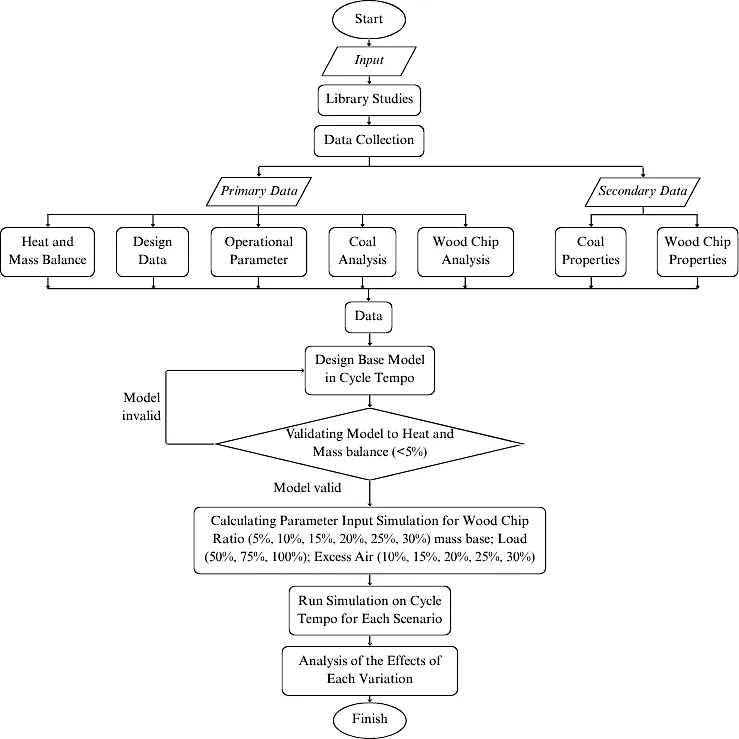
Figure 1: Research Flow Chart
Model Input Parameters:
The simulation inputs comprised fuel properties, combustion conditions, and steam cycle operating parameters. Fuel inputs included calorific value, moisture content, elemental composition (C, H, N, S, O), and ash content. The stoichiometric air requirement was determined for each coal–wood chip mixture, while the excess air ratio (λ) defined the combustion air supply. Steam cycle parameters included steam temperature, pressure, and mass flow rate, feedwater temperature, and condenser pressure. These inputs represented the plant operating conditions across the investigated load levels.
Table 1: Fuel Properties
| Parameter | Units | Basis | Coal | Wood Chip |
|---|---|---|---|---|
| Gross Calorific Value (HHV) | kcal/kg | AR | 4201,2 | 2658,2 |
| Net Calorific Value (LHV) | kcal/kg | AR | 3831,6363 | 2221,48834 |
| Total Moisture | % | AR | 33,51 | 43,23 |
| Moisture in Analysis Sample | % | ADB | 17,97 | 5,85 |
| Ash Content | % | ADB | 4,71 | 2,83 |
| Volatile Matter | % | ADB | 39,25 | 74,13 |
| Fixed Carbon | % | ADB | 38,06 | 17,19 |
| Total Sulphur | % | ADB | 0,52 | 0,04 |
| Carbon (C) | % | ADB | 54,37 | 49 |
| Hydrogen (H) | % | AR | 3,32 | 6,2 |
| Nitrogen (N) | % | ADB | 0,86 | 0,45 |
| Oxygen (O) | % | AR | 14,16371693 | 41,3016729 |
| HHV ADB | kcal/kg | ADB | 5161 | 4398 |
| LHV ADB | kcal/kg | ADB | 4841,320495 | 4057,61137 |
| HHV DB | kcal/kg | DB | 6200 | 4700 |
Baseline Model Calibration and Validation:
The baseline model was developed using plant operating data and validated against Heat and Mass Balance (HMB) reference data at 100%, 75%, and 50% load. Calibration involved adjusting turbine exhaust enthalpy, furnace heat loss, auxiliary power consumption, primary air flow rate, and flue gas temperatures at the economizer and air preheater (APH) outlets. The simulated results were then compared with the corresponding HMB values to assess model accuracy [16]. Deviations remained below 5% for the evaluated parameters, supporting the model's suitability for subsequent simulations [17].
[Figure - see the formatted PDF]
Figure 2: Simulation Model on Cycle Tempo
Simulation Scenarios:
The validated model was used to evaluate the combined effects of operating load, excess air ratio, and wood chip co-firing proportion. The simulation matrix comprised three load levels (50%, 75%, and 100%), five excess air ratio settings, and seven co-firing proportions, yielding 105 cases. All cases converged successfully. For each case, fuel mixture properties and stoichiometric air requirements were updated according to the co-firing proportion, while the excess air ratio determined the combustion air supply.
Table 2: Simulation Matrix
| Variable | Variance | Quantity |
|---|---|---|
| Load | 100% (TMCR), 75%, 50% | 3 |
| Air Ratio (λ) | 1,10; 1,15; 1,20; 1,25; 1,30 | 5 |
| Wood chip ratio (mass base) | 0% (baseline), 5%, 10%, 15%, 20%, 25%, 30% | 7 |
| Total | 105 | |
Simulation Outputs and Performance Indicators:
The outputs covered fuel consumption, power generation, thermal performance, combustion conditions, and flue gas characteristics. The evaluated parameters included fuel mass flow rate; gross and net electrical power; Net Plant Heat Rate (NPHR); boiler efficiency; turbine gross cycle efficiency; auxiliary power consumption; combustion air and flue gas mass flow rates; flue gas Oâ‚‚ concentration and temperature; furnace outlet temperature; and flue gas COâ‚‚ mass flow rate.
Fossil COâ‚‚ emission intensity was calculated relative to net electrical power generation to quantify fossil COâ‚‚ emissions per unit of net electricity produced. This indicator was distinguished from total flue gas COâ‚‚ flow, which includes both fossil COâ‚‚ from coal and biogenic COâ‚‚ from wood chip combustion [18]. Therefore, a reduction in fossil COâ‚‚ emission intensity does not necessarily indicate an equivalent reduction in total direct emissions or life-cycle greenhouse gas emissions [19].
RESULTS AND DISCUSSION:
The baseline simulation model was verified using Heat and Mass Balance (HMB) reference data under 100%, 75%, and 50% load conditions. The differences between the simulated results and reference values remained below 5%, demonstrating good agreement for the evaluated parameters. In addition, all 105 simulation scenarios achieved successful convergence. These outcomes established a reliable foundation for further analysis of how co-firing proportions and excess air ratios influence power plant performance and fossil COâ‚‚ emissions.
Table 3: Validation of Cycle Tempo Model
| Parameter | 100 % Load | 75% Load | 50% Load | ||||||
|---|---|---|---|---|---|---|---|---|---|
| HMB | Model | Dev. (%) | HMB | Model | Dev. (%) | HMB | Model | Dev. (%) | |
| Extraction to HPH 2 (t/h) | 15,65 | 15,46 | -1,23 | 10,58 | 10,46 | -1,11 | 6,95 | 6,88 | -1,06 |
| Extraction to HPH 1 (t/h) | 16,84 | 16,66 | -1,09 | 11,96 | 11,77 | -1,58 | 7,98 | 7,75 | -2,94 |
| Extraction to Deaerator (t/h) | 17,32 | 17,43 | +0,65 | 12,08 | 12,11 | +0,29 | 8,25 | 8,32 | +0,82 |
| Extraction to LPH 2 (t/h) | 11,35 | 11,37 | +0,19 | 8,08 | 8,09 | +0,18 | 5,64 | 5,64 | +0,04 |
| Extraction to LPH 1 (t/h) | 15,51 | 15,52 | +0,05 | 10,97 | 11,04 | +0,63 | 7,34 | 7,40 | +0,82 |
| Exhaust Turbine to Condenser (t/h) |
140,91 | 146,66 | +4,08 | 109,52 | 113,62 | +3,74 | 81,11 | 84,72 | +4,45 |
| Condenser exhaust (t/h) | 173,29 | 173,55 | +0,15 | 132,48 | 132,75 | +0,21 | 97,52 | 97,76 | +0,25 |
| Boiler Efficiency, HHV (%) | 84,50 | 84,50 | 0,00 | 84,50 | 84,50 | 0,00 | 83,60 | 83,60 | 0,00 |
| Net Plant Heat Rate (kcal/kWh) | 2.634 | 2.634 | 0,00 | 2.768 | 2.768 | 0,00 | 3.156 | 3.156 | 0,00 |
| η thermal Netto (%) | 32,65 | 32,64 | -0,03 | 31,07 | 31,06 | -0,02 | 27,25 | 27,24 | -0,02 |
Effect of Wood Chip Co-firing on Plant Performance:
The simulation findings indicated that the proportion of wood chips influenced the net thermal efficiency of the power plant. At 100% load and 20% excess air, introducing wood chips at a 30% mass fraction decreased net thermal efficiency from 32.64% to 31.95% [Figure 3].
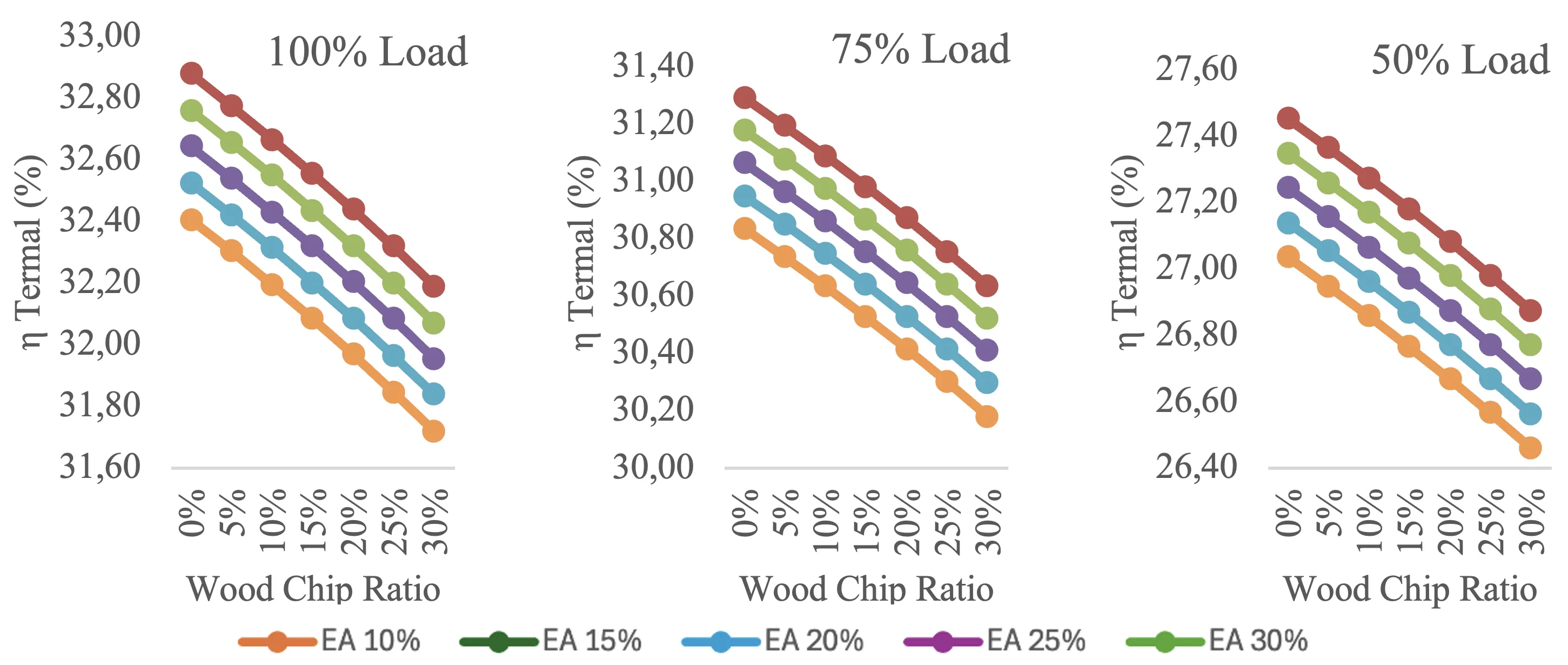
Figure 3: Wood Chip Ratio to Net Thermal Efficiency on 100% Load, 75% Load, and 50% Load
This corresponds to a decline of 0.69 percentage points. The reduction may be attributed to differences in heating value and combustion properties between coal and wood chips. Furthermore, the higher fuel mass requirement suggests that additional fuel must be processed and supplied to meet the required thermal energy input. As presented in Table 4, the 30% co-firing scenario increased fuel mass consumption by approximately 15%, potentially affecting fuel handling and feeding system requirements [20].
Table 4: Total Fuel Flow (T/H) at EA 20%
| Wood Chip Ratio | Total Fuel Flow (T/h) | ||
|---|---|---|---|
| 100% Load | 75% Load | 50% load | |
| 0 | 35,16 | 27,10 | 19,44 |
| 5 | 35,93 | 27,69 | 19,87 |
| 10 | 36,74 | 28,31 | 20,31 |
| 15 | 37,58 | 28,96 | 20,78 |
| 20 | 38,46 | 29,64 | 21,26 |
| 25 | 39,38 | 30,35 | 21,77 |
| 30 | 40,35 | 31,09 | 22,31 |
Net Plant Heat Rate (NPHR) was also examined to assess the influence of fuel composition on the thermal energy required for electricity generation. As reported in Table 5, incorporating 30% wood chips by mass increased NPHR by approximately 2.2% across all three operating load conditions. This increase indicates that more thermal energy was required per unit of net electrical output [19]. Therefore, NPHR should be assessed together with net thermal efficiency and fuel consumption to establish a consistent understanding of the effects of co-firing on plant performance across the simulated operating conditions.
Table 5: Net Plant Heat Rate on 100% Load
| Wood Chip Ratio | Net Plant Heat Rate (kcal/kWh) | ||||
|---|---|---|---|---|---|
| EA 10% | EA 15% | EA 20% | EA 25% | EA 30% | |
| 0% | 2.615,06 | 2.624,47 | 2.634,00 | 2.643,56 | 2.653,18 |
| 5% | 2.623,45 | 2.632,94 | 2.642,49 | 2.651,99 | 2.661,69 |
| 10% | 2.632,16 | 2.641,64 | 2.651,42 | 2.660,97 | 2.670,81 |
| 15% | 2.641,31 | 2.650,94 | 2.660,60 | 2.670,29 | 2.680,02 |
| 20% | 2.650,93 | 2.660,69 | 2.670,24 | 2.680,07 | 2.689,94 |
| 25% | 2.660,86 | 2.670,74 | 2.680,42 | 2.690,38 | 2.700,37 |
| 30% | 2.671,40 | 2.681,41 | 2.691,21 | 2.701,04 | 2.711,15 |
Effect of Co-firing on Fossil COâ‚‚ Emission Intensity:
At 100% load and an excess air ratio of 20%, increasing the wood chip fraction to 30% by mass lowered fossil COâ‚‚ emission intensity from 1.0134 to 0.8144 kg COâ‚‚/kWh, equivalent to a reduction of approximately 19.6% [Figure 4].
[Figure - see the formatted PDF]
Figure 4: Wood Chip Ratio to COâ‚‚ Emission Intensity
This finding highlights the potential of biomass co-firing to decrease fossil COâ‚‚ emissions per unit of net electricity generated. The reduction can be attributed to the partial replacement of coal with biomass, which decreases the proportion of fossil carbon in the fuel mixture. Nevertheless, this result reflects fossil COâ‚‚ emission intensity rather than total COâ‚‚ emissions and must be interpreted in accordance with the emission accounting approach adopted in the simulation.
Under the same 30% wood chip co-firing condition, the simulated biogenic COâ‚‚ emission rate reached approximately 12,345.24 kg/h.
[Figure - see the formatted PDF]
Figure 5: Wood Chip Ratio to COâ‚‚ Emission Biogenic
This emission originates from biomass combustion and should be accounted for separately from fossil COâ‚‚ when evaluating the environmental implications of co-firing. Accordingly, although a higher wood chip proportion reduces fossil COâ‚‚ emission intensity, biogenic COâ‚‚ emissions should also be reported to provide a more comprehensive representation of combustion-related COâ‚‚ emissions. Distinguishing between fossil and biogenic COâ‚‚ is essential for consistent emissions accounting. However, the overall climate benefits of biomass co-firing depend on additional factors, including biomass sourcing, forest or biomass regrowth, and the associated life-cycle carbon balance [19].
Effect of Air Ratio on Plant Performance and Emissions:
An increase in the excess air ratio from 10% to 30% resulted in a decrease in net thermal efficiency of approximately 0.4–0.5 percentage points [Figure 6], accompanied by a 1.46–1.57% rise in specific COâ‚‚ emissions [Figure 7], depending on the load condition.
[Figure - see the formatted PDF]
Figure 6: âˆ†Η Thermal Netto to Reff Point (EA 20%, WC 0%) in %-Point
[Figure - see the formatted PDF]
Figure 7: Percentage Change in COâ‚‚ Emissions Intensity (%) of EA 10% to EA 30%
These results suggest that the amount of excess air supplied during combustion can affect the overall thermal performance of the power plant. Variations in excess air influence the volume of flue gas flowing through the boiler and the associated heat losses through exhaust gases. Nevertheless, the extent of these effects varies with the operating load and the assumptions incorporated into the simulation model. Therefore, the increase in specific COâ‚‚ emissions should be understood as a rise in emissions per unit of net electricity generated, rather than necessarily indicating an increase in the total amount of COâ‚‚ produced.
[Figure - see the formatted PDF]
Figure 8: Percentage Change in COâ‚‚ Emissions Intensity (%) of EA 10% to EA 30%
CONCLUSION:
This study evaluated the effects of coal and wood chip co-firing on the thermal performance and fossil COâ‚‚ emission intensity of the Timor-1 Power Plant using Cycle-Tempo simulations. The baseline model was validated against Heat and Mass Balance (HMB) reference data at 100%, 75%, and 50% load, with deviations below 5%. All 105 simulation scenarios converged successfully, enabling a systematic assessment of different co-firing ratios, excess air ratios, and operating loads.
At 100% load and an excess air ratio of 20%, increasing the wood chip fraction to 30% by mass reduced net thermal efficiency from 32.64% to 31.95%, a decrease of 0.69 percentage points. Over the same operating condition, fossil COâ‚‚ emission intensity decreased from 1.0134 to 0.8144 kg COâ‚‚/kWh, equivalent to a reduction of approximately 19.64%. However, this reduction was accompanied by an approximately 15% increase in fuel mass requirements and an approximately 2.2% increase in Net Plant Heat Rate (NPHR) across the evaluated load conditions. Increasing the excess air ratio from 10% to 30% also reduced net thermal efficiency by approximately 0.4–0.5 percentage points and increased fossil COâ‚‚ emission intensity by approximately 1.46–1.57%, depending on operating load.
These findings demonstrate that wood chip co-firing can reduce fossil COâ‚‚ emission intensity, but the extent of this benefit must be considered alongside changes in thermal efficiency, heat rate, and fuel handling requirements. Consequently, the highest co-firing ratio does not necessarily represent the most suitable operating condition. Feasible operating conditions should instead be identified by balancing fossil COâ‚‚ emission reduction with net thermal efficiency and NPHR, while ensuring compliance with the applicable guaranteed performance limits at each operating load. Further evaluation against these limits, supported by operational validation under co-firing conditions, is recommended before implementation at the Timor-1 Power Plant.
REFERENCES



Polin Pangihutan Panggabean, Jaka Windarta, Udi Harmoko, Thermal Performance and Fossil CO₂ Emissions of Coal–Wood Chip Co-Firing at the Timor-1 Power Plant: A Cycle-Tempo Simulation Study, Int. J. Sci. R. Tech., 2026, 3 (10), 1259-1267. https://doi.org/10.5281/zenodo.23662409
 10.5281/zenodo.23662409