

We use cookies to ensure our website works properly and to personalise your experience. Cookies policy
Rohilkhand College of Nursing, Bareilly, (U.P)
Introduction:- Child is a gift from the creator. When a child is born to family, it brings bundle of joy, happiness and responsibility to the family, society and country. Now-a days, child sexual abuse is the most prevalent health problem in children, where a child faces severe consequences and it is still a sensitive good touch and bad touch for the society as well as parents, Most of the parents and teachers hesitate to discuss about good and bad touch.[1] Problem statement:-A study to assess the effectiveness of a structured teaching programme on knowledge regarding good touch and bad touch among school age children in selected school Bareilly, U.P. Objectives:- To assess the pre-test level of knowledge regarding good touch and bad touch among school age children.To evaluate the effectiveness of structured teaching programme on knowledge regarding good touch and bad touch among school age children.To determine the association between pre-test knowledge score with their selected demographic variables. Materials and Method:- A Pre-experimental study was conducted at Jingle Bells Public School, Bareilly. A total of 60 school age children were selected using convenient sampling technique. Data were collected using a validated self-structured questionnaire comprising 30 questions covering socio-demographics. Data was analyzed by using descriptive and inferential statistics. Ethical clearance and informed consent were obtained. Results:- type of family shows statistically significant with chi square value 5.357 that shows H2 is accepted because the level of knowledge had association with the demographic variable education at p value 0.05. The post test score (12.78) is higher than pre test score (10.03) the mean difference between pre test and post test is 2.75 and t-test is 4.08 as H1 is accepted at p value 0.05. people had inadequate to moderate knowledge but after STP knowledge was somewhat increase Conclusion:- result shows low to moderate knowledge need to conduct more studies on Good touch and Bad touch among School age children. Need to conduct more study through role play in the commmunity area.
Child is a gift from the creator. When a child is born to family, it brings bundle of joy, happiness and responsibility to the family, society and country. The Children are the inheritance of the world. Childhood is a golden period and a blue print of an adult, is the bridge between birth and adulthood. So, it has to be taken care of well, with the fulfilment of emotional, psychological and physical needs. “Childhood” generally signifies happy living, healthy nutrition, love, warmth, support and overall affectionate environment. The attitudinal behaviour of children should be hale and hearty. The first sensory input in life comes from the sense of touch experienced by a foetus where he/she is in the mother’s womb and feels protective. Parents, siblings, elders, friends and teachers play an important role in a child development. Now-a days, child sexual abuse is the most prevalent health problem in children, where a child faces severe consequences and it is still a sensitive good touch and bad touch for the society as well as parents, Most of the parents and teachers hesitate to discuss about good and bad touch.[1]
Children represent the most vulnerable and valuable segment of society and are considered the future of every nation. Ensuring their safety, well-being, and holistic development is a fundamental responsibility of families, educators, healthcare professionals, and the community. However, children across the world continue to face multiple threats to their physical, emotional, and psychological health, among which child sexual abuse (CSA) is one of the most serious and under-recognized problems. Child sexual abuse not only violates the fundamental rights of children but also has long-lasting adverse consequences on their mental health, social functioning, and overall quality of life.[2]
"Sexual abuse" means employment use, persuasion, inducement, enticement or coercion of any child to engage in or assist any other person to engage in any sexually explicit conduct. It also includes rape molestation, prostitution or other forms of sexual exploitation of children.[3]
World Health Organization and United Nations Children's Fund, global studies published between 2014 and 2020 estimate that 1 in 4 girls and 1 in 6 boys experience some form of sexual abuse before the age of 18. In India, a national study conducted by the Ministry of Women and Child Development in 2007 reported that about 53% of children had experienced some form of sexual abuse. Despite these findings, many cases remain unreported due to fear, stigma, and lack of awareness. In India, cultural taboos surrounding discussions of sexuality and personal safety often hinder effective communication about these topics. This lack of awareness can lead to a cycle of silence and shame, preventing children from seeking help or reporting inappropriate behavior.[4]
According to estimates, up to 1 billion children between the ages of 2 and 17 worldwide. In India According to CSA reported 2020 data have been the victims of physical 66%, sexual 50%, or emotional abuse 15% or neglect within the last 12 months. The impact of childhood violence on health and well-being is lifelong. The number of child abuse cases reported is on a continuous rise. In India , one case of child sexual abuse in reported every 15 minute. According to the National Crime Records Bureau [NCRB], more than 64,000 sexual abuse cases were reported 2022. In 2023, about 177,335 crimes against children were registered in India.[5]
Childhood is the most essential stage in the growth process. The Good Touch, Bad Touch activities are designed to teach children about appropriate behaviour, sexual or otherwise, so that they can defend themselves in this frightening situation. Children in India are unaware of the issue, making them more vulnerable to child sexual abuse (CSA), which is becoming a growing social problem. [6]
NEED FOR STUDY
Children are abused in different ways. According to WHO, one out of every four females and out of six males are being abused. in development countries, 12.6% of children are abused. The recent studies and press news show that males are also equally or even in higher proportion is being abused sexually.[7]
Globally, child abuse and its consequences remain a major public health problem. The structured teaching programmes are effective in improving knowledge about good and bad touch among school going children. [8]
Childhood is most important time in human development. Bad touch is serious and widespread problem in India. Both boys and girls are vulnerable. Research has shown that it is three times more often in girls than boys. Survey conducted among elementary students in India have shown that one in four had suffered from bad touch. Statistics also revealed that it has effected both the genders. [9]There is a need for more research that focus on awareness and prevention of good touch and bad touch. The need for the study is to understand school age student's knowledge of good touch and bad touch in children and how they aware about the good touch and bad touch and associated psychological problems and disorders. Hence the researcher felt the need to assess the knowledge of school age children regarding good touch and bad touch in selected school of Sarabha, Ludhiana.
Previous studies have shown that many children have inadequate baseline knowledge regarding personal safety and appropriate touch, highlighting the urgent need for structured educational interventions. In many cases, children are unaware of how to differentiate between appropriate and inappropriate touch. They may also feel hesitant to report such incidents due to fear, shame, or lack of knowledge.[10]
Therefore, this study is undertaken to assess the effectiveness of a structured teaching programme on improving knowledge regarding good touch and bad touch among school-age children in selected schools, Children are often unaware of personal safety and may not be able to differentiate between appropriate and inappropriate touch, making them vulnerable to abuse.[11]
OBJECTIVES OF THE STUDY
1. To assess the pre-test level of knowledge regarding good touch and bad touch among school age children.
2. To evaluate the effectiveness of Structured Teaching Programme on knowledge regarding good touch and bad touch among school age children.
3. To determine the association between pre-test knowledge score with their selected demographic variables.
HYPOTHESIS
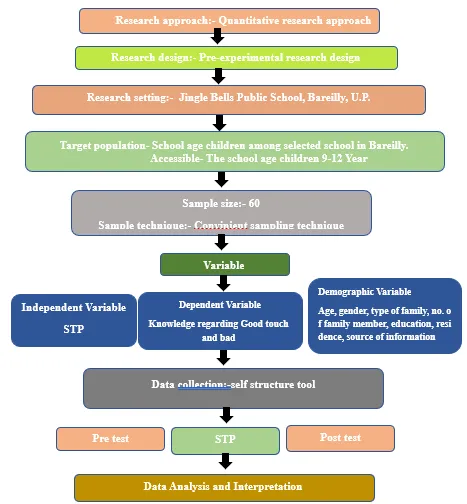
ANALYSIS AND INTERPRETATION:
Section A:- Frequency wise distribution of demographic performa. n=60
| S. N. | DEMOGRAPHIC VARIABLES | TOTAL FREQUENCY | PERCENTAGE (%) |
|---|---|---|---|
| 1 | Age group 9 years 10 years 11years 12 year |
22 28 10 0 |
36.6% 46.6% 16.6% 0% |
| 2 | Gender Male Female |
36 24 |
60% 40% |
| 3 | Type of family Nuclear family Joint family Extended family |
42 18 0 |
70% 30% 0% |
| 4 | Class a) 3 b) 4 c) 5 d) 6 |
16 22 14 8 |
26.6% 36.6% 23.3% 13.3% |
| 5 | No. of family member 1-3 members 4-6 members 7 and above |
16 44 0 |
26.6% 73.3% 0% |
| 6 | Residence includes: Rural Urban semi-urban |
27 33 0 |
45% 55% 0% |
| 7 | Source of information: Parents Teachers Friends Television / Internet |
35 25 0 0 |
58.3% 41.6% 0% 0% |
Table no:- 6 Comparison of pretest and post test knowledge regarding Good touch and bad touch among school age children
| Test | Mean | S D | Mean difference | T value | Df | P value |
|---|---|---|---|---|---|---|
| Pre test | 10.03 | 3.64 | 2.75 | 4.08 | 1 | Significant at 0.05 |
| Post test | 12.78 | 3.75 |
H1 Is accepted as t value is significant at p value 0.01
Section C: Association Between Level of Knowledge to their Demographic Variable
| Demographic variable | High | Moderate | Low | Total | Chi- Square | Df | Tabulated value | P value |
|---|---|---|---|---|---|---|---|---|
| Age group | ||||||||
| 9 years | 0 | 9 | 13 | 22 | 1.110 | 2 | 5.991 | Not significant At p<0.05 |
| 10 years | 0 | 12 | 16 | 28 | ||||
| 11 year | 0 | 6 | 4 | 10 | ||||
| 0 | 0 | 0 | ||||||
| Gender | ||||||||
| Male | 0 | 15 | 21 | 36 | 0.102 | 1 | 3.841 | Not significant At p<0.05 |
| Female | 0 | 11 | 13 | 24 | ||||
| Type of family | ||||||||
| Nuclear | 0 | 27 | 15 | 42 | 5.357 | 2 | 5.991 | significant At p<0.05 |
| Joint | 0 | 3 | 15 | 18 | ||||
| Class | ||||||||
| 3rd | 0 | 8 | 8 | 16 | 2.253 | 3 | 7.815 | Not significant At p<0.05 |
| 4th | 0 | 8 | 14 | 22 | ||||
| 5th | 0 | 5 | 9 | 14 | ||||
| 6th | 0 | 5 | 3 | 8 | ||||
| No. Of family member | ||||||||
| 1-3 | 0 | 7 | 9 | 16 | 0.341 | 1 | 3.841 | Not significant At p<0.05 |
| 4-6 | 0 | 23 | 21 | 44 | ||||
| Residence | ||||||||
| Rural | 0 | 9 | 18 | 27 | 0.519 | 2 | 5.991 | Not significant At p<0.05 |
| Urban | 0 | 14 | 19 | 33 | ||||
| Source of information | ||||||||
| Parents | 0 | 16 | 19 | 35 | 1.143 | 3 | 7.815 | Not significant At p<0.05 |
| Teachers | 0 | 8 | 17 | 25 | ||||
* significant at 0.05
Knowledge Scores according to Demographic Variables Distribution in Study Population
The distribution of knowledge scores varied significantly across several demographic factors in the study population. Type Family statistically significant association with knowledge levels (chi square = 5.357). as Research hypothesis (H2) is accepted.
REFERENCES

Mishqat Lateef, Kuldeep Pal, Kushal Kumar, Mannat Kaur, Princia Rolita D. Souza, Pratibha Charan, Effectiveness of a Structured Teaching Programme on Knowledge Regarding Good Touch and Bad Touch Among School Age Children at Selected School Bareilly, U.P., Int. J. Sci. R. Tech., 2026, 3 (10), 1082-1087. https://doi.org/10.5281/zenodo.23526821
 10.5281/zenodo.23526821