

We use cookies to ensure our website works properly and to personalise your experience. Cookies policy
Genba Sopanrao Moze college of pharmacy Wagholi Pune 412207
Good Manufacturing Practice (GMP) plays an important role in assuring safety, quality and effectiveness of pharmaceutical products. It provides the standards of manufacture, quality assurance, documentation, equipment management and regulatory compliance. Rapid technological developments have introduced the promising technology of Artificial Intelligence (AI) in pharmaceutical manufacturing and quality management. Machine learning, deep learning, computer vision and predictive analytics are some of the technologies which can be used to monitor processes in real time, conduct automated quality inspections, perform predictive maintenance and detect any deviations in the manufacturing process. Integration of AI into the field of GMP in pharmaceuticals could provide benefits in the form of better understanding of process, identification of quality risks, consistent quality of products and better data analysis. AI can help in QA/QC functions by detecting anomalous patterns, analysis of manufacturing documents and deviation investigations. However, implementation of AI in GMP environments raises a number of issues such as integrity of data, model validation, algorithm transparency, cybersecurity, reliability of the system, and compliance with regulation. Proper validation, performance monitoring, change control documentation, and human supervision are required to guarantee the reliability and applicability of the AI systems. In this review, a general idea of AI technology is introduced and described with regard to pharmaceutical GMP. The basic technologies used in AI and its applications in manufacturing and quality assurance are described. Moreover, the possible advantages, quality risk management, regulatory issues, and future prospects of this approach are reviewed.
The importance of the pharmaceutical industry cannot be overlooked because of its immense contribution towards the prevention, diagnosis, and treatment of different diseases through development and manufacture of pharmaceutical products. Its contribution towards the health of the society can never be ignored, and it ensures that high-quality pharmaceutical products are provided. The main reason behind maintaining the quality of the products is that the medicines affect human health and hence the need for quality standards in manufacturing.[1]
Good Manufacturing Practices (GMP) are the policies and concepts designed to guarantee the continuous manufacturing and control of drugs under a specific standard of quality. Good manufacturing practices deal with different areas of the manufacture of drugs, such as handling of raw materials, training of personnel, maintenance of equipment, sanitization, manufacturing process, quality control, packaging, labeling, and documentation. Good Manufacturing Practice is mainly meant to eliminate potential risks such as contamination, product confusion, manufacturing mistakes, and variations in product quality .[1,2]
It is crucial for GMP to contribute to patient safety through provision of high-quality products made within certain conditions. The approach provides a systematic framework for conducting QA and assists the pharmaceutical industry in recognizing and solving issues related to product manufacturing. GMP contributes to the processes of inspections, traceability, data integrity, and continuous quality improvement as well. Nevertheless, traditional approaches to manufacturing and quality control might take a lot of time and efforts. Such aspects make the application of new technologies even more relevant and necessary [1,2].
This review attempts to give an insight into the use of AI for pharmaceutical GMP, covering such aspects as the basics of GMP, AI technologies used, applications in manufacturing and quality control, advantages offered by AI and their contribution to quality risk management. Regulatory obstacles, limits of application, and perspectives are also discussed. It is stressed that a risk-based approach using good data is needed for successful AI implementation in pharmaceuticals.
Artificial Intelligence (AI) is one of the most complex technologies used by computers to conduct learning, prediction, and pattern recognition. Various AI technologies like machine learning, deep learning, computer vision, and predictive analytics are increasingly being considered for application in the healthcare and pharmaceutical industry. Some of the ways in which such AI technologies can be applied include the optimization of processes, automation of visual inspections, predictive maintenance, deviation detection, and analyzing large quantities of data. The emergence of AI systems has provided new possibilities for improving pharmaceutical manufacturing and quality management.[3]
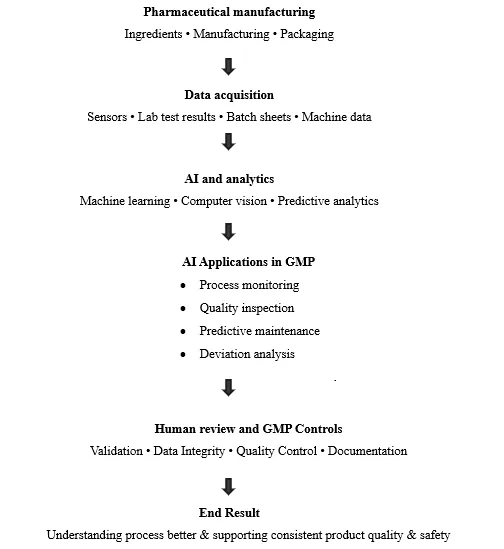
Figure 1: Conceptual Integration of Artificial Intelligence in Pharmaceutical GMP Procedures
AI-based pharmaceutical production systems can analyse real-time process information, detect unusual patterns, and predict potential manufacturing failures before they significantly affect product quality. When integrated with automation and digital manufacturing technologies, AI can support consistent production, reduce repetitive manual tasks, and improve process monitoring. Technologies such as industrial sensors, the Internet of Things (IoT), electronic batch records, and process analytical technologies can provide data that AI systems use to identify trends and support timely decisions. However, AI-assisted operations must remain under appropriate human supervision and established quality management procedures [2,3].
Combining AI technology into GMP processes involves a variety of important issues such as regulatory compliance, data integrity, system validation, cybersecurity, algorithm transparency, and risk management. AI algorithms can provide erroneous information due to the incorrectness or incompleteness of training data. Additionally, a lack of explainability and proper documentation of algorithmic decision making could be problematic for the regulated environment of the pharmaceutical industry. Thus, AI technology has to be adequately assessed, validated, monitored, and documented [2,3].
The aim of this review article is to provide an overview of AI-driven pharmaceutical Good Manufacturing Practices, with particular emphasis on applications in pharmaceutical manufacturing and quality control, potential benefits, regulatory and technical challenges, and future perspectives. The objectives are to examine how AI can support GMP compliance, explore its role in Quality Risk Management (QRM), identify barriers to implementation, and discuss strategies for the responsible integration of AI into pharmaceutical manufacturing systems. This review highlights the importance of combining technological innovation with regulatory oversight, data governance, and human expertise to achieve reliable, safe, and high-quality pharmaceutical production [2,3].
1. Overview of Pharmaceutical Good Manufacturing Practices (GMP)
1.1 Definition of GMP
Good Manufacturing Practices (GMP) refers to the regulatory measures and guidelines meant to ensure consistent manufacture, processing, packaging, testing, and control of pharmaceutical products. This helps in ensuring that the medicines are consistent with the required safety, identity, strength, purity, and quality standards. It is applicable throughout the process of pharmaceutical manufacturing from the acquisition of the raw materials to the distribution of the finished product [1,4].
1.2 GMP Objectives
GMP has mainly been designed with the main objective of producing pharmaceutical products that are safe, effective and of high quality. The main objectives of GMP include: Maintaining uniform quality of product, prevention of contamination and confusion, minimizing errors, documentation accuracy and protecting patients. GMP also ensures compliance of pharmaceutical companies with regulations and confidence in product quality [1].
1.3 Principles of GMP
Some of the principles of GMP include personnel training and hygiene, adequate facilities for manufacture, appropriate design and maintenance of equipment, control of starting materials, validation of the manufacturing process, and documentation. QA and QC are vital for ensuring the quality of products. Equipment calibration, preventive maintenance, deviation tracking, and corrective and preventive action (CAPA) help detect issues that might arise during the manufacturing process.
1.4 The Importance of GMP in Pharmaceutical Manufacturing
The importance of GMP in pharmaceutical manufacturing is due to its capability of ensuring product consistency, preventing contamination, providing traceability, and achieving compliance with regulations. Documentation allows tracking of raw materials, manufacturing processes, and batch of the product. GMP assists in the identification of quality issues and investigations in case of deviation. Quality management systems will help pharmaceutical companies avoid production of defective products [1,4].
3. Basic Principles of Artificial Intelligence in the Pharmaceutical Sector
3.1 Definition of Artificial Intelligence (AI)
Artificial intelligence is the computer-based technology through which machines can execute activities such as learning, pattern identification, predictions, and decision making. In the pharmaceutical field, artificial intelligence assists in improving the process efficiency, quality of the product and adherence to Good Manufacturing Practice (GMP). It is capable of analyzing big data and identifying mistakes and potential quality issues.
3.2 Types of Artificial Intelligence (AI) Technologies
1. Learning Machine (ML): Understands trends in historical data to forecast any issues in the manufacturing process and quality of the product.
2. Deep Learning: Utilizes neural networks to process data and recognize any flaws in the products.
3. Computer Vision: Checks visual data for defective tablets, packaging damage, and labeling mistakes.
4. Natural Language Processing (NLP): Understands written texts like Standard Operating Procedures (SOPs), deviation reports, and audit files.
5. Predictive Analytics: Utilizes both historical and current data to forecast equipment failure and process deviations.
3.3 Role of AI in Pharmaceuticals Manufacturing
AI plays various roles in pharmaceutical manufacturing, including:
1. Process monitoring: Helps monitor temperature, pressure, humidity, and other vital process variables.
2. Predictive maintenance: Helps predict equipment failures before they happen.
3. Quality inspection: Helps to detect errors in tablets, capsules, and packaging.
4. Production improvement: Helps to reduce material wastage and improve the efficiency of production processes.
5. Quality risk management: Helps to identify any risks affecting product quality and safety.
3.4 Difference Between Traditional system and AI-driven Systems [6,7]
| Traditional systems | AI-driven systems |
|---|---|
| Monitoring by rules or manual | AI-enabled supervision |
| Planned maintenance | Predictive Maintenance |
| Human-based quality control | Automated defect inspection |
| Manually reviewing documents | Analysis of documents using AI |
| Restricted pattern identification | Complex pattern recognition |
4. Applications of AI in Pharmaceutical GMP
The use of Artificial Intelligence (AI) in the pharmaceutical industry is being considered more often to increase manufacturing efficiency, quality of products, monitoring of processes, and compliance with regulations. AI applications like Machine Learning (ML), Deep Learning, Computer Vision, and Natural Language Processing (NLP) can analyze pharmaceutical data and find patterns. When used properly, AI tools can help pharmaceutical companies enhance GMP (Good Manufacturing Practice).
4.1 AI in Production of Pharmaceuticals
Artificial Intelligence (AI) can help in the manufacturing process for pharmaceuticals by analyzing the data collected during the manufacturing process and determining the right process conditions. The use of Machine Learning (ML) can be applied in the examination of factors such as mixing time, granulation moisture content, drying temperature, compression force, and coating conditions. This could help in minimizing variations from one batch to another, ensuring consistency in the manufacturing process, and eliminating wastage of materials.[8,9]
4.2 AI in Process Monitoring
Artificial intelligence has the ability to analyze the data gathered from the sensors and other pieces of equipment that are used in manufacturing. The parameters like temperature, pressure, humidity, and speed of mixing can be observed to find any unusual trend. Computerized monitoring is important along with its reliability and accuracy of recorded data [9,10].
4.3 AI in Quality Control
Computer vision through AI could be helpful in detecting any observable defects such as cracks, colour variations, broken edges, and irregular coating on tablets and capsules. Machine Learning could also help in reviewing laboratory data and highlighting any abnormal results for further evaluation. This technology could make the inspection process more efficient; nevertheless, the output from AI should be evaluated through validated techniques.[8,10]
4.4 AI in Quality Assurance
AI may contribute to quality assurance through analyzing electronic batch records, classifying deviations and recognizing quality issues occurring repeatedly. NLP could be used to mine the information related to quality issues from investigation reports, audit reports, and CAPA documents. Such processing could be helpful for quality specialists when it comes to the priority of investigations and recurring risk assessment. The final decision on quality should comply with the pharmaceutical quality system and GMP requirements [9,10].
4.5 AI in Predictive Maintenance
Predictive Maintenance employs performance data from machines in order to predict any potential failures that could cause disruptions in the production process. Predictive maintenance involves using AI in analysing machine vibrations, temperatures, motor currents, and maintenance history in order to predict the occurrence of any problems with the machines. Machine maintenance and suitability for use should still be carried out using the approved methods [8,11].
4.6 AI in Environmental Monitoring
AI can assist in environmental monitoring through temperature, humidity, differential pressure, and airborne particle monitoring. AI can detect anomalies that might show signs of ventilation issues or exceedances of established environmental levels. These detections can allow for quick investigation of any potential hazards. AI-assisted environmental monitoring should complement, but not substitute, necessary environmental control and contamination control measures [8,9].
4.7 AI in Supply Chain Management
It is possible to apply AI to historical demand, inventory, performance of suppliers, and delivery time in order to optimize the pharmaceutical supply chain. There could be predictive models that could help in the detection of the shortages and disruptions in supply chains. These uses will enable the availability of medicines and prevention of manufacturing disruptions. The risk assessment, supplier selection, and materials quality should be integrated into the existing quality system [9].
4.8 AI in Pharmaceutical Documentation
The use of artificial intelligence techniques, especially NLP, may help with the tasks of classification, data extraction, and document review. Such technologies may detect any missing information, inconsistencies, and even classify SOPs, batch records, and deviations reports. Nevertheless, it is crucial that all electronic documents should be accurate, complete, protected, and auditable. In order to maintain such requirements for computer systems used for GMP operations, validation and controls are needed [10,11].
5. Applications of artificial intelligence in Quality Control and Quality Assurance in pharmaceutical manufacturing
QC and QA are critical parts of Good Manufacturing Practice (GMP) in pharmaceutical production. QC entails inspecting raw materials, process materials, and final products for conformance to specified requirements. QA assures compliance with approved procedures and quality standards in manufacturing and inspection processes in pharmaceutical production. AI can help here through analysis of manufacturing data, defect detection, and quality pattern recognition. [12,13]
5.1 AI-assisted visual inspection
Computer vision systems using AI technology are able to detect defects in tablets, pills, and pharmaceutical packaging that are visually detectable. This system can recognize cracks in products, broken tablets, discoloration, improper labels, and other defects in the packaging. The accuracy of the process will depend upon the quality of the training images used.
5.2 Identification of defects and product variability
Machine learning can be used to examine the properties of the product like size of the tablet, its shape, colour, and appearance. The products that fail to meet the criteria set for the product will then be labelled as possible defective products and be investigated for any underlying problem. [13,14]
5.3 Analysis of laboratory and analytical data
AI could be used to assist in assessing data that is collected using analytical equipment such as HPLC, IR, and dissolution testing instruments. AI tools could recognize abnormalities in the results, variations in analytical trends, and possibly out-of-trend (OOT) results. Such information could be used by quality control staff for investigation prioritization of a laboratory failure. [13,15]
5.4 AI support for batch record review
Document analysis using AI techniques may be used to help review electronic batch manufacturing records, determine if there is any information missing, point out inconsistent entries, and identify possible documentation mistakes. Also, quality assurance departments may use AI techniques to detect repetitive deviations and review CAPA records. Such applications could be useful for the pharmaceutical quality system. [12,13]
5.5 Validation and human oversight
Systems that utilize AI to conduct GMP-related work have to be evaluated and validated with respect to their intended use. The accuracy, reliability, data integrity, and performance of such systems need to be continuously monitored during their use. decisions based on the data. [12,14]
6. AI in Quality Risk Management (QRM)
6.1 Meaning of Quality Risk Management
Quality risk management (QRM) is defined as a methodology for the identification, assessment, control, communication, and review of risks associated with the safety of pharmaceutical products. Artificial intelligence (AI) can be used for this process by analysing data and making decisions [9].
6.2 AI-Based Risk Identification
AI algorithms analyse production records, equipment readings, laboratory results, and previous deviations to identify potential risks. They can help detect abnormal temperature changes, equipment failures, contamination indicators, and recurring product defects before they cause serious quality problems [3].
6.3 Risk Prediction and Prioritization
Machine learning systems have the ability to utilize historical as well as current data to forecast manufacturing issues. Forecasts assist in prioritizing the risky processes, analysing anomalies, and allocating resources appropriately. Every forecast must be properly verified.
6.4 AI in Deviation Management and CAPA
AI has the ability to categorize deviations, review past investigation reports, determine potential root causes, and detect trends. It also helps in the CAPA monitoring process. However, verification, root cause analysis, and approval have to be done by competent people.
6.5 AI in Deviation Management and CAPA
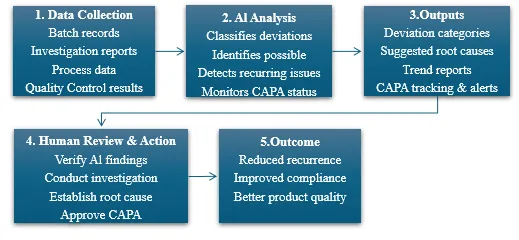
Flowchart: Illustrating the role of Artificial Intelligence in Pharmaceutical Deviation Management and Corrective and Preventive Action (CAPA).[18]
7. Regulatory Challenges and Compliance
7.1 Regulatory Requirements for Pharmaceutical GMP
Good Manufacturing Practices (GMPs) make sure medicines are manufactured to a certain quality level. The AI technologies which are utilized for the manufacture of medicines have to ensure product quality, patient safety, and documentation.[19,20]
7.2 FDA Requirements
The FDA governs pharmaceutical production and the electronic record-keeping in relation to the same. 21 CFR Part 11 deals with electronic records and signatures. AI systems should conform to the requirements concerning documentation, validation, access and data integrity. [19].
7.3 WHO and PIC/S GMP Principles
International GMP standards guidelines are provided by the World Health Organization (WHO) and the Pharmaceutical Inspection Co-operation Scheme (PIC/S). The following are among the key principles in the guidelines: Quality Management, Documentation, Validation, Training of Personnel and Data Integrity. [20,21].
7.4 Computerized System Validation
Computer System Validation creates documented proof of the ability of the computerized system to carry out its intended functions. AI systems need to be evaluated on their accuracy, reliability, and fitness for purpose before GMP implementation. [19,21].
7.5 Data Integrity
Data integrity guarantees that records of pharmaceutical data are complete, consistent, and accurate. ALCOA+ guidelines mandate that the data is attributable, legible, contemporary, original, accurate, complete, consistent, enduring, and available. AI must keep trackable records of the input data, output data, and modifications [20,22].
7.6 Explainability and Transparency
Predictions from AI models can be hard to understand. The manufacturer should provide the following details about the model: its intended use, inputs, limitations, and outputs. This will aid quality professionals in checking the decisions made using AI and identifying any variances.
7.7 Accountability and Human Oversight
Qualified personnel need to verify critical AI results, debug any mistakes, and validate quality decisions as per laid out protocols. Proper allocation of responsibility for monitoring, maintenance, and adherence avoids dependence on automation [21,22]
7.8 Change Control and Model Lifecycle Management
AI models can evolve as a result of software changes, re-training, or data revisions. It is important to document the changes, conduct risk assessment, perform tests, and get the changes approved as per the proper change control processes
7.9 Difference between Traditional GMP and AI-supported GMP Regulations
| GMP activity | Traditional GMP | AI-supported GMP regulations |
|---|---|---|
| Process monitoring | Periodic testing and manual evaluation | Continuous process data analysis |
| Quality control | Manual examination and conventional tests | Inspection and pattern detection using AI |
| Data integrity | Maintaining records and manual evaluation | Electronic track-and-trace systems and automated checks, as validated |
| Risk management | Risk assessment by employees | Risk prediction from data |
| Documentation | Manual or electronic record evaluation | AI-based record evaluation with manual checks |
| Change control | Changes to the system/process authorized in writing | Software and data changes assessed in writing |
| Final decisions | Quality personnel authorized by the company | Authorized personnel are responsible for GMP decisions |
8. Benefits of AI-Driven Pharmaceutical GMP
AI enhances pharmaceutical GMPs through ensuring quality of the products, process control, and data-driven decision-making. Key advantages of using AI include:
1. Enhanced defect identification: The use of AI for vision systems detects defects in tablets, capsules, labels, and packaging materials, making quality control possible [5].
2. Consistent production processes: AI ensures that parameters like temperature, pressure, and mixing time are monitored for process deviations to ensure consistency [9].
3. Quick data processing: AI quickly processes massive amounts of manufacturing and lab data for identifying trends and anomalies [5].
4. Failure prediction: Predictive analytics helps predict equipment failures and process anomalies [9].
5. Reduced manual effort AI performs manual tasks such as document reviews, visual inspections, and batch record reviews [5].
6. Equipment maintenance: AI helps to predict equipment issues and plan for maintenance [9].
7. Traceability: The analysis by AI of electronic records enables better understanding of quality trends as well as review of manufacturing data [5].
8. Quality decision making: AI provides data-driven insights for quality risk management, deviation investigations, and corrective and preventive actions (CAPA) [9,23].
9. AI-Driven Pharmaceutical GMP (Major Benefits)
9. Limitations and Implementation Challenges of AI-Driven Pharmaceutical GMP
Though artificial intelligence (AI) has significant potential in improving pharmaceutical GMPs, there are several challenges that come with adopting artificial intelligence (AI) into practice.
1. Expensive implementation process: AI applications need a considerable amount of money to invest in software, hardware, validation, integration, and maintenance [3].
2. Quality of the data: AI algorithms need data that is of good quality. Bad data will lead to poor predictions and negatively impact the quality of the end product [24,25].
3. Integration of the system: Integrating AI with the current manufacturing machines, laboratory facilities, and electronic batch records may pose technical difficulties [3,26].
4. Cybersecurity risks: AI systems can be prone to cyberattacks and data manipulation. They need proper data integrity and cybersecurity protection [25,26].
5. Lack of explainability: Some AI applications cannot explain how they make decisions and are hard to interpret in quality investigations [24,27].
6. Prediction error: Prediction errors in form of false positives would result in unwarranted tests while false negatives would ensure that any defect is left unnoticed [24,27].
7. Lack of qualified personnel: AI implementation requires people trained in pharmaceutical GMP, data science, computer systems validation, and quality assurance [3,27].
8. Regulatory uncertainty: Regulatory standards and requirements associated with certain types of AI use may be unclear [3,25].
9. Drift of the model: Changes in production environment or changes in the input data could affect the accuracy of the AI model and regular monitoring and assessment is required[24,27].
10. Automation bias: Overreliance on AI recommendations could cause an incorrect decision and therefore appropriate supervision of GMP activities should be maintained [3,25].
10. Future Perspectives of AI-Driven Pharmaceutical GMP
The utilization of artificial intelligence (AI) technology will become more significant in pharmaceutical GMP practices through better process monitoring, higher product quality, and better decision making through data analysis. Pharmaceutical factories that utilize artificial intelligence will be able to monitor the manufacturing process constantly and spot any deviations in the manufacturing process early. The integration of such facilities with Process Analytical Technology (PAT) will enable the realization of real-time release testing (RTRT), which will be scientifically sound and permitted by regulations [28,29].
Digital twins, which are virtual models of manufacturing processes, might contribute to the creation of simulation of production environment and the optimization of process parameters, as well as identification of quality risks prior to the occurrence. Continuous manufacturing with AI support and advanced predictive quality systems might also help to ensure the consistency of the process and prevent any unpredictable disruption [29,30].
Electronic record security, audit trails, and risk-based governance will be necessary for preserving data integrity and system reliability.
The successful implementation of the above-mentioned technologies will require cooperation between pharmacists, process engineers, data scientists, quality assurance specialists, and regulatory affairs experts. Nevertheless, these technologies are developing opportunities rather than GMP procedures and should be implemented under proper validation, risk assessment, and data integrity management [28-30].
SUMMARY
The sensible use of AI carries a great deal of promise for the enhancement of pharmaceutical production and quality management. When used sensibly, with risk management, validation, transparency, and control at its core, with data integrity, regulatory compliance, human supervision, and patient safety being key concerns, AI has great potential to enhance GMP systems.
CONCLUSION
Good Manufacturing Practices (GMP) play an important role in providing high-quality, safe, pure, effective, and consistent pharmaceutical products. GMP is an organized system that allows controlling the manufacturing of pharmaceuticals, their quality assurance, quality control, documentation, maintenance of equipment, and practices of personnel. Adherence to GMP ensures that products will not be contaminated, manufactured incorrectly, or have defects and also guarantees patients' safety. At the same time, classical approaches to implementation of GMP require time-consuming inspections, excessive documentation, and late recognition of the quality issues.
The use of Artificial Intelligence (AI) in pharmaceutical GMP has brought many new possibilities for optimization of the manufacturing processes and pharmaceutical quality management. Machine learning, deep learning, computer vision, and predictive analytics can assist in process monitoring in real time, automatic visual inspection, predictive maintenance, evaluation of electronic batch records, and quality risk management. Such technologies allow analysing large amounts of data on manufacturing and quality, detecting abnormal patterns, and giving alerts on possible process deviations. Thus, AI can help in the more consistent manufacturing, faster data analysis, and evidence-based quality decisions.
Moreover, AI ought to be used to complement, not substitute, skilled human judgment and regulation. Pharmacists, quality assurance specialists, engineers, and other competent personnel need to validate AI-produced results and remain accountable for any critical quality-related decisions. Further advancements in the area of intelligent pharmaceutical production, PAT technology, digital twins, and predictive quality systems will likely increase the role of AI in GMP.
REFERENCES



Sanket Vijaykumar Warghade, Pranjli Ugale, Dr. Tushar. T. Shalke, An Overview of AI-Driven Pharmaceutical GMP: Regulatory Challenges, Quality Risk Management and Future Perspectives, Int. J. Sci. R. Tech., 2026, 3 (11), 389-399. https://doi.org/10.5281/zenodo.23976257
 10.5281/zenodo.23976257