

We use cookies to ensure our website works properly and to personalise your experience. Cookies policy
Department of Pharmaceutical Quality Assurance, S.S P. Shikshan Sanstha’s Siddhi College of Pharmacy, Chikhali, Pune, Maharashtra 411062, India
For decades, pharmaceutical process validation has rested on a relatively narrow set of habits: a fixed qualification protocol, a small handful of conformance batches, and a periodic review of trends to argue that manufacturing is operating consistently. That posture is being challenged. Over roughly the last ten years, manufacturers and regulators have begun exploring how techniques drawn from artificial intelligence — including machine learning, deep learning, artificial neural networks, fuzzy logic, and digital twin modelling — can be brought into every phase of the validation lifecycle. This narrative review gathers the most informative recent literature on the topic and weaves it into a single account aimed at practitioners, quality leaders, and academics alike. United States Food and Drug Administration's three-stage framework — process design, process qualification, and continued process verification — and traces how artificial intelligence is being combined with Process Analytical Technology and Quality by Design to enable real-time monitoring, predictive quality control, and adaptive process understanding. It then turns to the regulatory environment, where instruments such as the International Council for Harmonization Q8–Q13 series, GAMP 5 Second Edition, the FDA's Artificial Intelligence and Machine Learning Action Plan, and the European Union Artificial Intelligence Act are beginning to define how adaptive, data-driven models can be qualified and maintained under Good Manufacturing Practice. Persistent obstacles — model drift, fragmented data, limited explain ability, cyber risk, and the absence of harmonized international guidance — are highlighted as genuine barriers rather than solved problems.
Process validation is the connective tissue of pharmaceutical manufacturing quality assurance. It is the documented, scientifically defensible evidence that a manufacturing operation, run inside its established parameters, will consistently deliver a product meeting its predetermined specifications and quality attributes[1,2]. The expectation has shifted considerably since the concept was formalized in the 1980s. Earlier practice leaned heavily on demonstrating repeatability across a small, fixed number of production batches — a posture that illuminated very little about the underlying physics, chemistry, and operational variability driving the process[3,4]. Around 2011, the United States Food and Drug Administration replaced that narrow paradigm with a broader, lifecycle-based vision in which validation is treated as a continuous activity spanning process design, process qualification, and continued process verification[2,5]. In parallel, the industry adopted Quality by Design, a development philosophy that begins with predefined objectives and emphasizes product and process understanding anchored in sound science and quality risk management. Together with Process Analytical Technology, Quality by Design built the data foundation and cultural readiness that would later make artificial intelligence a natural extension of pharmaceutical quality systems. PAT instruments — near-infrared spectrometers, Raman probes, in-line particle size analyzers — generate vast, continuous process data streams that classical statistical methods struggle to exploit fully, particularly when the relationships between process parameters and quality attributes are non-linear or high-dimensional[1,9] .
Artificial intelligence, broadly understood as the capacity of computational systems to perform tasks that have traditionally required human cognition, has matured rapidly across many industries over the past fifteen years[10,11,12]. In pharmaceutical sciences, that maturation has produced applications stretching from early-stage drug discovery and molecular design through formulation development, clinical trial optimization, pharmacovigilance, and manufacturing quality control[1,13,14]. Within manufacturing specifically, families of techniques — machine learning, deep learning, artificial neural networks, fuzzy logic, and digital twins — are increasingly deployed to model complex non-linear relationships between critical process parameters and critical quality attributes, to detect anomalies in real time, and to support predictive maintenance of production equipment[1,8]. Yet the same adaptability that makes these tools so useful also strains the traditional validation paradigm, which has historically assumed that once a piece of software is qualified, its behaviour remains fixed and deterministic. Adaptive models whose internal parameters shift as new data arrive do not fit that assumption comfortably[8,9,10,11]. Regulators — including the FDA, the European Medicines Agency, and several international standards bodies — have begun publishing guidance that addresses how such adaptive systems should be qualified, monitored, and controlled across their operational life.
Building on that backdrop, this narrative review consolidates what is currently known about applying artificial intelligence within pharmaceutical process validation. It revisits the fundamental principles of validation, summarises the AI techniques most relevant to the domain, discusses concrete applications across the three validation stages, considers the integration of AI with PAT and Quality by Design, and surveys the regulatory perimeter that governs AI use in Good Manufacturing Practice environments. The closing portions of the review address remaining challenges, current limitations, and likely future directions for this fast-moving area of practice.
2. Fundamentals of Pharmaceutical Process Validation[3]
The FDA defines process validation as the systematic collection and evaluation of data — from the process design stage through commercial production — that establishes scientific evidence that a process is capable of consistently delivering a quality product[3,15,16]. That lifecycle concept partitions validation into three interdependent stages, each with distinct objectives, activities, and documentation requirements, and is presented in summary form in Table 1.
2.1 Stage 1: Process Design[3,17]
During process design, the commercial manufacturing process is defined using knowledge accumulated through development and scale-up studies. Activities at this stage typically include risk assessments, design of experiments, and the establishment of a design space that links critical process parameters to critical quality attributes.
2.2 Stage 2: Process Qualification[3,18]
Process qualification tests whether the designed process is in fact capable of reproducible commercial manufacture. It encompasses the qualification of facilities and equipment through installation and operational qualification, followed by process performance qualification, in which a predetermined number of production-scale batches are manufactured and evaluated against agreed acceptance criteria.
2.3 Stage 3: Continued Process Verification[16,18,19]
Continued process verification provides ongoing assurance — during routine commercial production — that the process remains in a validated state of control. It has replaced the older habit of periodic revalidation with continuous data collection, trending, and statistical evaluation of critical process parameters and quality attributes across the commercial life of the product[3,5]. Underpinning all three stages is a regulatory expectation that manufacturers build quality into the process from the outset, through rigorous, science- and risk-based understanding of variability sources, rather than relying solely on end-product testing[7,15]. That expectation is precisely where AI-enabled analytics — capable of continuously learning from high-volume, high-dimensional manufacturing data — offer the most visible incremental value over classical statistical process control.
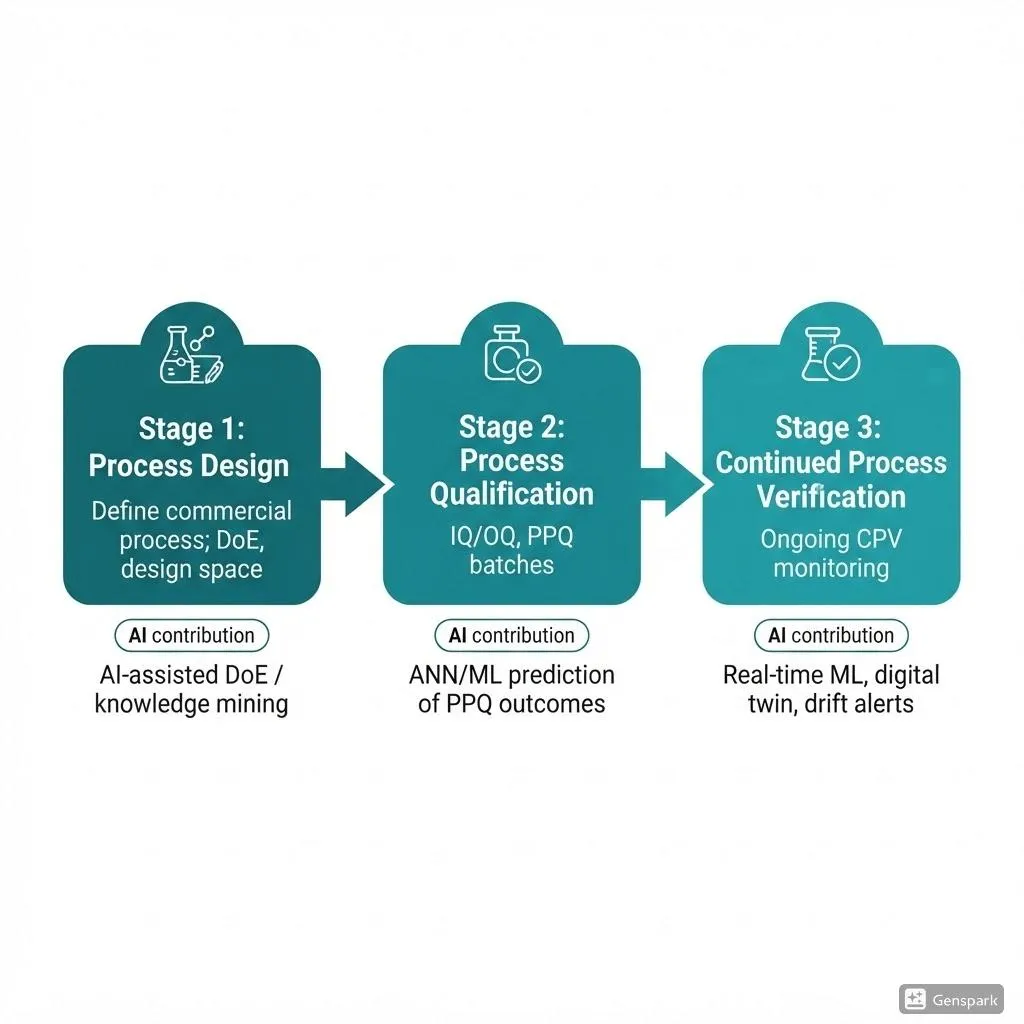
Figure 1. The three-stage lifecycle approach to pharmaceutical process validation, indicating where artificial intelligence contributes the most value at each stage.
|
Stage |
Objective |
Typical Activities |
AI Contribution |
|
Stage 1: Process Design |
Define the commercial manufacturing process using development and scale-up knowledge. |
Risk assessment; design of experiments; design space development. |
AI-assisted design of experiments; knowledge mining; early design-space prediction. |
|
Stage 2: Process Qualification |
Confirm that the process design is capable of reproducible commercial manufacturing. |
Facility/equipment qualification (IQ/OQ); process performance qualification batches. |
Neural-network and machine-learning prediction of batch outcomes; smarter sampling for PPQ. |
|
Stage 3: Continued Process Verification |
Provide ongoing assurance that the process remains in a state of control. |
Continuous data collection; statistical trending; periodic process capability review. |
Real-time machine-learning monitoring; digital twins; drift and anomaly alerts. |
Table 1. Summary of the three-stage FDA process validation lifecycle and the corresponding role of artificial intelligence.
3. Overview of Artificial Intelligence[9]
Artificial intelligence refers to computational systems capable of performing tasks that typically require human cognitive abilities — pattern recognition, prediction, classification, and decision-making under uncertainty[1,13].
It is best understood as an umbrella discipline rather than a single technology, encompassing machine learning, deep learning, expert systems, fuzzy logic, and simulation-based approaches such as digital twins[10,11]. Within pharmaceutical sciences, AI adoption began with relatively narrow computational models applied to molecular property prediction and has since expanded into nearly every stage of the drug lifecycle, including discovery, formulation, clinical development, regulatory submission, and post-market surveillance[7,12]. Inside manufacturing and quality operations, the same set of techniques is increasingly used for real-time process monitoring, defect detection in visual inspection systems, predictive maintenance of production equipment, and compliance-related document and data management[1,14]. What distinguishes AI from classical automation is its capacity to learn patterns directly from data and to refine its performance as more data become available, rather than following only static, pre-programmed rules[8,11]. That same characteristic is what complicates the direct application of legacy computer system validation approaches, which were originally designed for deterministic, unchanging software behaviour.
4. AI Techniques Used in Process Validation
A range of AI techniques, each with distinct mathematical foundations and practical strengths, has been applied within pharmaceutical process validation. Figure 2 sketches the taxonomy of the five technique families discussed in this section, and Table 2 compares their principal characteristics side by side.
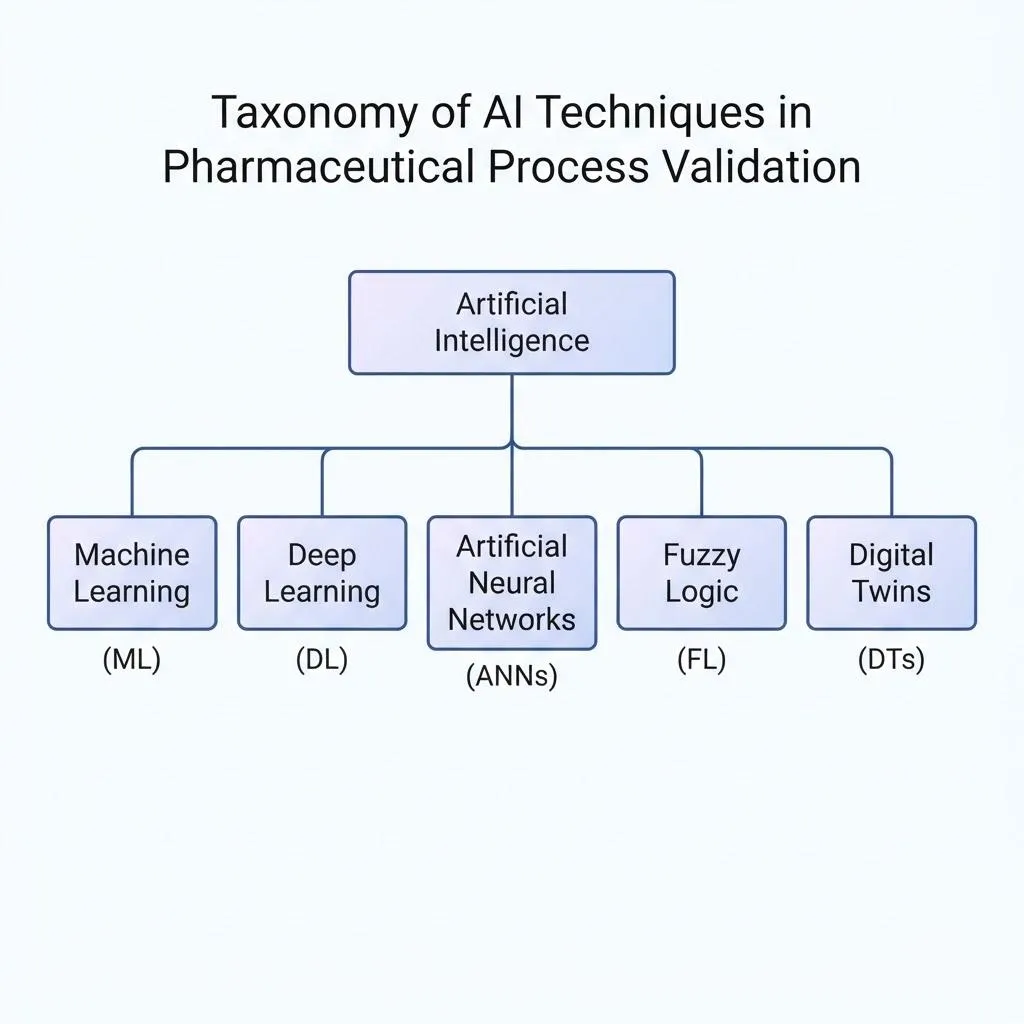
Figure 2. Taxonomy of the principal artificial intelligence technique families used in pharmaceutical process validation.
4.1 Machine Learning[7,13,15]
Machine learning encompasses algorithms that infer statistical relationships from historical data without being explicitly programmed with fixed rules[7,15,16]. Common approaches used in pharmaceutical manufacturing include regression models, support vector machines, random forests, and gradient-boosted decision trees. These approaches are typically used to predict critical quality attributes from process and raw-material data, to classify batches as within or outside specification, and to detect early indicators of process drift[15,19]. Machine learning models are particularly valuable in continued process verification, where they can continuously ingest incoming batch data and flag statistically meaningful deviations well before they would be apparent through traditional control charts.
4.2 Deep Learning[1,11]
Deep learning is a subset of machine learning built from multi-layered artificial neural networks that can automatically extract hierarchical features from complex, high-dimensional data such as images, spectra, and time-series signals[11,13]. In pharmaceutical process validation, convolutional neural networks are commonly applied to visual inspection tasks, including tablet defect detection and packaging integrity checks. Recurrent architectures, meanwhile, are used to model sequential process data such as granulation or drying curves[1,8]. Deep learning's principal advantage is its ability to model highly non-linear relationships without requiring extensive manual feature engineering, though this comes at the cost of reduced interpretability.
4.3 Artificial Neural Networks
Artificial neural networks — the conceptual foundation of deep learning — have a longer track record of application within pharmaceutical formulation and process modelling[12]. They have been used to map relationships between formulation variables, process parameters, and finished-product performance, including successful prediction of in vitro dissolution profiles that supported bioequivalence assessments during process validation of exhibit batches[12,17]. Because neural networks can approximate complex, non-linear design spaces more flexibly than classical response-surface methodology, they are frequently embedded within Quality by Design workflows to establish process parameter limits linked to clinical performance outcomes.
4.4 Fuzzy Logic
Fuzzy logic systems provide a mathematical framework for reasoning under uncertainty using degrees of truth rather than fixed binary states[1]. They are well suited to modelling expert heuristics and qualitative process knowledge that resists precise numerical definition[1,17]. In process validation contexts, fuzzy logic has been applied to risk assessment and decision-support systems in which multiple qualitative inputs — supplier reliability, equipment condition, operator experience — are combined into an overall risk score. Fuzzy-rule-based controllers are also occasionally combined with neural networks in so-called neuro-fuzzy systems, in a deliberate attempt to pair the interpretability of rule-based reasoning with the pattern-learning capacity of artificial neural networks.
4.5 Digital Twins[20,21]
A digital twin is a dynamic, data-driven virtual replica of a physical process or asset, continuously updated using data from sensors, Process Analytical Technology instruments, and manufacturing execution systems, and used to simulate, predict, and optimize the behaviour of its physical counterpart[22]. A fully developed digital twin architecture — illustrated later in Figure 4 — comprises physical components, virtual components, and a bidirectional data communication layer connecting the two[21,23]. Pharmaceutical applications include hybrid models that combine mechanistic first-principle equations with machine-learned surrogate models to estimate and control critical quality attributes, such as particle size in lipid nanoparticle manufacturing, in real time[24,25]. Industry analyses suggest that digital twin adoption can meaningfully reduce batch failure rates and shorten troubleshooting cycles by allowing manufacturers to test process changes virtually before implementing them on the physical line.
|
Technique |
Core Principle |
Typical Data Type |
Representative Use in Process Validation |
|
Machine Learning |
Statistical learning of patterns from historical data. |
Tabular process and batch data. |
Critical quality attribute prediction, batch classification, drift detection [7,15]. |
|
Deep Learning |
Multi-layer neural networks with automatic feature extraction. |
Images, spectra, time-series signals. |
Visual defect detection, spectral analysis [11,13]. |
|
Artificial Neural Networks |
Non-linear input-output mapping inspired by biological neurons. |
Formulation and process variables. |
Dissolution prediction, design-space modelling [12,17]. |
|
Fuzzy Logic |
Reasoning with degrees of truth rather than binary states. |
Qualitative and expert heuristic inputs. |
Risk scoring, decision support [1,17]. |
|
Digital Twins |
Hybrid mechanistic and data-driven virtual replica of a process. |
Multi-source real-time sensor and PAT data. |
Real-time simulation, critical quality attribute control, what-if analysis [20,23]. |
Table 2. Comparison of artificial intelligence techniques applied in pharmaceutical process validation.
5. Applications of Artificial Intelligence in Pharmaceutical Process Validation
5.1 Applications in Process Design (Stage 1)[7,17]
During process design, artificial intelligence supports the analysis of historical development data, the mining of scientific literature, and the intelligent design of experiments. These capabilities help developers identify the most informative combinations of process parameters to test with fewer experimental runs[12,15]. Machine learning models trained on prior formulation and process datasets can also generate early predictions of a design space before full-scale experimentation is undertaken, accelerating early development timelines.
5.2 Applications in Process Qualification (Stage 2)[12,13] In process qualification, neural-network and machine-learning models are increasingly used to predict the outcome of process performance qualification batches before they are actually manufactured, allowing developers to flag combinations of process parameters that are likely to produce out-of-specification results[15,17]. AI-based statistical tools also support the design and analysis of sampling plans used to demonstrate batch-to-batch reproducibility, improving the statistical rigour with which qualification conclusions are drawn.
5.3 Applications in Continued Process Verification (Stage 3)[15,19]
Continued process verification is the stage in which artificial intelligence contributes the most continuous and visible value. Real-time machine learning models can monitor incoming batch and in-process data, apply statistical process control logic augmented with pattern recognition, and generate early alerts when a process begins to drift from its established state of control, often before conventional control charts would detect a meaningful shift[7,14]. Predictive maintenance algorithms — built on sensor and equipment performance data — further reduce unplanned downtime and equipment-related deviations that could otherwise compromise a validated process.
5.4 Environmental Monitoring, Defect Detection, and Predictive Maintenance[7]
Beyond the three core stages, AI-driven analytics are applied to closed robotic work cells used in aseptic processing, where advanced environmental monitoring strategies rely on continuous data analysis to detect contamination risk[11,13]. Computer-vision-based deep learning models are also widely used for automated tablet and vial defect detection, replacing or augmenting manual visual inspection with higher throughput and more consistent detection performance.
6. Integration of AI with Process Analytical Technology and Quality by Design[2,5,6]
Process Analytical Technology and Quality by Design together provide the philosophical and infrastructural basis on which AI-enabled process validation is built. PAT emphasizes designing, analyzing, and controlling manufacturing through timely measurement of critical quality and performance attributes; QbD emphasizes the proactive design of the process and product around a defined design space[8,20]. Artificial intelligence operates as the analytical engine that converts the continuous, high-dimensional data streams generated by PAT instruments — such as near-infrared and Raman spectrometers — into actionable, real-time quality decisions.
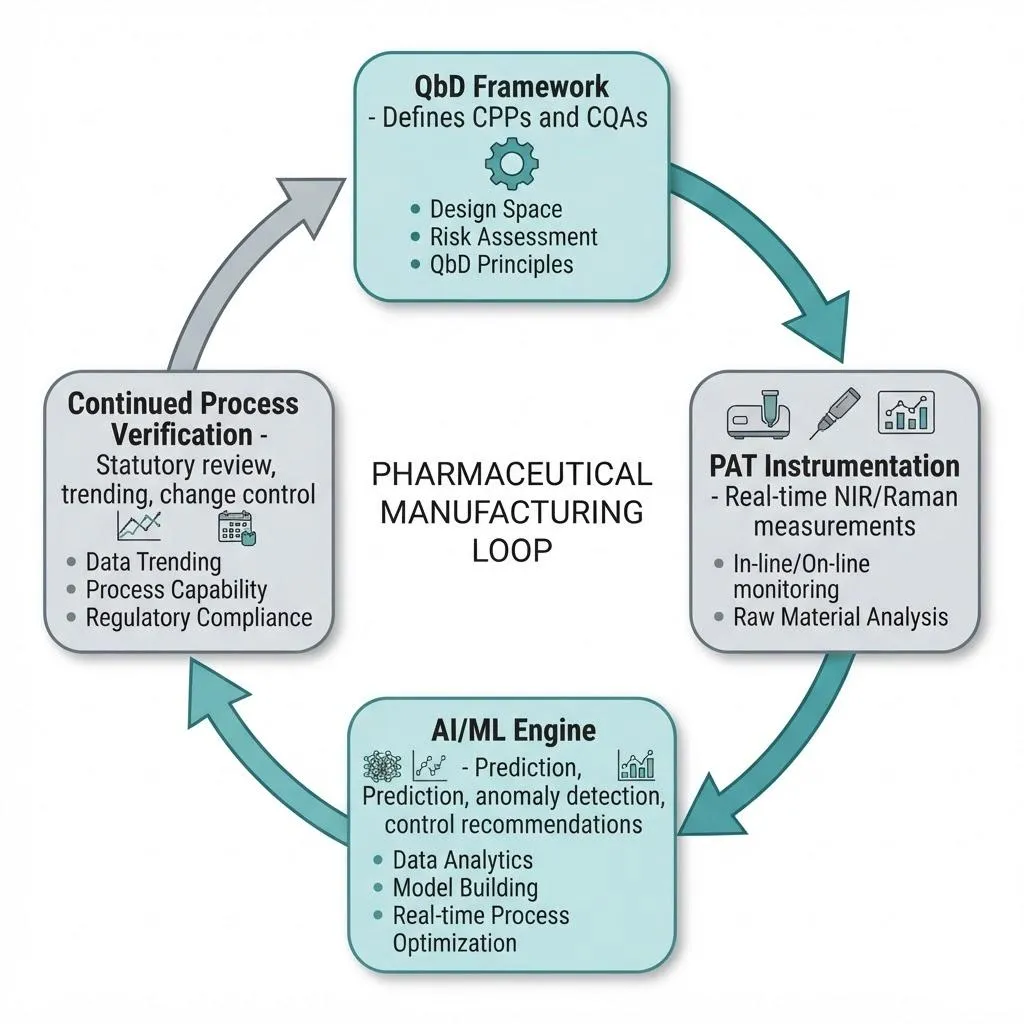
Figure 3. Closed-loop integration of Quality by Design, Process Analytical Technology, and artificial intelligence within continued process verification.
The integration just described is central to the vision of real-time release testing, in which the quality of a finished product is inferred from a combination of in-process measurements and process control information rather than solely from traditional end-product testing[8,21,23]. Digital twins extend this integration further by enabling manufacturers to simulate the effect of a proposed process change virtually, reducing the experimental burden typically associated with revalidation after change.
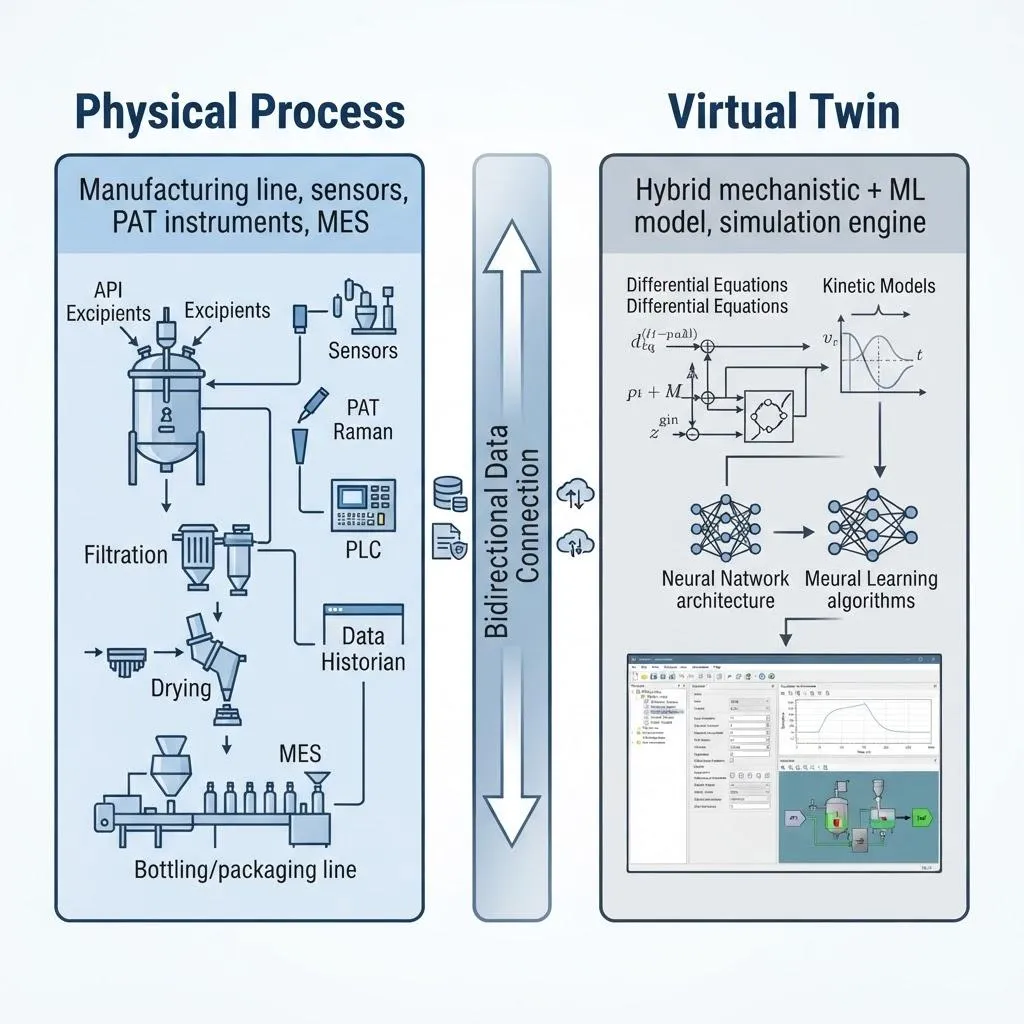
Figure 4. Digital twin architecture supporting AI-enabled process validation, showing bidirectional data flow between the physical process and its virtual replica.
7. Regulatory Considerations
The adoption of artificial intelligence within Good Manufacturing Practice regulated pharmaceutical manufacturing has prompted regulators and standards bodies to extend or adapt existing frameworks[3,5,6,7,8,9,10]. Table 3 summarizes the principal guidance documents and standards relevant to AI-enabled process validation, spanning process validation guidance, quality system guidelines, computer system validation frameworks, and AI-specific regulatory instruments[2,4].
The International Council for Harmonization Q8 through Q13 series collectively establishes the scientific and quality-system foundation, including pharmaceutical development, quality risk management, pharmaceutical quality systems, lifecycle management, and continuous manufacturing, within which AI tools must operate[5]. GAMP 5 Second Edition extends risk-based computer system validation principles to cover automation platforms and, increasingly, AI/ML models, drawing a clear distinction between the qualification and change-management expectations of adaptive systems and those of conventional deterministic software[6,7]. The FDA's Artificial Intelligence and Machine Learning Action Plan and its associated draft guidance on predetermined change control plans introduce the concept of pre-specifying the boundaries within which a model may be permitted to learn and adapt post-deployment, without requiring a full revalidation for every incremental update[8]. The European Union Artificial Intelligence Act introduces a risk-tiered regulatory structure that is likely to classify certain AI applications in medicinal product manufacturing as high-risk, subjecting them to additional conformity assessment and post-market monitoring obligations[9,10]. International standards such as ISO/IEC 42001 for AI management systems, ISO/IEC 27001 for information security, and ISO/IEC 25010 for software quality characteristics provide complementary, internationally recognized frameworks that many manufacturers are beginning to reference in their AI governance programmed[6,15,16]. A recurring theme across these frameworks is the emphasis on a risk-based lifecycle approach: rather than attempting to validate an AI model once at deployment, manufacturers are expected to maintain ongoing oversight of model performance, data quality, and drift throughout the product's commercial life — echoing the same lifecycle philosophy that underpins Stage 3 continued process verification.
|
Guidance / Standard |
Issuing Body |
Relevance to AI-Enabled Process Validation |
|
ICH Q8–Q13 |
International Council for Harmonization |
Establishes Quality by Design, quality risk management, pharmaceutical quality systems, lifecycle management, and continuous manufacturing foundations [2,4]. |
|
FDA Process Validation Guidance (2011) |
U.S. Food and Drug Administration |
Defines the three-stage process validation lifecycle referenced throughout this review [3]. |
|
GAMP 5 (2nd Edition) |
International Society for Pharmaceutical Engineering |
Extends risk-based computer system validation to automation and AI/ML platforms [5]. |
|
AI/ML SaMD Action Plan and PCCP Draft Guidance |
U.S. Food and Drug Administration |
Introduces predetermined change control plans for adaptive AI/ML models [6,7]. |
|
EU Artificial Intelligence Act |
European Union |
Risk-tiered regulatory structure likely to classify certain manufacturing AI as high-risk [8]. |
|
ISO/IEC 42001 / 27001 / 25010 |
International Organization for Standardization |
International standards for AI management, cybersecurity, and software quality [9,10]. |
Table 3. Key regulatory guidance and standards relevant to AI-enabled process validation.
8. Challenges and Limitations
8.1 Model Drift and Data Quality[9,15]
Artificial intelligence models are only as reliable as the data used to train and subsequently monitor them. Concept drift — in which the statistical relationship between process inputs and outputs shifts over time due to raw-material variability, equipment ageing, or seasonal factors — can silently degrade model performance if not actively monitored[7,22]. Because pharmaceutical manufacturing data are often fragmented across disparate systems with inconsistent formats, achieving the data quality and integration needed for robust AI performance remains a substantial practical barrier.
8.2 Explainability and Interpretability[1,8]
Deep learning models in particular often function as opaque, difficult-to-interpret systems — a quality that complicates the regulatory expectation that manufacturers demonstrate scientific understanding of why a process behaves as it does, rather than simply relying on a model's predictive accuracy. This tension between predictive performance and explainability is one of the most frequently cited barriers to broader AI adoption in validated Good Manufacturing Practice environments.
8.3 Cybersecurity[9,10]
As AI systems become more deeply embedded in manufacturing control and data infrastructure, they also introduce new cybersecurity exposure — including the risk of adversarial manipulation of sensor data or model inputs, which could compromise both product quality and patient safety if not appropriately safeguarded.
8.4 Bias and Generalizability[1,6]
AI models trained on data from a specific product, site, or equipment configuration may not generalise well to other contexts. Biases embedded in historical training data can be inadvertently propagated into model predictions — an issue that regulators have specifically flagged as a persistent pain point for AI/ML validation frameworks.
8.5 Regulatory and Organizational Readiness[6,7]
Despite meaningful recent progress, harmonised international guidance for AI/ML validation remains incomplete. Many pharmaceutical organisations lack the internal expertise, governance structures, or change-management processes needed to qualify and maintain adaptive AI systems confidently[7,24]. Workforce upskilling, cross-functional collaboration between data scientists and quality professionals, and cultural acceptance of model-based evidence are frequently identified as prerequisites for successful adoption.
9. Future Perspectives
Several converging trends suggest that artificial intelligence will play an increasingly central role in pharmaceutical process validation over the coming decade[14,20]. Continued expansion of Process Analytical Technology instrumentation and Industry 4.0-aligned manufacturing execution systems will further enrich the data infrastructure available to train and monitor AI models[24,25]. Digital twins are expected to mature from isolated pilot applications toward broader deployment across unit operations, supported by projected substantial market growth in digital twin technology for pharmaceutical manufacturing over the coming years[6,7]. On the regulatory front, predetermined change control plans and similar mechanisms are likely to be refined and more widely adopted, providing a structured pathway for manufacturers to update AI models within pre-agreed boundaries without triggering a full revalidation cycle for every change[8,9,6]. Greater regulatory harmonisation across the FDA, the European Medicines Agency, and other national authorities — potentially supported by international standards such as ISO/IEC 42001 — may reduce the current fragmentation of guidance and lower the compliance burden for global manufacturers[2,4,8,26]. Finally, continued integration of AI with real-time release testing, autonomous process control, and predictive quality frameworks is expected to shift validation practice further away from retrospective, batch-based assessment and towards a continuous, proactive assurance of quality — consistent with the broader trajectory of Quality by Design and Pharmaceutical Quality System philosophy first articulated in the ICH Q8 to Q10 guidelines.
CONCLUSION
Artificial intelligence is reshaping pharmaceutical process validation by extending the analytical depth, responsiveness, and predictive capability available at every stage of the validation lifecycle — from process design through continued process verification. Machine learning, deep learning, artificial neural networks, fuzzy logic, and digital twin technologies each contribute distinct strengths, ranging from non-linear prediction of critical quality attributes to real-time simulation of complex unit operations. When integrated with established Quality by Design and Process Analytical Technology frameworks, these techniques enable a closed-loop, data-driven approach to demonstrating and sustaining a validated state of control. Realising this potential responsibly, however, requires manufacturers to address persistent challenges related to data quality, model drift, explainability, cybersecurity, and regulatory harmonisation. Emerging regulatory instruments — including predetermined change control plans, GAMP 5 Second Edition, and international AI management standards — provide an increasingly structured foundation for the risk-based governance of AI throughout its lifecycle. As these frameworks mature, artificial intelligence is likely to become not merely a supplementary analytical tool but an integral component of how pharmaceutical manufacturers design, qualify, and continuously verify the processes that safeguard product quality and patient safety.
REFERENCES


Taufik Mulla*, Siddheshwar Sonavane, Ayush Tambe, Megha Hange, P. N. Sable, Artificial Intelligence In Pharmaceutical Process Validation: A Review, Int. J. Sci. R. Tech., 2026, 3 (7), 823-834. https://doi.org/10.5281/zenodo.21530907
 10.5281/zenodo.21530907