

We use cookies to ensure our website works properly and to personalise your experience. Cookies policy
Department of Agada Tantra, Sri Dharmasthala Manjunateshwara College of Ayurveda and Hospital, Hassan, Karnataka. India.
Background: In Ayurveda, dermal manifestations occur primarily due to the imbalance of specific Doshas and Dhatus, among one such is Visarpa, an acute condition with a quick spreading involving mainly skin, blood, and lymph and muscle tissue due to vitiation of all three Doshas. And visarpa without getting initial treatment it manifests into post herpetic ulcer, as the basic nature of the disease is Rakta and Pitta predominant, management is focused on Shodhana, Rakthamokshana, Shamana and Lepa Chikitsa. This case study is an attempt to evaluate the role of Ayurvedic management in Visarpa and post herpetic ulcer management. Case Presentation: A 77 years old male patient visited Agadatantra OPD presented with a progressively worsening ulcer over nape of neck associated with severe pruritis, pain and pus discharge which is continuous in nature for 15 days, Patient had a history of herpes zoster infection past 1 month was neglected and untreated. Intervention: The patient was treated with an Ayurvedic treatment protocol including Aragwadadi Kashaya, Ropana Gritha, Nimbadi guggulu, Dashanga lepa, Nimbadi kashaya and jaloukavacharana. The treatment was planned based on Kapha-Pitta Shamana, Vrana ropana, Krimighna Chikitsa, and Rakta Prasadana principles. Result: Reduction in ulcer size, itching, discharge, erythema and pain was observed over successive treatment and follow-ups, with complete clinical resolution and no reported adverse effects. Result: This case highlights the potential effectiveness of a structured Ayurvedic approach in the management of post herpetic ulcer (herpes zoster).
According to the report, skin diseases contribute around 1.79% to the global burden of diseases.
Although PHI has been reported to affect up to 58% of patients with shingles 1. According to a study conducted in India, higher incidence of Visarpa observed in younger age group (21-40 years of age). Recent studies have revealed that the incidence of skin problem and skin diseases caused by virus are increasing. It is characterized by the localized painful spread of skin rashes and blisters. Ayurveda mention that Visarpa spreads like a snake and thus it is considered as Pradhan Vyadhi 2. Many skin diseases are mentioned in Ayurveda classics on the basis of their origin. Most of the skin diseases are caused due to Vata, Pitta and Kapha Dosha aggravation. Some are Raktaja Vyadhi and some are caused by Agantuja (foreign agents). It is an Aashukarvyadhi (acute disease) of skin whose complications such as post therapeutic neuralgia can affect till many years. Postherpetic neuralgia (PHN) represents a type of peripheral neuropathic pruritus that occurs after an episode of shingles and is characterized by localized pain, paresthesia, and itch, termed postherpetic itch (PHI); all may simultaneously exist within the same dermatomal distribution 3, is characterized by localized painful spread skin rashes and blisters. Herpes is correlated in Ayurveda with Visarpa based on its symptomatology. It is an Aashukari Vyadhi (acute disease) characterized by Aashu Anunnata Shopha, Daha, Jwara, Vedana and Pidika and it is described as Agnidagdhavat.4 Visarpa has given simile of Aashivisha or Sarpa Visha due to its rapid nature of spreading.5
CASE REPORT
A 77 years old male patient visited Agadatantra OPD-10, presented with a chief complaint of non- healing pustular ulcer over nape of neck associated with severe itching (kandu), pain (toda) and pus discharge (srava) which is continuous in nature for 15 days; Patient had a history of herpes zoster infection past 1 month
The patient is a known case of Diabetes Mellitus-II under oral medication since 5 years; patient took folk medicine for past 15 days, but didn’t found result
Past surgical history: No relevant surgical
history.
Family History: No similar complaints have been reported among family members.
Psychosocial Status: The patient appears anxious and irritable.
Personal History:
· Bowel Habits: Once daily with hard stools
· Appetite: Irregular, often accompanied by abdominal bloating
· Diet: Mixed (includes both vegetarian and non-vegetarian foods)
· Micturition: 2–3 times during the day and 1–2 times at night
· Sleep: Disturbed, primarily due to pain
· Allergies: None reported
Past surgical history: No relevant surgical history.
Family History: No similar complaints have been reported among family members.
Psychosocial Status: The patient appears anxious and irritable.
Personal History:
General Examination
On Examination
Temperature - 98.6°F
Pulse rate - 92/min
BP - 130/80 mmhg
RS – NVBS heard
CVS - S1S2 heard
CNS - Conscious and oriented
P/A - Soft and non-tender
Local examination
MANAGEMENT
Treatment given.
Advice on discharge
Follow up medicine advice after 15 days
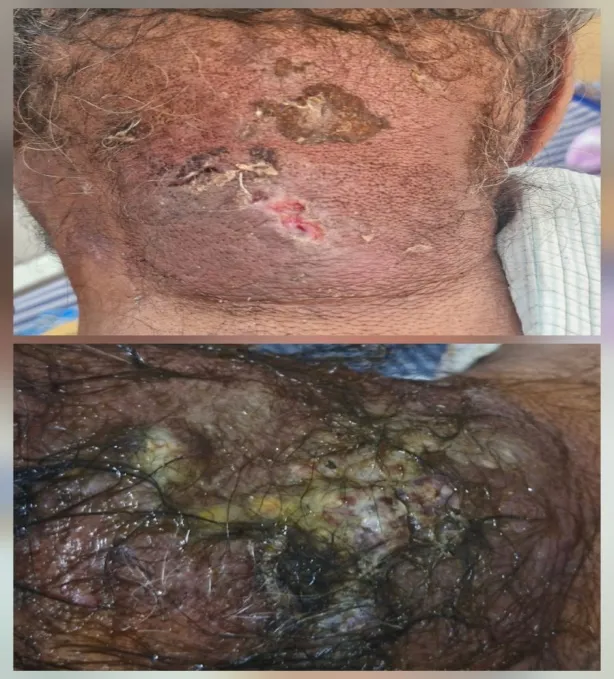
Fig 1: Before treatment
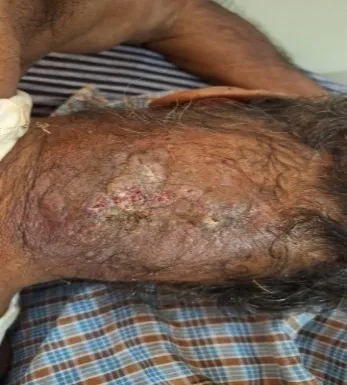
Fig 2: During treatment
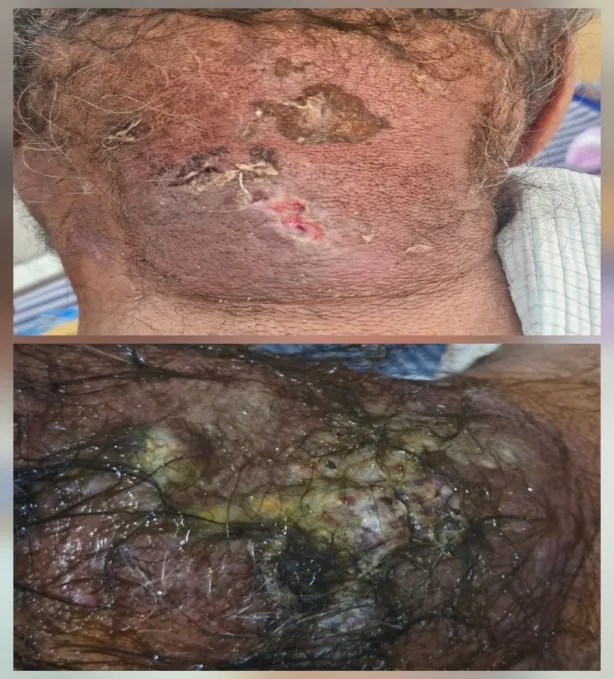
Fig 3: After treatment (at the time of discharge)
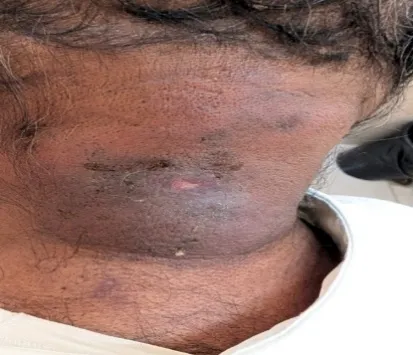
Fig 4: 1st follow up after 15 days.
|
Observation and symptoms |
Kandu (itching) |
Srava (discharge) |
Raga (redness) |
|
Day 0 |
++++ |
++++ |
++++ |
|
Day 3 |
++ |
+++ |
++ |
|
Day 5 |
++ |
+ |
+ |
|
Day 8 |
- |
- |
- |
|
Day 15 |
- |
- |
- |
Table 1: Observations And Results
DISCUSSION
Visarpa is caused due to the involvement of all the three Doshas where Pitta is predominant 6. The vitiation of the Doshas is due to both Nija and Agantu Nidanas. Etiological factors such as Aharaja -diet and Viharaja- life style related, injury, poisons, toxins, burns etc. some of these Nidana causes vitiations of the Dosha and Khavaigunya (disease prone condition) in Dhatu and some cause direct vitiation of Dosha and Dhatu leading to Visarpa. It shows that favorable condition for disease phenomenon or infection occurs first. The Nija Hetus are intake of Lavana, Amla, Katu, Ushna, Dadhi, Amla, Raga, Shadava, Shukla, Sura, Souveera etc 7. These etiological factors cause vitiation of Pitta and Rakta immediately leading to Visarpa 8. Aragwadadi Kashaya with the properties of Kapha-Vatahara, Ushna veerya, Katu Vipaka. It is indicated in skin diseases mostly visha, prameha etc. disorders as this drug consists of antimicrobial, anti-inflammatory, antihyperlipidemic etc. properties in it 9. Ropana gritha is Pitta Shamaka and helps in healing wound by accelerating wound healing and works as anti-septic and cleansing action 10. Dashanga Lepa is one such an Ayurvedic formulation clinically used as an anti-inflammatory agent and widely recommended for treating of skin disorders including herpes wounds, eczema and inflammation11. Nimbadi kashaya is mentioned has actions like kapha pitha hara, rakta prasadhana, lekhana etc. Most of the ingredients in this formulation have an anti-inflammatory action, hence can be considered to have rakta prasada property and is effective in reducing the symptoms associated with increased kapha and pitha dosha. Being a tikta rasa pradhana formulation if helps in the Shoshana of kleda and hence removes the ama in dosha and dhatus there by clearing the corresponding srotas12.
CONCLUSION
Visarpa Roga needs to be approached with Pitta Pradhana Tridoshahara Chikitsa. In-spite of chronicity and severity of the disease, Ayurvedic Shodhana and Shamana measures showed significant symptomatic improvement in this case of Visarpa (herpes) and its complication.
REFERENCES



Nataraj H. R.*, Yatheesh K. R., MDP Ishara, Ayurveda Management of Post Herpetic Ulcer (Visarpa) - A Case Study, Int. J. Sci. R. Tech., 2026, 3 (7), 1005-1009. https://doi.org/10.5281/zenodo.21675302
 10.5281/zenodo.21675302