

We use cookies to ensure our website works properly and to personalise your experience. Cookies policy
1Department of Mathematics, Shri. Dr. R. G. Rathod Arts and Science College, Murtizapur Dist. Akola (M.S.), India
2Department of Mathematics, Shri Shivaji College of Arts, Commerce and Science, Akola (M.S.), India
This paper investigates the dynamical behaviour and evolution of a spatially homogeneous and anisotropic Bianchi Type-III universe filled with a perfect fluid within the framework of modified f(R,T) gravity. We adopt the specific functional form f(R,T)=R+2?T, where R is the Ricci scalar, T represents the trace of the energy-momentum tensor and ? is a constant. To obtain exact solutions of the non-linear field equations, we use a proportional relationship between the expansion scalar (?) and the shear scalar (?). Furthermore, instead of a time-varying deceleration, we used the constant deceleration parameter q=M-1 to obtain solution. The physical and geometrical properties of the model are obtained and analyzed in detail.
The accelerated expansion of the present universe is now a well-established cosmological fact, heavily supported by Type Ia Supernovae observations [1,2,3,4].While Einstein's General Theory of Relativity (GR) relies on the assumption of an unknown mysterious dark energy to drive this acceleration, the exact physical characteristics of this component are still not fully understood. Consequently, modified theories of gravity have gained significant attention as an effective theoretical alternative to describe this late-time acceleration [5]. Among these alternatives, the f(R,T) theory of gravity introduced by Harko et al. [6] modifies the Einstein-Hilbert action and couples matter directly with geometry. We use the spatially homogeneous and anisotropic Bianchi Type-III model to study how these early directional expansions evolve over time.
The f(R,T) gravity framework generalizes earlier models like f(R) gravity [7,8,9]. Harko et al. [6] proposed a gravitational Lagrangian that is a function of both the Ricci scalar R and the trace of the energy-momentum tensor T. This specific coupling means that the covariant divergence of the energy-momentum tensor is generally non-zero, making the resulting field equations highly dependent on the matter source. A commonly used functional form of this theory is f(R,T)=R+2f(T). By choosing a linear formulation f(T)=λT, researchers can derive field equations capable of simulating dark energy-like expansion without adding a cosmological constant.
Various researchers have explored different cosmological models using f(R,T) gravity. Reddy et al. [10] studied Bianchi Type-III universe containing perfect fluids while Adhav [11] investigated locally rotationally symmetric Bianchi Type-I models. Naidu et al. [12] and Chandel and Ram [13] expanded this to other Bianchi type models. Several other authors [14,15,16,17,18] have tested these models against observational parameters and different cosmic fluids. These studies collectively show that f(R,T) gravity is a flexible and effective tool for modeling cosmological dynamics.
Motivated by these ongoing theoretical advancements and previous studies on special forms of deceleration parameters [19], we identify a specific gap in the current literature. Chaubey and Shukla [14] explored generalized Bianchi models using a linearly varying deceleration parameter. Munde [20] utilized a special form of deceleration parameter in f(R,T) gravity. The specific application of the Akarsu-Dereli constant deceleration parameter q=M-1 [21] to a spatially homogeneous Bianchi Type-III universe in f(R,T) gravity remains unexplored. Therefore, the primary objective of this paper is to reconstruct the cosmological model filled with a perfect fluid. Following the base mathematical framework laid out by Munde [20], we modify the kinematical approach to integrate this constant deceleration parameter. Through this modification, we aim to investigate how this specific assumption alters the exact solutions of the non-linear field equations and the physical behaviour of the universe.
The structural outline of this paper is organized as follows: Section 2 presents metric and field equations, Section 3 deduces the solutions, Section 4 contains the physical properties, Section 5 discusses the physical and kinematical behaviour of the field equations and Section 6 summarizes the conclusion.
2. METRIC AND FIELD EQUATIONS
f(R,T) theory modifies the standard gravitational action by introducing an arbitrary function dependent on the Ricci scalar R and the trace of the energy-momentum tensor T. Harko et al. explicitly classified this theory into three specific functional forms to study different cosmological consequences
f(R,T)=R+2f(T) (1)
f(R,T)=f1(R)+f2(T) (2)
f(R,T)=f1(R)+f2(R)f3(T) (3)
For the purpose of our present investigation, we select the first functional form, which provides a direct and viable coupling between matter and geometry
f(R,T)=R+2f(T) (4)
By varying the Einstein-Hilbert action with respect to the metric tensor, the corresponding gravitational field equations in f(R,T) gravity are obtained as
Rμν-½Rgμν=8πTμν+2f'(T)Tμν+[2pf'(T)+f(T)]gμν (5) To obtain exact deterministic solutions, we assume a linear functional form for the trace of the stress-energy tensor
f(T)=λT (6)
where λ acts as a constant proportionality parameter.
To describe the early anisotropic expansion of the universe, we consider a spatially homogeneous Bianchi Type-III metric, defined by the line element
ds2=dt2-A2dx2-e-2mxB2dy2-C2dz2 (7)
where A, B and C represent the directional cosmic scale factors which are functions of cosmic time t and m is a positive constant. The matter source driving the cosmic expansion is assumed to be a perfect fluid, for which the energy-momentum tensor is defined as Tμν=(ρ+p)uμuν-pgμν , where ρ is the energy density and p represents the thermodynamic pressure of the cosmic fluid.
By utilizing the selected metric (7) and the linear trace condition (6), the generalized field equations (5) reduce to a system of highly non-linear differential equations for the Bianchi Type-III spacetime
B̈/B+C̈/C+ḂĊ/BC=(8π+3λ)p-λρ (8)
Ä/A+C̈/C+ȦĊ/AC=(8π+3λ)p-λρ (9)
Ä/A+B̈/B+ȦḂ/AB-m2/A2=(8π+3λ)p-λρ (10)
ȦḂ/AB+ḂĊ/BC+ȦĊ/AC-m2/A2=λp-(8π+3λ)ρ (11)
Ȧ/A-Ḃ/B=0 (12)
Here, the overhead dot symbolizes the derivative with respect to cosmic time t. To thoroughly analyze the dynamic and structural properties of this proposed model, it is essential to define several fundamental kinematical parameters. The spatial volume V and the average scale factor a of the universe are given by
V=ABC, a=(ABC)â…“ (13)
The directional Hubble parameters which measure the rate of expansion along the x, y and z axes respectively are defined as
Hx=Ȧ/A, Hy=Ḃ/B, Hz=Ċ/C (14)
The overall mean Hubble parameter H representing the average expansion rate, is formulated as
H=⅓(Ȧ/A+Ḃ/B+Ċ/C) (15)
The expansion scalar θ is directly related to the mean Hubble parameter by
θ=3H (16)
The deceleration parameter q, which indicates whether the cosmic expansion is speeding up or slowing down, is expressed as
q=-aä/a2̇ (17)
Finally, the shear scalar σ2 and the mean anisotropic parameter Δ are defined respectively as
σ2=½[∑i=13Hi2-â…“θ2] (18)
Δ=â…“∑i=13((Hi-H)/H)2 (19)
3. SOLUTION OF THE FIELD EQUATIONS
Integrating the field equation (12), we readily obtain a direct proportionality between the scale factors as
B=c1A (20)
where c1 is a positive constant of integration. Substituting this condition into equations (8)-(11) reduces the field equations into a more compact system. However, this system remains highly non-linear with four unknowns A, C, ρ and p. To achieve an exact deterministic solution, we adopt the linearly varying deceleration parameter proposed by Akarsu and Dereli [21] which is given in its general form as
q = -kt + M-1
where k ≥0 and M ≥0 are constants. Depending on the values of these constants, this generalized deceleration parameter leads to three distinct cases
q=-1
k=0, M=0
1. for
q=M-1
k=0, M>0
2. for
q=-kt+M-1
k>0, M≥0
3. for
For the purpose of our present investigation, we utilize the second case (k = 0, M > 0) to obtain the solution, which yields a constant deceleration parameter
q=M-1 (21)
where M is a positive constant.
Equating (17) and (21) and performing successive integrations, we deduce the explicit expression for the mean scale factor of the universe as
a=(αt+β)1/M (22)
where α and β are arbitrary constants of integration. Consequently, using equation (13), the spatial volume of the universe becomes
V=a3=(αt+β)3/M (23)
using equations (13), (20) and (23), we obtain
V=c1A2C=(αt+β)3/M (24)
To solve the system, we apply a well-established physical condition in cosmology, assuming that the expansion scalar (θ) is directly proportional to the shear scalar (σ). This condition results into linear relationship between metric coefficients as
A=Cn (25)
where n is an arbitrary constant (with n ≠ 1 to preserve anisotropy). By solving equations (20), (24) and (25) simultaneously, we determine the exact expressions for the directional scale factors as follows
A=(c1)-n/(2n+1)(αt+β)3n/(M(2n+1)) (26)
B=(c1)(n+1)/(2n+1)(αt+β)3n/(M(2n+1)) (27)
C=(c1)-1/(2n+1)(αt+β)3/(M(2n+1)) (28)
using (26)-(28), the line element (7) becomes
ds2=dt2-[(c1)-2n/(2n+1)(αt+β)6n/(M(2n+1))]dx2-[(c1)(2(n+1))/(2n+1)e-2mx(αt+β)6n/(M(2n+1))]dy2
-[(c1)-2/(2n+1)(αt+β)6/(M(2n+1))]dz2 (29)
4. PHYSICAL PROPERTIES OF THE MODEL
To comprehensively understand the cosmological implications and dynamical evolution of the derived Bianchi Type-III model, it is imperative to investigate its fundamental physical and kinematical parameters.
Using the explicit solutions for the directional scale factors derived in equations (26)-(28), the spatial volume V and the average scale factor of the universe are explicitly expressed as
V=(αt+β)3/M (30)
a=(αt+β)1/M (31)
The directional Hubble parameters, which quantify the expansion rates along the spatial coordinates are obtained by differentiating the scale factors (26)-(28) with respect to cosmic time t
Hx=Hy=3nα/(M(2n+1)(αt+β)), Hz=3α/(M(2n+1)(αt+β)) (32)
Consequently, the mean Hubble parameter H representing the overall expansion rate of the universe is calculated as
H=α/(M(αt+β)) (33)
The scalar expansion θ which determines the volumetric growth rate of the fluid, is obtained as
θ=3α/(M(αt+β)) (34)
The shear scalar σ2 measuring the anisotropic distortion of the cosmic fluid flow is deduced as
σ2=(3α2(n-1)2)/(M2(2n+1)2(αt+β)2) (35)
The mean anisotropic parameter Δ which indicates the degree of deviation from an isotropic expansion, is found to be
Δ=2((n-1)/(2n+1))2 (36)
Furthermore, utilizing the derived scale factors and substituting them into the highly non-linear field equations (10) and (11), we obtain exact algebraic expressions for the dynamical variables. The energy density of the cosmic fluid is determined as
ρ=(m2(4π+λ)c1-2n/(2n+1))/(4(8π2+6πλ+λ2)(αt+β)6n/(M(2n+1)))-(3nα2[Mλ(2n+1)+12π(n+2)+9λ])/(4(8π2+6πλ+λ2)M2(2n+1)2(αt+β)2) (37)
Also, the thermodynamic pressure driving the expansion is calculated as
p=-(m2(4π+λ)c1-2n/(2n+1))/(4(8π2+6πλ+λ2)(αt+β)6n/(M(2n+1)))+(3nα2[-2M(8π+3λ)(2n+1)+6(12πn+4λn-λ)])/(8(8π2+6πλ+λ2)M2(2n+1)2(αt+β)2) (38)
5. DISCUSSION OF PHYSICAL AND KINEMATICAL BEHAVIOURS
The solutions derived in the previous section help us to understand how the Bianchi Type-III universe evolves over time. By observing the initial and late-time values of the parameters, we can describe the physical behaviour of the model.
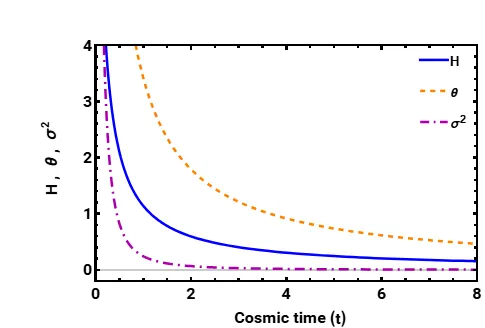
Figure 1: Graph of , and vs Cosmic Time ()
From equation (30), the spatial volume of the universe vanishes at the initial time t = -β/α. As cosmic time t increases, the spatial volume expands continuously and becomes infinitely large as t→∞. This shows that our universe starts from an initial singularity and expands indefinitely.
From Fig.1, the mean Hubble parameter (H), expansion scalar (θ) and shear scalar (σ2) are infinite at the initial epoch. However, as t→∞, these parameters decreases monotonically and approach zero. This behaviour of the Hubble and expansion parameters is highly consistent with standard cosmological models as discussed by Pradhan et al. [22] for similar anisotropic spacetime.
The mean anisotropic parameter (Δ) is independent of time and remains constant. Since Δ≠0 for n ≠1 the model does not approach complete isotropy at late times. This constant anisotropic behaviour in f(R,T) gravity matches the results observed by Sahoo et al. [23] in their respective models.
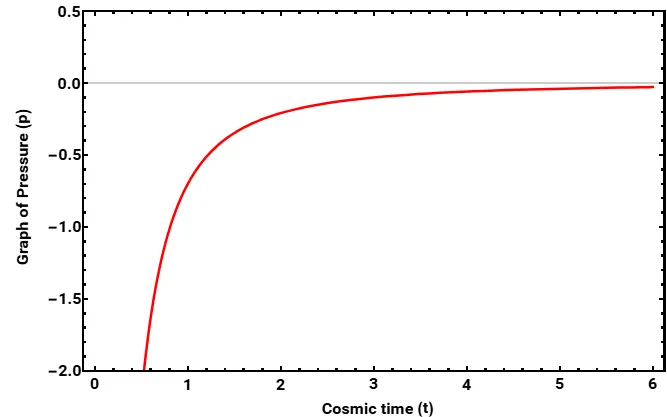
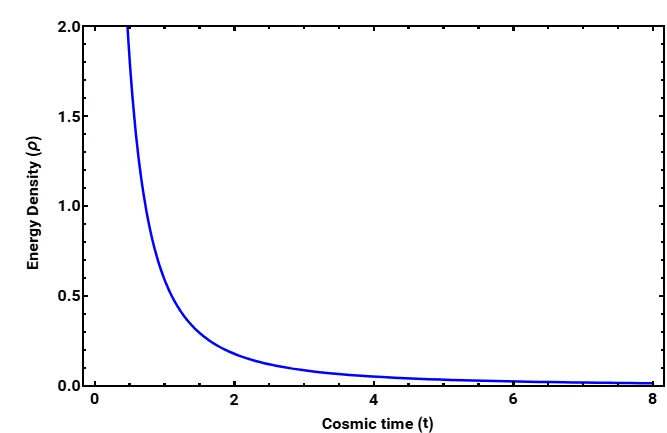
Figure 2: Graph of Energy Density () vs Cosmic Time () Fig.3: Graph of Pressure () vs Cosmic Time ()
The constant deceleration parameter q=M-1 is a key feature of this model. For 0 < M < 1, the value of q is strictly negative. A negative deceleration parameter indicates that the universe is undergoing an accelerated expansion, which is in excellent agreement with recent Type Ia Supernovae observations [1,2].
From Fig. 2 the energy density (ρ) is positive and infinitely large at the initial epoch and it monotonically decreases to zero as t →∞. From Fig. 3 the thermodynamic pressure (p) is negative throughout the evolution. It is an increasing function of cosmic time (t) and approaches zero at late times. In modern cosmology, negative pressure is a strong indicator of dark energy, which drives the late-time acceleration of the universe.
CONCLUSION
In this paper, we have investigated the dynamical evolution of a spatially homogeneous and anisotropic Bianchi Type-III cosmological model in modified f(R,T) gravity. By adopting the functional form f(R,T)=R+2λT and applying the Akarsu-Dereli constant deceleration parameter q=M-1, we successfully derived exact deterministic solution for the non-linear field equations.
The physical and kinematical properties of the model, strongly supported by our graphical analysis, reveal that a universe begins with an initial singularity and expands indefinitely. The plots of the Hubble parameter (H), expansion scalar (θ), and shear scalar (σ2) clearly demonstrate that the initial rapid expansion and high anisotropic distortion gradually dampen, eventually approaching zero at late cosmic times. However, a highly distinctive feature of this model is that the mean anisotropic parameter (Δ) remains strictly constant.
Furthermore, the model naturally accommodates the late-time accelerated expansion of the present universe. The constant deceleration parameter remains strictly negative (for 0 < M < 1), which is in excellent agreement with modern cosmological observations. The graphical behaviour of the perfect fluid shows that the energy density (ρ) decreases from an initially infinite stage to zero. The thermodynamic pressure (p) remains negative throughout the evolution. This negative pressure provides the necessary repulsive effect to drive the cosmic acceleration.
Ultimately, using the deceleration parameter q=M-1 within the f(R,T) gravity framework yields a mathematically and physically viable model. It successfully describes an expanding, anisotropic and accelerating universe without requiring the insertion of an explicit cosmological constant, thereby offering a strong theoretical alternative to standard General Relativity.
REFERENCES


N. G. Mahalle, A. S. Nimkar, M. T. Sarode, Dynamics of Bianchi Type-III Universe in F(R,T) Gravity, Int. J. Sci. R. Tech., 2026, 3 (10), 528-534. https://doi.org/10.5281/zenodo.23237197
 10.5281/zenodo.23237197