

We use cookies to ensure our website works properly and to personalise your experience. Cookies policy
Department of Urban and Regional Planning, Rivers State University, Port Harcourt
Cities in low- and middle-income countries are faced with double challenges: increasing rate of urbanization including urban expansion, and deepening rate of environmental degradation and deterioration. This study examined the Integration of Green Economy and Industry 4.0 in Urban Planning for Environmental Sustainability most especially as evidence and its pathways for low- and middle-income cities. The study adopted a desktop research approach where secondary data were sourced, analyzed and integrated to develop a framework for the integration of green economy, industry 4.0, and urban planning. An integrated framework linking industry 4.0 enablers to green economy outcomes in urban planning and physical development was developed and proposed. The study revealed that green economy offers a normative framework for decoupling growth from resource depletion, while Industry 4.0 provides digital tools for real-time monitoring, automation, and data-driven governance. The convergence of the green economy and Industry 4.0 represents a "twin transition" comprising digitalization and sustainability which are no longer parallel tracks, but interdependent forces reshaping industrial systems. When Industry 4.0 technologies are deployed city-wide, they transform urban infrastructure into an integrated productive system.
Cities are the primary sites of the 21st-century sustainability challenges, occupying less than 3% of the earth’s land surface but accounts for 70% of global greenhouse gas emissions, 60% of resource use, and 80% of Gross Domestic Product (GDP) (UN-Habitat, 2010, World Bank, 2010, UNEP, 2012). In Low and Middle-Income (LMICs) countries, rapid urbanization exacerbates these pressures through inadequate infrastructure provision, pollution, and exposure to climate change hazards. In Sub-Saharan African region for instance, urban populations are projected to double by 2050, amplifying the pressure on infrastructure, ecosystems, and public health (Olalekan, Owolabi, & Adebayo, 2025). Traditional planning approaches struggle with data gaps, weak enforcement, and limited citizen participation in a bit to tackle these problems.
The United Nations recognizes the nexus that existed in Sustainable Development Goal 11 which states; “Make cities and human settlements inclusive, safe, resilient and sustainable.” Targets 11.5 and 11.6 obviously links urban planning practice with such target to reductions in air pollution, waste mismanagement and disaster risk. Achieving these targets requires more than incremental improvements to existing systems hence, demands new approaches that align economic activity with environmental limits.
The convergence of two global transitions offers such an approach. The first is the green economy transition, defined by the United Nations Environment Programme as an economy that results in improved human well-being and social equity while significantly reducing environmental risks and ecological scarcities (UNEP, 2020). The second is the Industry 4.0 transition, characterized by the integration of cyber-physical systems, Internet of Things (IoT), Artificial Intelligence (AI), Big Data Analytics, and Digital twins into production and service systems. When integrated deliberately, Industry 4.0 technologies can function as enabling conditions for green economy outcomes in cities. While digital twins allow planners to simulate flood and heat scenarios before investing in infrastructure, IoT sensor networks provides real-time data on air and water quality, enabling targeted interventions. AI-driven platforms can optimize energy flows, waste collection routes, and material re-use in circular economy systems, hence advancing planning of human settlements with less complexity and promoting smart city development.
The World Economic Forum’s “Life Weaver” framework illustrates this integration in practice (GS Engineering & Construction. 2024). According to this framework, the integration rests on five principles: harmonization of energy flow, mobility and data; innovation emerging from urban challenges; invisible technology that enhances human creativity; ecological co-evolution with natural systems; and integrated experiences that dissolve boundaries between services and spaces (GS Engineering & Construction. 2024). Cities such as Singapore, Helsinki, and Barcelona have applied variants of this model to reduce emissions, improve resilience, and create green jobs. However, the evidence base remains concentrated in high-income contexts with strong digital infrastructure, governance capacity, and fiscal space. This gap is critical because the most acute sustainability challenges are in the Global South. The World Bank estimates that low- and middle-income countries require USD 256 and 821 billion annually to develop climate resilient infrastructure; and also notes that investing an average of 1.4% of GDP annually could reduce emission in developing countries by as much as 70% by 2050 and boost resilience (World Bank, 2022).
Noteworthy is that integration remains fragmented. Most Industry 4.0 applications target high-income smart cities, while green economy policies in LMICs lack data infrastructure. Hence this paper examine how Industry 4.0 tools can be integrated into green economy planning to improve environmental sustainability in LMIC cities.
2.0 Green Economy and Urban Sustainability: The Core Logic
The UN Environment Programme defines a green economy as one that results in improved human well-being and social equity while significantly reducing environmental risks (UNEP, 2020). A green economy is not Gross Domestic Product (GDP) with solar panels. It is an economic system designed to improve human well-being while radically reducing environmental risk and ecological scarcity and damage. In cities, this translates to nature-based solutions, circular waste systems, and low-carbon infrastructure. The Intergovernmental Panel on Climate Change (IPCC) Sixth Assessment Report identifies data-driven scenario modeling and real-time monitoring as enabling conditions for urban adaptation (IPCC, 2022). However, implementation in LMICs is hindered because of data gaps and weak institutional capacity. The UNEP green economy model emphasizes investment in natural capital and green jobs to decouple growth from environmental harm. In cities, this translates to low-carbon transport, circular waste systems, and ecosystem-based adaptation. The IPCC AR6 identifies real-time data and scenario modeling as critical enablers for urban adaptation (IPCC, 2022). The shift is from throughput growth to value creation per unit of nature used.
2.1 However, key procedure involves are:
2.2 Why are cities the leverage point?
This is because cities have 70% of global CO2, 75% of energy use, 80% of GDP, on 3% of land (UN-Habitat 2024). Green economy cannot be achieved without a change in urban systems. Urban sustainability hinges on subsystem that incorporate linear city models and green economy models. Such subsystems include:
Meanwhile, the hard tensions nobody should undermine cut across:
So, what actually can move this practice in cities?
Nevertheless, the intellectual bottom line is that green economy reframes the environment from a constraint to a design parameter. Urban sustainability is where that abstraction collides with pipes, pavement, and politics. The real test here is not just the technology, this is because we have solar, Electric Vehicles (Evs), heat pumps. The test is whether we can rewire institutions, incentives and cultural ideas of status fast enough. A sustainable city is not one with more Leadership in Energy and Environmental Design (LEED) buildings. It is one where the default choice for a resident is also the low-carbon, low-wastes, high-wellbeing choice because the system has already been designed in that way.
3.0 Industry 4.0 in the Urban Context: The City as a Cyber-Physical System
Industry 4.0, at its core, is the fusion of digital, physical, and biological systems via cyber-physical technologies. In factories, that looks like smart sensors, digital twins, and autonomous robotics. In the urban context, the “factory floor” becomes the city itself. The same principles apply, but the stakeholders, constraints and consequences scale up by orders of magnitude.
3.1 From Industrial Plants to Urban Operating Systems
Industry 4.0 technologies don’t stay inside warehouses. When deployed city-wide, they transform urban infrastructure into an integrated production system: see table 2.1. The city becomes a machine for living. Every check, pipe, and bus is a data-generating asset in a feedback loop of sensing, analysis, and actuation.
|
s/n |
Industry 4.0 Pillars |
Factory Applications |
Urban Applications |
|
1 |
IoT & Sensors |
Machine health monitoring |
Smart grids, traffic flow sensors, air quality networks, water leak detection |
|
2 |
Big Data & AI |
Predictive maintenance |
Predictive policing, demand-responsive transit, dynamic zoning enforcement |
|
3 |
Digital Twins |
Virtual replica of production line |
Scenario testing, zoning and Landuse, real time traffic optimization, smart grids, carbon tracking, etc. |
|
4 |
Autonomous Systems |
AGVs, collaborative robots |
Autonomous shuttles, drone delivery, robotic waste collections |
|
5 |
Additive Manufacturing |
On-demand parts |
Distributed micro-factories for construction, spare parts for infrastructure |
|
6 |
Cloud/Edge Computing |
MES integration |
City data platforms, edge nodes on traffic lights for real-time decisions |
Source: Researchers, 2026
Table 2.1: Industry 4.0 Applications in Factory and Cities.
3.2 Key Urban Domains Reshaped by Industry 4.0
However, the Core Tension lies in efficiency against agency and as such, Industry 4.0 optimizes for throughput, quality and cost. Practical to cities, is that logic risks that has to do with treating citizens as work pieces do exists. Nevertheless, three intellectual fault lines emerges:
4.0 Industry 4.0 and Smart Urban Systems: The Convergence of Cyber-Physical Intelligence
Industry 4.0 and smart urban systems represents parallel manifestations of the same technological paradigm shift. It is the fusion of physical infrastructure with computational intelligence, data, and connectivity. Both are attempts to resolve the core inefficiencies of 20th-century industrial and urban organization by embedding feedback loops, autonomy, and predictive capacity into previously inert systems. Industry 4.0 marks the fourth discontinuity in industrial production. Where Industry 1.0 mechanized, 2.0 electrified, and 3.0 automated, 4.0 cognizes. The factory ceases to be a collection of machines and becomes a cyber-physical system.
Beholding the city as an operating system, if industry 4.0 cognizes the factory, smart urban systems attempt to cognize the state of the city. The modern city is an accumulation of 19th and 20th-century systems where transit, water, power, waste rarely communicate. The smart city theory is that integration and intelligence can yields significant gains in efficiency and quality of life. Sensory layer can distribute IoT across utilities, transport, environment, and buildings. Urban data platforms can aggregate isolated municipal data into a single operational view. For instance, Singapore deployed a dynamic 3D digital twin used to model crowd flow, heat islands, and new construction impact (Kaspersky, 2021; Asia News Network, 2024).
Algorithmic governance can deploy AI for predictive maintenance of bridges, dynamic traffic signaling, demand-response energy grids, and emergency service pre-positioning. For what is regarded to as Citizen as node, two-way interfaces via applications and platforms are utilized. This of course reframes residents from passive consumers of services to active sensors and participation in urban feedback loops. The underlying claim here is that cities, like factories, suffers from dormancy. Information about problems propagates slowly. Smart systems compress that dormancy between event, detection, and response.
5.0 Integrating Green Economy and Industry 4.0: The Twin Transition
The convergence of the green economy and Industry 4.0 represents what the European Union (EU) calls the "twin transition" comprising digitalization and sustainability which are no longer parallel tracks, but interdependent forces redesigning industrial systems. One providing the tools, the other provides the direction. The green economy is basically about outcomes that is low-carbon, resource-efficient, socially inclusive growth etc. Its emphases on decoupling economic activity from environmental degradation.
Industry 4.0 is fundamentally about methods and problem-solving enablers such as cyber-physical systems, IoT, AI, big data, and advanced automation. It focuses is how we can optimize production and services at unprecedented granularity. Integration occurs when the ‘’how’’ of Industry 4.0 is deliberately deployed to achieve the "what" of the green economy. Without that intent, Industry 4.0 can just as easily accelerate waste through hyper-efficiency and faster consumption cycles.
5.1 Integration of Green Economy and Industry 4.0
This can be achieved through:
IoT sensors and AI analytics enable real-time energy, water, and material tracking at the machine level. Smart factories can cut energy use 20-30% by predicting demand spikes, shutting down idle lines, and routing production to off-peak hours. Digital twins can simulate processes to find the lowest-emission configuration before physical resources are committed.
Industry 4.0 technology makes circularity traceable and profitable. Block chain which is a digital record keeping system and Radio Frequency Identification (RFID)/scanner, tags and create product passports showing material composition, origin, and repair history. AI-powered sorting in recycling plants can distinguish polymer grades at scale. Additive manufacturing allows on-demand spare parts, extending product life and reducing inventory waste.
Smart grids are pure Industry 4.0: they balance volatile renewable inputs using machine learning forecasts, IoT-connected storage, and automated demand response. Industrial micro-grids let factories trade surplus solar power peer-to-peer without a central utility.
Cloud computing, preventive maintenance, and predictive services shift value from physical goods to data and uptime. For instance, a jet engine sold as "thrust-as-a-service" means Rolls-Royce optimizes for fuel efficiency and longevity, not unit sales. That aligns profit with emissions reduction.
This is a Rebound Effect. Industry 4.0 efficiency can lower unit costs, increasing total consumption. A smart logistics algorithm that cuts fuel per delivery may also enable same-day shipping everywhere, raising total emissions. Efficiency without absolute caps is not sustainability.
Data centers, IoT devices, and 5G networks have material and energy costs. Training one large AI model can emit as much as 5 cars over their lifetimes. A green Industry 4.0 demands renewable-powered compute and design for e-waste recovery from day one.
Green economy promises jobs; Industry 4.0 threatens to automate them. Without policy, we risk high-skill green-technology enclaves alongside displaced manufacturing communities. Integration requires reskilling frameworks and just-transition funding.
5.2 Conditions for Successful Integration
6.0 Synchronizing Industry 4.0 with City Planning: Building a Responsive City
Industry 4.0 is not just for factories. Its core ideas comprise of real-time data, connected systems, and decentralized decision-making and these are exactly what modern cities need. When you synchronize Industry 4.0 with City Planning, you stop planning cities that are static and start designing smart cities with integrated networking, high resilient capacity, social and economic sustainability. It should be noted that traditional city planning works with 5-10 years master plans. Industry 4.0 works in milliseconds. Synchronizing them means building a city that senses and responds to:
The goal therefore is to design a city where land use, mobility, and utilities adapts to real-time industrial and citizen needs. However, three Synchronizing points that matters most are;
6.1 Integration Gaps in LMICs
Reviews by the World Bank and UN-Habitat shows limited deployment of Industry 4.0 in African cities due to cost barriers, energy constraints, and weak institutional capacity (Chen et al., 2016; UN-Habitat, 2024; World Bank, 2025). The studies noted that institutional fragmentation and weak local planning systems still hamper urban decarbonization where many cities lack the capacity and mechanisms requires to translate national climate goals in to actions. This is because from the cost perspective, smart infrastructures have low upfront and very high maintenance costs and large ICT investments that are underutilized (UN-Habitat, 2024; World Bank, 2025). Case studies from Lagos and Nairobi for example highlight potential for low-cost sensors and mobile data, but lack rigorous impact evaluation (Zimmerman, L., Olaolorun, F., & Radloff, S. (n.d); Shaw, et al., 2017).
7.0 Conceptual Model
The conceptual framework for this research suggests that sustainable urban development can be achieved through the synergistic interactions of Industry 4.0 technologies, Green Economy principles, and Urban Planning systems. Industry 4.0 provides the technological foundation, Urban Planning ensures spatial and institutional integration, while the Green Economy defines the sustainability objectives. Their integration bring about the transformation of cities into intelligent, low-carbon, and resource-efficient urban systems.
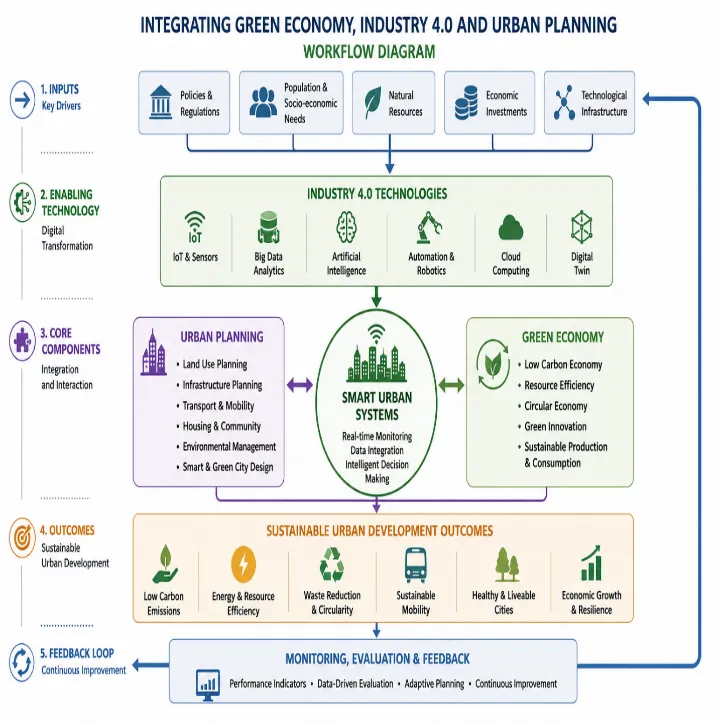
Soruce: Reserachers’ Conceptualisation (2026)
Fig. 1: Integrating Green Economy, Industry 4.0, and Urban Planning
7.1 Conceptual Linkages between the Variables in the Framework
The interactions among Industry 4.0, Green Economy, and Urban Planning can be understood through a systems-based approach where each component plays a distinct but interdependent role: Industry 4.0 as an Enabling Technology facilitate the transition to a Green Economy by improving resource efficiency, reducing wastes, and optimizing energy consumption. Smart sensors, real-time monitoring systems, and predictive analytics enable cities and industries to minimize environmental impacts while improving productivity. Urban Planning as a decision making process and as an Implementation Mechanism translates sustainability and technological innovations into spatial realities. This is achieve via smart zoning, transit-oriented development, green infrastructure development, and compact city design. Urban planners integrate Industry 4.0 outcomes into physical urban systems, hence supporting the objectives of Green Economy. Green Economy as a Sustainability Goal provides the normative foundation of the framework. It defines the desired outcomes of urban transformation, including decoupling of carbon emissions, circular resource use, sustainable consumption, and improved quality of life. It guides both technological deployment and spatial planning decisions.
7.2 Policy Implications
7.3 Mediating and Intervening Factors
The effectiveness of this integration is influenced by several mediating factors such as:
These factors determine the extent to which Industry 4.0 technologies and Green Economy principles are successfully embedded into urban planning systems.
CONCLUSION
Integrating Industry 4.0 tools into green economy planning for sustainable development most especially in low- and medium-income cities critically enhance environment quality and standard when properly deployed. It produces measurable gains in physical planning, governance trust, ecological recovery, household welfare and smart city development. The model demonstrates that digital technologies are not substitutes for governance but enablers of more responsive and inclusive decision-making with attention to inclusion and institutional capacity. Industry 4.0 without green constraints is acceleration without steering. Green economy without Industry 4.0 is ambition without instrumentation. The integrated model is intelligent in decarbonization using cyber-physical systems to make the invisible visible. Carbon flows, waste heat, embodied water, labour conditions, once measured in real time, they can be managed, once managed, they can be priced, once priced, markets is self-correct. City planning still assumes the city is hardware. Industry 4.0 treats it like software. Syncing them means designing cities that update, not just expand.
REFERENCES
Sub-Saharan African cities. thedocs.worldbank.org
Sub-Saharan African cities. thedocs.worldbank.org

Akue Leka Oscar1, Evangeline N. Anthony Le-ol2, Florence O. Gbarabe3*, Integrating Green Economy And Industry 4.0 In Urban Planning For Environmental Sustainability: Evidence And Pathways For Low And Middle-Income Cities., Int. J. Sci. R. Tech., 2026, 3 (8), 386-395. https://doi.org/10.5281/zenodo.21884489
 10.5281/zenodo.21884489