

We use cookies to ensure our website works properly and to personalise your experience. Cookies policy
Department of Chemistry, Surabhi Dayakar Rao College of Pharmacy, Rimmanaguda, Gajwel, Siddipet, Telangana-502312.
A simple, rapid, and reliable reverse-phase high-performance liquid chromatography (RP-HPLC) method was successfully developed for the simultaneous estimation of Clindamycin phosphate and Benzoyl peroxide in pharmaceutical dosage forms. Chromatographic separation was achieved using a Phenomenex ZorbaxC18-SB column with a mobile phase of phosphate buffer (pH 4.5) and acetonitrile (45:55 v/v) at a flow rate of 1.2 ml/min, resulting in well-resolved peaks with retention times of 2.923 min and 3.939 min, respectively. The method demonstrated satisfactory system suitability parameters, including acceptable tailing factors and theoretical plate counts. Validation studies confirmed excellent linearity with correlation coefficients greater than 0.999 for both drugs. Precision and intermediate precision studies showed %RSD values within acceptable limits, while accuracy studies indicated mean recoveries close to 100%. Sensitivity was established through low LOD and LOQ values, and robustness studies confirmed the reliability of the method under slight variations in chromatographic conditions. Overall, the validated RP-HPLC method proved precise, accurate, sensitive, and robust, making it suitable for routine quality control analysis of Clindamycin phosphate and Benzoyl peroxide in bulk and pharmaceutical formulations.
Pharmaceutical analysis ensures drug safety, efficacy, and quality throughout development using advanced techniques like High-Performance Liquid Chromatography (HPLC)1,2,3. Reverse Phase HPLC (RP-HPLC) is widely used to analyze pharmaceutical combinations, such as the acne treatment Clindamycin and Benzoyl Peroxide4,5. Simultaneous estimation of these drugs improves laboratory efficiency and reduces analysis time and solvent consumption6. However, this requires careful method development to manage challenges in polarity differences, analyte instability, and potential excipient interference7. The process involves optimizing chromatographic parameters to achieve well-resolved peaks with high reproducibility. This literature review reveals that Mandava et al8 reported developed and validated an RP-HPLC method for simultaneous estimation of Clindamycin, Metronidazole, and Clotrimazole. The method used a C18 column with a flow rate of 1 mL/min and detection at 238 nm. The drugs were separated within 5 minutes, and the method showed good accuracy and precision with Flow rate is1ml/min and Run time is 5 min. Chemically Clindamycin is 7-chloro-6,7,8-trideoxy-6-{[4-(methylsulfonyl) phenyl] amino}-1-thio-L-threo-α-D-galacto-octopyranoside 9,10 having Antibiotic property and Benzyl peroxide is used as topical retinoid.
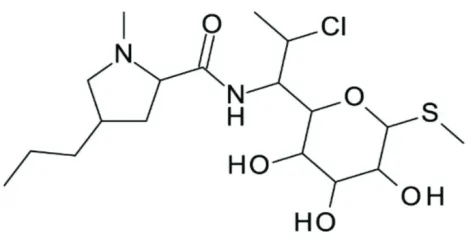
Figure 1: Structure of clindamycin
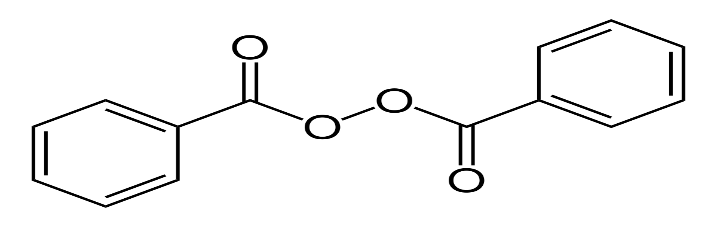
Figure 2 : Structure of Benzyl Peroxide
MATERIALS AND METHODS:
HPLC grade acetonitrile (Qualigens) and methanol (Rankem) were used in this study, and HPLC was used with auto sampler and PDA detector during the process.
Optimized Method conditions:
Instrument used : HPLC equipped with auto sampler and PDA detector
Temperature : Ambient
Column : Phenomenex Zorbax C18-SB, (150×4.6mm, 3mm)
Buffer : Phosphate buffer (pH-4.5)
Mobile phase : 45% Phosphate buffer: 55% ACN
Flow rate : 1.2 ml per min
Wavelength : 220 nm
Injection volume : 10 ml
Run time : 8 min.
Method Validation: Method validation is performed according to guidelines such as those provided by ICH.
Precision: The precision of an analytical procedure expresses the closeness of agreement (degree of scatter) between a series of measurements obtained from multiple sampling of the same homogeneous sample under the prescribed conditions. Precision may be considered at three levels; repeatability, intermediate precision and reproducibility.
Accuracy: The accuracy of an analytical procedure expresses the closeness of agreement between the value which is accepted either as a conventional true value or an accepted reference value and the value found.
Assay:
Standard Solution Preparation: Accurately weigh and transfer 4mg of Clindamycin phosphate and 20mg Benzoyl peroxide working standard into a 20ml clean dry volumetric flask add Diluents and sonicate to dissolve it completely and make volume up to the mark with the same solvent. (Stock solution), Further pipette 0.6ml of the above stock solution into a 10ml volumetric flask and dilute up to the mark with Diluents (12ppm Clindamycin phosphate &6 0ppm Benzoyl peroxide).
Linearity: A stock solution was prepared by accurately weighing 4 mg of Clindamycin phosphate and 20 mg of Benzoyl peroxide into a 20 mL volumetric flask, dissolving with diluent, and making up the volume to the mark. For linearity studies, 0.2, 0.4, 0.6, 0.8, and 1.0 mL aliquots of the stock solution were transferred separately into 10 mL volumetric flasks and diluted to volume with diluent to obtain concentrations of 4, 8, 12, 16, and 20 ppm of Clindamycin phosphate and 20, 40, 60, 80, and 100 ppm of Benzoyl peroxide, respectively.
RESULTS AND DISCUSSION:
Optimized chromatographic conditions:
The optimized HPLC method used a flow rate of 1.2 ml/min, injection volume of 10µL and run time of 8 min . The analysis was performed using and HPLC system equipped with an auto sampler and PDA detector.
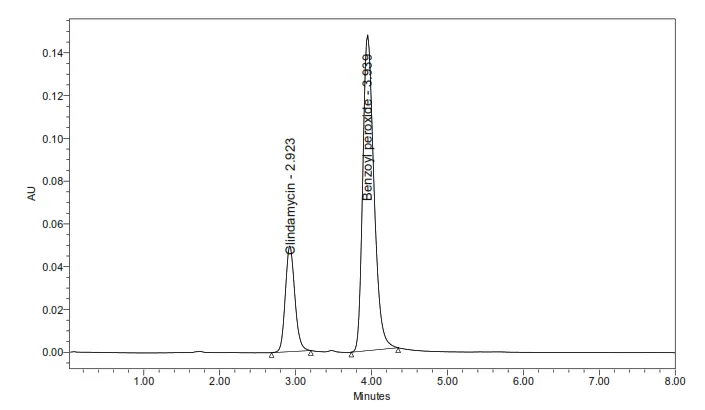
Figure 3: Optimized method chromatogram for Clindamycin and Benzyl peroxide
System Suitability: Tailing factor for the peaks due to Clindamycin and Benzoyl phosphate in Standard solution should not be more than 2.0, Theoretical plates for the Clindamycin and Benzoyl phosphate peaks in Standard solution should not be less than 2000
|
S.No |
Name |
RT(min) |
Area (µVsec) |
Height(µV) |
Resolution |
USP tailing |
USP Plate count |
|
1 |
Clindamycin |
2.923 |
5487 |
298 |
5.2 |
1.02 |
3645 |
|
2. |
Benzoyl phosphate |
3.939 |
32145 |
4754 |
0.24 |
5428 |
Table 1: Results of system suitability parameters
Validation Parameters:
Assay:
|
S.No |
Solution
|
Drug |
RT (min) |
Area (µ Vsec) |
Height (µV) |
Resolution |
USP tailing |
USP plate count |
|
1 |
Standard |
Clindamycin phosphate |
2.923 |
5531 |
13536 |
5.4
|
1.52 |
2080 |
|
Benzoyl peroxide |
3.939 |
35983 |
18461 |
1.08 |
5023 |
|||
|
2 |
Sample |
Clindamycin phosphate |
2.919 |
5485 |
13568 |
5.3
|
1.45 |
3096 |
|
Benzoyl peroxide |
3.939 |
35521 |
18483 |
1.09 |
4862 |
Table 2: Chromatogram for standard and Sample
Linearity:
|
S.no. |
Clindamycin phosphate |
Benzyl peroxide |
||
|
Concentration (µg/ml) |
Peak Area |
Concentration (µg/ml) |
Peak Area |
|
|
1 |
4 |
1826 |
20 |
10765 |
|
2 |
8 |
3648 |
40 |
22485 |
|
3 |
12 |
5372 |
60 |
33169 |
|
4 |
16 |
7392 |
80 |
42863 |
|
5 |
20 |
9175 |
100 |
53548 |
Table 3 : Area of different concentration of clindamycin phosphate and benzyl peroxide
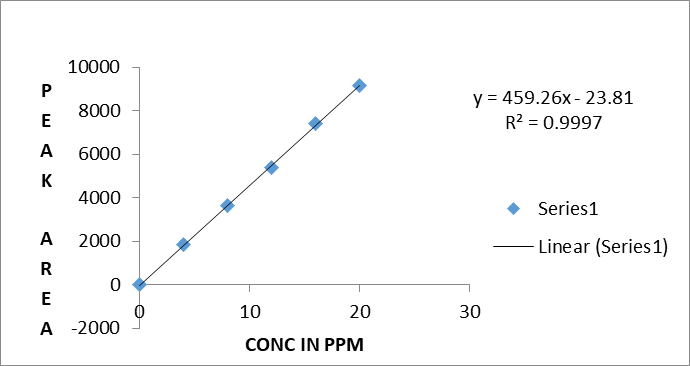
Figure 4: Calibration graph for Clindamycin phosphate
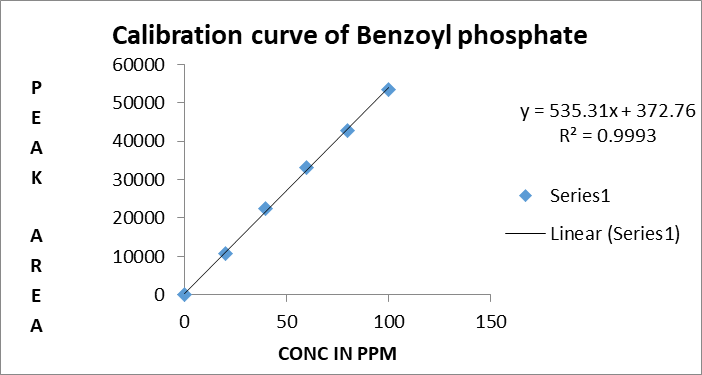
Figure 5: Calibration graph for Benzyl peroxide
Precision:
|
Injection |
Clindamycin phosphate Peak Area |
Benzyl peroxide peak Area |
|
Injection-1 |
5493 |
34063 |
|
Injection-2 |
5445 |
34742 |
|
Injection-3 |
5458 |
34523 |
|
Injection-4 |
5466 |
34450 |
|
Injection-5 |
5420 |
34012 |
|
Injection-6 |
5414 |
34167 |
|
Average |
5449.333 |
34326.17 |
|
Standard Deviation |
29.62206 |
289.9265 |
|
%RSD |
0.5 |
0.8 |
Table 4 : Results of Precision for Clindamycin phosphate and Benzyl peroxide
Intermediate precision:
|
Injection |
Clindamycin phosphate Peak Area |
Benzyl peroxide Peak Area |
|
Injection-1 |
5522 |
35301 |
|
Injection-2 |
5547 |
35053 |
|
Injection-3 |
5569 |
35682 |
|
Injection-4 |
5535 |
35123 |
|
Injection-5 |
5525 |
35965 |
|
Injection-6 |
5530 |
35463 |
|
Average |
5538 |
35431.17 |
|
Standard Deviation |
17.54993 |
347.5137 |
|
%RSD |
0.3 |
1.0 |
Table 5 : Results of Intermediate precision for Clindamycin phosphate and Benzyl peroxide
Accuracy:
|
Drug |
% Conc (at specification Level) |
Peak area |
Amount Added (mg) |
Amount Found (mg) |
% Recovery |
Mean Recovery |
|
Clindamycin phosphate |
50% |
2745 |
2 |
1.98 |
99.1 |
99.4 |
|
100% |
5531 |
4 |
3.6 |
99.0 |
||
|
150% |
8328 |
6 |
6.0 |
100.2 |
||
|
Benzyl peroxide |
50% |
18082 |
10 |
10.0 |
100.3 |
99.7 |
|
100% |
35752 |
20 |
19.8 |
99.2 |
||
|
150% |
53836 |
30 |
29.9 |
99.5 |
Table 6 : Accuracy (recovery) data for Clindamycin phosphate and Benzyl peroxide
LOD & LOQ:
|
Drug name
|
Baseline noise (µ V) |
Signal obtained (µV) |
S/N |
Concentration |
||||
|
LOD |
LOQ |
LOD |
LOQ |
LOD |
LOQ |
LOD |
LOQ |
|
|
Clindamycin phosphate |
68 |
68 |
197 |
662 |
2.90 |
9.74 |
0.50 µg/ml |
0.84 µg/ml |
|
Benzyl peroxide |
68 |
68 |
200 |
674 |
2.94 |
9.91 |
||
Table 7 : The results of LOD & LOQ of Clindamycin phosphate & Benzyl peroxide
CONCLUSION
The developed RP-HPLC method was validated as per ICH guidelines and proved to be precise, accurate, sensitive, and robust for the simultaneous estimation of Clindamycin phosphate and Benzoyl peroxide. The %RSD values for precision and intermediate precision were within acceptable limits, confirming reproducibility. Recovery studies indicated high accuracy with mean recoveries close to 100%. The LOD and LOQ values demonstrated the sensitivity of the method, while robustness studies confirmed its reliability under slight variations in chromatographic conditions. Therefore, the proposed method can be effectively applied for routine quality control analysis of these drugs in bulk and pharmaceutical formulations.
REFERENCES


M. Venkataramana*, P. Sri Anjali, D. Shivaparameshwari, M. Navya Sri, M. Sri Vidhya, Daraksha Anjum, Development And Validation Of RP HPLC Method For The Simultaneous Estimation Of Clindamycin Phosphate And Benzoyl Peroxide In Pure And Dosage Forms, Int. J. Sci. R. Tech., 2026, 3 (6), 1477-1483. https://doi.org/10.5281/zenodo.20845867
 10.5281/zenodo.20845867