

We use cookies to ensure our website works properly and to personalise your experience. Cookies policy
Department of Pharmaceutical chemistry, Shellino Education Society, Arunamai College of Pharmacy, Mamurabad, Jalgaon, Maharashtra 425002
A simple, Précised, Accurate method was developed for the estimation of Lasmiditan by RP-HPLC technique. Chromatographic conditions used are stationary phase Agilent ECLPDS X DB 4.6mm x 250 mm, 5m ,Mobile phase Methanol : 0.1% Acetic acid in the ratio of 70:30 and flow rate was maintained at 1ml/min, detection wave length was 266nm, column temperature was set to 300C and diluent was mobile phase Conditions were finalized as optimized method. System suitability parameters were studied by injecting the standard six times and results were well under the acceptance criteria. The method demonstrated excellent linearity in concentration ranges of 5-25 (?g/ml) for Lasmiditan with correlation coefficients (R2) 0.9999, confirming strong linearty.The regression equation obtained were Y= 137.9 X + 50.97 for Lasmiditan. The accuracy was studied through recovery studies and was found to be 99.41% to 100.74%.Method of precision showed %RSD value within acceptable limit (?2%),ensuring reproducibility. LOD and LOQ are 0.006µg/ml and 0.0017µg/ml respectively. By using above method assay of marketed formulation was carried out 100.23% was present. Robustness studies further confirmed method reliability under small variations in method parameters.
The common drug of choice for migraine include nonspecific analgesics, like NSAID and specific drug like triptains. Lasmiditans is the First and Only Medicine in New Class of Acute treatment for migraine1 that received FDA approved Approval in 20192.The triptans have the risk of life threatening cardiovascular side effects because of their activation of 5-HT1B receptor.3,4 The high risk associated with triptans can be overcome by Lasmiditan with a newer oral 5-Hydroxy tryptamine receptor agonist with high affinity for 5-HT1F and low affinity for 5 HT1B receptors.5,6Lasmiditans and gepants that have no vasoconstrictive properties could theoretically be used for the treatment of acute migraine attacks in patients with TIA or stroke. The symptomatic relief from migraine with or without aura can be attained from Lasmiditan, sold under the brand name MigditanTM.The drug is taken orally. Lasmiditan along with other nonspecific drug was found to be associated with significant pain reduction and mild adverse effects7 the side effects caused by Lasmiditan can be over weighed due to its effectiveness in treating Acute Migraine8.The main aim of present study is to estimation of Lasmiditan bulk drug by using simple and accurate RP-HPLC method.9-16
Figure No.1: Structure of Lasmiditan
Brand Name: MigditanTM 50
IUPAC Name: 2, 4, 6-Trifluoro-N-[6-[(1-methyl-4-piperidinyl)carbonyl]-2-pyridinyl]benzamide
Chemical Formula: C19H18F3N3O2
Molecular Weight: 377.367 g·mol−1
Method development for Lasmiditan refers to the scientific process of creating a standardized analytical technique, typically using a High Performance Liquid Chromatography (HPLC),to accurately measure the concentration of Lasmiditan in pharmaceutical sample like a tablets or solution, by optimizing parameters like mobile phase composition, column selection, detection of wavelength to ensure the reliable and precise quantification of the drug within a given formulation. Validation of Lasmiditan refers to the process of developing and testing of method to measure and quantify Lasmiditan.
Materials and Methods:
Lasmiditan (API), Lasmiditan tablets (MigditanTM 50), Methanol, 0.1% Acetic acid, Distilled water. All of solvents and chemicals were of HPLC quality grade.
Instrumentation:
The analysis of the drug was carried out on Agilent Gradient System with auto injector DAD Detector, Software chemstation, Analytical weighing Balance, Ultrasonicator.
Chromatographic Condition:
An Isocratic Elution carried out by using Methanol: 0.1% Acetic acid (70:30) v/v as the mobile phase. Equipped with Reverse Phase (Agilent) C18 column (4.6mm x 100mm; 2.5µm) and UV730D Absorbance detector and running chemstation. Column was used to determine the method at a flow rate 1ml/min by maintain the column temperature 300C.In addition, with an injection volume 20µL and the wavelength detected by 266nm.
API Formulation :( STOCK I)
Preparation of standard stock solution and working solution:
Accurately weighed 5 mg of Lasmiditan and transferred to 10mL volumetric flask.3/4 th of diluents Methanol: 0.1% Acetic acid (7:3) was added to the flask and sonicated for 15 minutes. Flasks were made up of with methanol mark upto 10mL volumetric flask and label them as a Standard stock solution of Lasmiditan (500 µg/ml of Lasmiditan).Moreover from this 0.1 ml from stock solution was pipette out, taken into 10mL volumetric flask and ,made up with Mobile Phase to make 5 µg/ml of Lasmiditan.
Sample Formulation: (STOCK II)
Preparation of Sample stock solution and working solution:
20 tablets were weighed and average weight of each tablet was calculated, then the weight equivalent to 5 tablets transferred into 10 mL volumetric flask. Add 10 ml of methanol and sonicate to dissolve completely upto the mark with diluents.futher the volume was made up with diluent and filter by HPLC filter to make 1000 µg/ml of Lasmiditan solution. From this 0.2 ml of filtered sample stock solution was transferred to 10 ml volumetric flask and made up with mobile phase to make 10 µg/ml of Lasmiditan.
Method Validation:
The established technique is validated in accordance with ICH criteria for the purpose of validation analytical methods. The validation matrics were: Linearity, Accuracy, Precision, limit of detection (LOD), limit of quantification (LOQ), Repeatability and robustness.
Linearity:
Linearity was conducted by preparing different standard solutions of Lasmiditan at different concentration levels. The standard solutions were prepared in the concentration range of 5-25µg/ml of Lasmiditan. Each concentration was injected into the HPLC system and record the areas obtained. Plot a graph between area taken on Y-axis and concentration on X-axis. Diluents were preparation as:
Accuracy:
Recovery studies were performed to calculate the accuracy of developed method to preanalysed sample solution, a definite concentration of standard drug (80%, 100%, and 120%) was added and then its recovery was analyzed.
Precision:
In this method precision was evaluated as system precision, method precision and intermediate precision. In system precision six replicate standard solutions of Lasmiditan were analyzed and %RSD was calculated. In method precision six preparations with sample were injected and %RSD, % recovery was calculated. The intraday and inter-day precision study was conducted for Lasmiditan.
Repeatability:
The repeatability was performed for six replicate at six concentrations in linearity Conc.20 µg/ml, precision under the same operating condition over short interval time. Repeatability studies Etoricoxib was found to be, the %RSD was less than 2, which shows high percentage amount found in between 99% to 100% indicates the analytical method that concluded.
LOD and LOQ:
LOD was measured by diluting the standard solution of Lasmiditan and determining the concentration was response of sample peaks are three times the noise peak. LOQ was measured by diluting the standard solution of Lasmiditan and determining the concentration was response of sample peaks are ten times the noise peak.


Where,
σ = the S.D. of the y-intercepts of regression lines.
S = the slope of the calibration curve.
The slope S may be estimated from the calibration curve and S.D. was used should be calculated from the y-intercepts of regression line in calibration curve.
Robustness:
Small deliberate change in method like Flow rate, Mobile phase ratio and temperature are made but there were no recognized change in the result and are within range as per ICH guidelines.
Assay:
Assay and % purity were calculated for brand MigditanTM 50 with label claim 50 gm observed value compared with that of standard value without interference from excipient used in tablet dosage form.
RESULT DISCUSSION:
Method development and Optimization
|
Parameter |
Condition |
|
Mobile phase |
Methanol : (0.1% )Acetic acid (70: 30% V/V) |
|
Flow rate |
1ml/min |
|
Analytical column |
Agilent C18 Column 100mm x 4.6mm, |
|
Detection of wavelength |
266nm |
|
Column Temperature |
300C |
|
Injection volume |
20µl |
|
Run Time |
7min |
Table No.1: Optimized condition
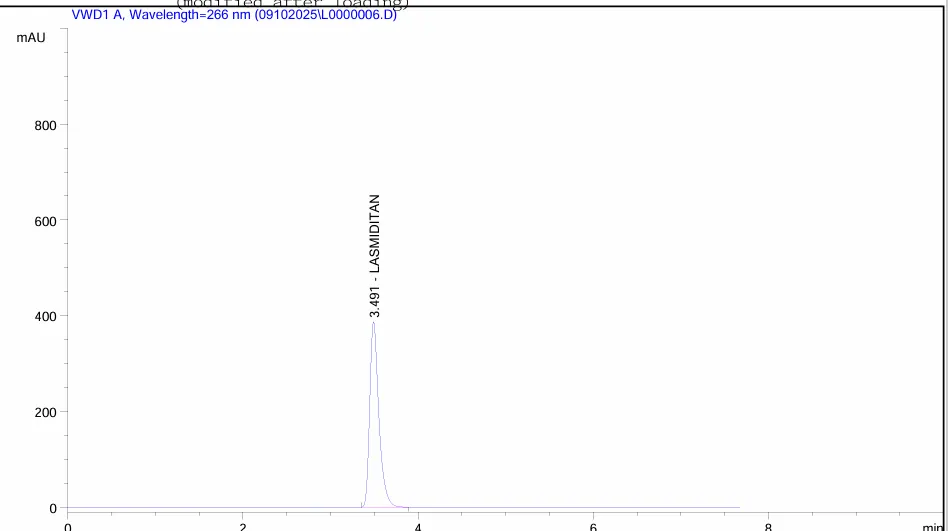
Figure No.2: Method development and optimization graph of Lasmiditan
Method Validation
Linearity-
Five concentration ranging 2-25 (μg/ml) were prepared and linearity were estimated in duplicate manner. The linearity equation for Lasmiditan was Y= 137.95 X + 50.846. For calibration curve over concentration range, and data has shown good correlation.
|
S. No |
Lasmiditan |
|
|
Concentration(μg/ml) |
Area |
|
|
Linearity-1 |
5 |
749.59 |
|
Linearity-2 |
10 |
1412.37 |
|
Linearity-3 |
15 |
2129.25 |
|
Linearity-4 |
20 |
2809.25 |
|
Linearity-5 |
25 |
3999.98 |
|
Slope |
137.9 |
|
|
Intercept |
50.97 |
|
|
C.C |
0.999 |
|
Table No.2: Linearity Data
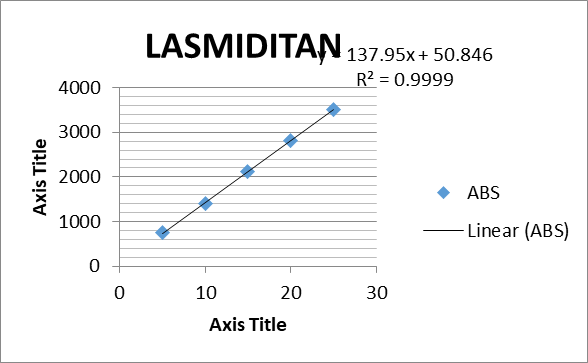
Figure No.3: Calibration Curve of Lasmiditan
Accuracy
Accuracy was determined by recovery studies which were carried out in three different concentration levels (80%, 100% and 120%). APIs with concentration 25, 50 and 75µg/ml of Lasmiditan were prepared. The percentage recovery values were found to be in the range of 98-102%.
|
Level of Recovery (%) |
Amount spiked((μg/ml) |
Amount recovered Mean (μg/ml) |
% Recovery |
SD |
% RSD |
|
80% |
8 |
7.95 |
99.37 |
0.06 |
0.06 |
|
100% |
10 |
10.07 |
100.76 |
0.02 |
0.02 |
|
120% |
12 |
11.88 |
99.00 |
0.04 |
0.04 |
Table No.3: Accuracy data
*mean of each 3 reading.
Precision
Precision of the method was established by injecting test preparation and tested through the complete analytical procedure from sample preparation to the final result.
|
Drug |
Conc (µg/ml) |
Intraday Precision |
Interday Precision |
||||
|
Mean± SD |
%Amt Found |
% RSD |
Mean± SD |
%Amt Found |
% RSD |
||
|
LSD |
10 |
1410.19±0.01 |
98.57 |
0.00 |
1241.65±0.45 |
86.34 |
0.04 |
|
15 |
2154.80±0.03 |
101.71 |
0.00 |
3641.12±0.28 |
173.56 |
0.01 |
|
|
20 |
2776.88±1.24 |
98.84 |
0.04 |
5934.25±0.57 |
213.32 |
0.01 |
|
Table No.4: Precision data
*Mean of each 3 reading
Repeatability:
Six replicates of a sample solution was anlaysed on a different day, different analyst and different RSD values.
|
Analyte |
Std. Concentration |
Mean |
%RSD |
|
Lasmiditan |
20 |
2797.42 |
0.02 |
Table No.5: Repeatability data
Robustness:
In robustness there is a small deviation in Wavelength and Mobile Phase (±10%) in their chromatographic condition and observed that there is no significant change in %RSD.
|
Parameters |
Level |
Conc. (µg/ml) |
Area of detected (mean ±SD) |
%RSD |
|
Change in Mobile-phase composition |
69:31 |
20 |
2746.2±5.69 |
0.21 |
|
71:29 |
20 |
2732.81±1.47 |
0.05 |
|
|
Wavelength change |
265nm |
20 |
2723.7±2.76 |
0.10 |
|
267nm |
20 |
2824.3±23.19 |
0.82 |
Table No.6: Robustness data
Limit of Detection and Limit of Quantification (LOD & LOQ)
The LOD concentrations of Lasmiditan were 0.006µg/ml and LOQ concentrations of Lasmiditan was 0.017µg/ml. Result of LOD and LOQ showed in table no 7.
|
Name |
LOD(μg/ml) |
LOQ(μg/ml) |
|
Lasmiditan |
0.006 |
0.017 |
Table No.7: LOD & LOQ data
Assay of Tablets:
The results of the analysis of synthetic mixture were reported. The assay value of drugs was close to 100, SD and % RSD are less than 2 indicate the no interference of excipient in the estimation of drug. Result of Assay of tablet showed in table no 8.
|
|
LSD* |
|
Label claim (mg) |
50 mg |
|
% found |
100 |
|
% Assay |
100.23 |
|
% RSD |
0.059 |
Table No.8: % Assay purity data
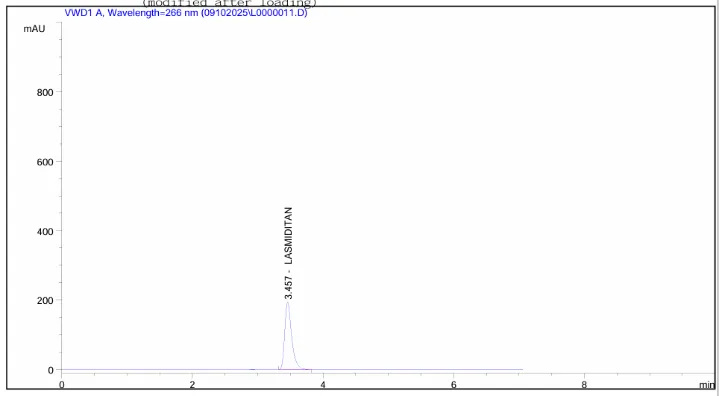
Figure No.4: Assay of Tablet (MigditanTM 50)
CONCLUSION
The proposed methods were found to be linear in the range of 5-25μg/ml with correlation coefficient close to one. Precision was determined by repeatability, Intermediate precision and reproducibility of the drugs. The robustness of developed method was checked by changing in the deliberate variation in solvent. The result obtained shows the developed methods to be Cost effective, Rapid (Short retention time), Simple, Accurate (the value of SD and %RSD less than 2), Precise and can be successfully employed in the routine. The Simplicity, Rapidly and Reproducibility of the proposed method completely fulfill the objective of this research work.
REFERENCES

K. R. Patil, K. L. Borole, S. A. Pawar, J. A. Bhangale, S. D. Barhate, Swapnal Prasad Joshi*, Hplc Method Development And Validation For The Estimation Of Lasmiditan Drug In Bulk And Tablet Dosage Form, Int. J. Sci. R. Tech., 2026, 3 (6), 1078-1085. https://doi.org/10.5281/zenodo.20741543
 10.5281/zenodo.20741543