

We use cookies to ensure our website works properly and to personalise your experience. Cookies policy
Computer Science and Engineering Department, BTIRT, Sagar, MP, India
Rolling element bearings are critical components of rotating machinery and are highly prone to degradation and failure during prolonged operation, making accurate Remaining Useful Life (RUL) prediction essential for predictive maintenance, reducing unexpected downtime, and improving system reliability and safety. In recent years, bearing prognostics has evolved from conventional machine learning methods toward advanced deep learning and hybrid physics-data-driven approaches. This review presents a comprehensive analysis of recent developments in bearing RUL prediction, with emphasis on vibration signal processing, health indicator construction, feature extraction, temporal degradation modeling, transfer learning, attention mechanisms, and physics-informed learning. Representative studies are compared based on bearing type, datasets, preprocessing and feature extraction methods, prediction architectures, and reported performance. Widely used datasets, including PRONOSTIA/FEMTO, XJTU-SY, PHM2012, CWRU, and IMS, are examined to highlight current research trends and validation practices. The review further discusses the transition from conventional techniques such as Support Vector Machines, Random Forest, and shallow neural networks to CNN-, LSTM-, BiLSTM-, Transformer-, graph-based, and hybrid models. Particular attention is given to approaches that improve the representation of degradation, capture temporal dependencies, handle varying operating conditions, and incorporate physical degradation information. Overall, hybrid deep learning and physics-data-driven methods demonstrate strong potential for improving RUL prediction accuracy, robustness, and generalization; however, challenges remain in data availability, cross-domain generalization, noise sensitivity, interpretability, computational cost, and real-time deployment.
Bearings are critical components of rotating machinery, supporting loads and enabling smooth operation in applications such as automotive, aerospace, wind energy, rail transport, and manufacturing. Because bearing degradation is a major cause of unexpected equipment failure and downtime, accurate Remaining Useful Life (RUL) prediction has become an important task within Prognostics and Health Management (PHM), particularly for predictive and condition-based maintenance [1]. Early prognostic methods mainly relied on physics-based models and signal-processing techniques, but their dependence on predefined degradation assumptions and operating conditions limited their adaptability. This led to the increasing adoption of data-driven approaches for learning complex and nonlinear degradation behavior.
Conventional machine learning methods, including Artificial Neural Networks (ANN), Support Vector Machines (SVM), Relevance Vector Machines (RVM), Random Forest (RF), and k-Nearest Neighbors (k-NN), have been applied to bearing diagnosis and RUL prediction [2]. Although these methods can model nonlinear relationships between monitoring features and degradation, they generally depend on handcrafted features and appropriate preprocessing. Deep learning has consequently gained greater attention because of its ability to automatically learn representative features from vibration signals. CNNs are effective in extracting local patterns, while LSTM, GRU, and BiLSTM networks are suitable for modeling temporal dependencies in degradation sequences [3]. Deep learning has also demonstrated promising performance in bearing RUL prediction by reducing the reliance on manually designed prognostic features.
Recent research has shifted toward hybrid architectures that combine convolutional, recurrent, attention-based, transformer, and time-frequency learning mechanisms. Such combinations aim to capture complementary spatial and temporal information and improve the representation of complex degradation patterns [4]. Attention- and transformer-based models further enhance the ability to focus on important degradation characteristics, while transfer learning and physics-informed approaches have been investigated to address limited data and changing operating conditions [5]. The detailed characteristics, datasets, methodologies, and reported results of representative studies are summarized in the comparative table presented in this review.
Despite substantial progress, reliable bearing RUL prediction remains challenging due to noisy, non-stationary vibration signals, limited run-to-failure data, varying operating conditions, cross-domain differences, uncertainty, and computational constraints. Therefore, this review systematically examines recent developments in bearing RUL prediction, covering datasets, preprocessing and feature extraction, health indicator construction, machine learning and deep learning architectures, hybrid approaches, and reported performance. Particular attention is given to the evolution of prognostic methods and the strategies used to improve accuracy, robustness, generalization, and practical applicability. Finally, current research gaps and future directions toward accurate, interpretable, lightweight, and deployable bearing prognostic systems are discussed.
2. METHODOLOGY: -
As shown in Fig. 1, bearing RUL prediction typically involves six main stages: data acquisition and preprocessing, signal processing, feature extraction or health indicator construction, feature selection or representation learning, model development, and RUL prediction and evaluation. These stages convert raw monitoring signals into useful degradation information, which is then used by machine learning, deep learning, or hybrid models to estimate the remaining useful life and assess prediction performance
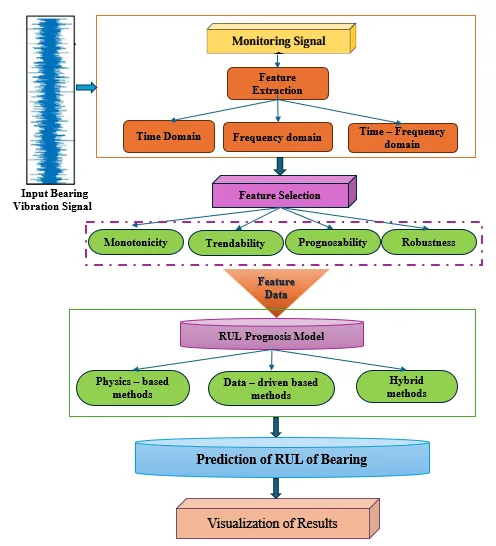
Fig. 1. RUL prediction Model
3. Benchmark Datasets for Bearing RUL Prediction
Several public run-to-failure datasets are widely used to evaluate bearing RUL prediction methods. The FEMTO/PRONOSTIA (IEEE PHM 2012) dataset contains vibration data from 17 rolling bearings operated under three conditions, with signals sampled at 25.6 kHz. It is widely used for benchmarking degradation modeling and RUL prediction. The XJTU-SY dataset contains complete degradation data from 15 bearings under three operating conditions and is particularly useful for evaluating model robustness under varying loads and speeds. The IMS dataset, developed by the University of Cincinnati, provides accelerated run-to-failure vibration data from rolling bearings and is commonly used for degradation analysis and RUL estimation. Together, these datasets provide complementary test conditions for assessing the accuracy, robustness, and generalization of bearing prognostic models [6].
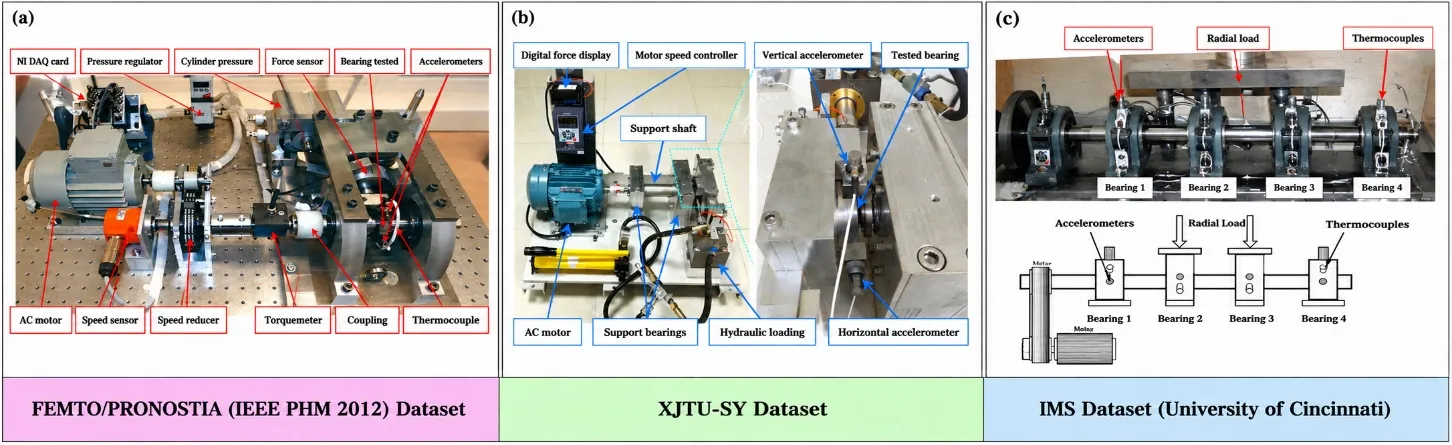
Fig. 2. Bearing test rigs [6] : (a) FEMTO/PRONOSTIA, (b) XJTU-SY, and (c) IMS datasets.
4. Comparative Analysis of Bearing RUL Prediction Methods
Table 1 provides a brief comparison of representative studies on bearing and other prognostic applications. It covers the datasets used, preprocessing and feature extraction methods, prediction models, and the main results reported by each study. The comparison shows how bearing RUL prediction has gradually shifted from traditional machine learning to deep learning and more advanced hybrid approaches that incorporate attention, Transformers, transfer learning, and physics-based information. It also highlights the commonly used benchmark datasets and the different strategies adopted to improve prediction accuracy and robustness. These comparisons help identify the current progress, limitations, and research gaps in bearing RUL prediction.
|
Author |
Bearing Type |
Dataset |
Preprocessing / Feature Extraction |
Methodology |
Outcome |
|
Magadán et al. (2024) [7] |
Rolling bearing |
Multiple bearing RUL datasets under different operating conditions |
Raw/processed bearing degradation data used for deep feature learning and robust cross-condition prediction. |
Deep learning-based bearing RUL prediction framework designed for robust prediction across datasets and operating conditions. |
Achieved robust bearing RUL prediction across different datasets and operating conditions without requiring model retraining or fine-tuning. Exact numerical values were not available in the supplied information. |
|
Zhang et al. (2024) [8] |
Rolling bearing |
PHM2012 and ABLT-1A datasets |
Autoencoder-based feature extraction; unsupervised anomaly detection for degradation-start identification. |
Two-stage framework: anomaly detection followed by Spatiotemporal Attention (STA) and BiLSTM for RUL prediction. |
On ABLT-1A, RMSE reduced by 23.8%, 16.9%, 22.8%, and 14.7%; MAE reduced by 63.7%, 55.7%, 62.5%, and 47.7%; R² increased by 4.7%, 3.4%, 4.5%, and 2.4% versus LSTM, RNN, GRU, and DCNN, respectively. |
|
Cen et al. (2024) [9] |
Machinery components including bearings |
C-MAPSS and XJTU-SY |
Feature-Sequence Dimension Attention and Multi-Source Information Fusion. |
MFSSCINet with multi-dimensional attention and feature-sequence convolution/interaction. |
Higher RUL prediction accuracy than other advanced computational methods. |
|
Saeed et al. (2025) [10] |
Rolling bearing |
FEMTO/PRONOSTIA; validated on CWRU |
Modified Multiscale Permutation Entropy (MMPE) used to construct a Health Indicator. |
MMPE-based Health Indicator combined with a regression Transformer. |
MSE = 3.6 × 10â»â¶ and RMSE = 5.48 × 10⻳; strong cross-dataset generalization. |
|
Zhu et al. (2024) [11] |
Machinery systems / bearings |
Experimental datasets |
Series Odd-Even Decomposition (SOED) and supervised contrastive regression loss (SupCR). |
Contrastive BiLSTM-enabled Health Representation Learning (CBHRL). |
Health representations improved by 17.19% to 291.30% in monotonicity, smoothness, and trendability. |
|
Yu et al. (2025) [12] |
Aircraft engine |
C-MAPSS FD001, FD002, and FD003 |
Sensor fusion to construct Health Index; joint sensor signals used as input. |
Parallel CNN–BiLSTM with ECA and multi-head attention. |
RMSE reductions of 0.95%, 2.03%, and 1.36%; Score reductions of 2.53%, 54.89%, and 20.59% on FD001–FD003, respectively. |
|
Rathore and Harsha (2024) [13] |
Rolling bearing |
IEEE PHM bearing datasets |
1D-CNN, stacked BiLSTM, attention, and domain-invariant feature extraction. |
TSBiLSTM with MK-MMD and domain-confusion layer for unsupervised transfer learning. |
Promising RUL prediction under dynamic operating conditions; exact numerical values not supplied. |
|
Song et al. (2024) [14] |
Bearing |
Review of multiple datasets and studies |
Reviews signal processing, feature extraction, and health indicators. |
Comprehensive review of traditional, ML, DL, and hybrid RUL methods. |
Comprehensive overview of advances, challenges, and future directions; no single numerical result. |
|
Yao et al. (2021) [15] |
Roller bearing |
XJTU-SY |
1D-CNN automatic feature extraction; global maximum pooling replaces fully connected layer. |
Improved 1D-CNN combined with parallel-input SRU. |
Maintained prediction accuracy while reducing manual intervention and time cost. |
|
Hassan et al. (2026) [16] |
Self-aligning double-row ball bearing |
University of Ferrara E1–E6; external PHM benchmark |
Standardization, RMS-based HI, gradient-based onset detection, and STFT spectrograms. |
Onset-aware transfer-learning regression using DenseNet-201, Xception, and ResNet-18. |
Average absolute RUL errors: 2.7% (DenseNet-201), 2.9% (Xception), 4.2% (ResNet-18). Onset-aware training reduced MAE by 94%; PHM transfer reduced MAE from 30.8 to 20.1. |
|
Ben Ali et al. (2015) [17] |
Rolling element bearing |
Experimental vibration run-to-failure bearing dataset |
Vibration measurements; Weibull fitting reduces fluctuations; smoothing for optimal prediction. |
SFAM neural network combined with Weibull distribution; seven health/degradation states. |
Reliable RUL prediction through nonlinear degradation learning and reduced fluctuations; exact numerical metrics not supplied. |
|
Ren et al. (2017) [18] |
Rolling bearing |
Real multi-bearing vibration dataset |
Three time-domain features and one novel frequency-domain feature. |
Deep neural network for multi-bearing collaborative RUL prediction. |
Superior to commonly used shallow prediction methods; exact numerical values not supplied. |
|
Deutsch and He (2018) [19] |
Rotating components (gears and bearings) |
Gear test-rig and bearing run-to-failure datasets |
Automatic hierarchical feature learning from PHM big data. |
Deep learning-based framework for degradation feature learning and RUL prediction. |
Promising RUL prediction performance compared with existing PHM methods; exact numerical values not supplied. |
|
Li and Jian (2024) [20] |
Wind turbine main bearing |
Historical vibration data from offshore wind turbines |
Sideband Energy Ratio (SER) features and exponential degradation fitting. |
Tree Seed Algorithm-optimized LSTM (TSA-LSTM). |
MAPE < 0.228 and RMSE < 0.014; SER improved early-fault sensitivity and degradation fitting. |
|
Zhao et al. (2025) [21] |
Rolling bearing |
Two publicly available bearing RUL datasets |
Dynamic differentiable wavelet decomposition, dual-channel enhancement, and frequency-domain gated filtering. |
Dynamic wavelet + Bidirectional Adaptive GCN + dual-constrained physics-information loss. |
Improved stability and accuracy through adaptive multi-scale extraction and physics-informed constraints; exact numerical values not supplied. |
|
He et al. (2025) [22] |
Rolling bearing with outer-ring defect |
Experimental full-life-cycle bearing degradation data |
Defect evolution modeling, multi-objective optimization, and BiLSTM mapping of vibration features to twin defects. |
Two-stage updated Digital Twin + Dual-Correlation Dynamic GCN (DC-DGCN). |
Improved accuracy and reliability by incorporating real-time health states and physical/digital feature correlations; exact numerical values not supplied. |
|
Wang et al. (2025) [23] |
Rolling bearing |
PHM2012 |
1D-DCAE extracts high-quality Health Indicators; self-labelled degradation data used for prediction. |
1D-DCAE + multilevel BiLSTM + Temporal Pattern Attention. |
Improved accuracy and robustness versus traditional labelling methods; strong generalizability and transferability. |
|
Sun et al. (2025) [24] |
Rolling bearing |
PHM2012 |
FFT frequency-domain conversion followed by CNN feature extraction. |
CBAM-CNN-LSTM with channel/spatial attention and temporal modeling. |
MSE reduced by 53%, MAE by 16.87%, and RMSE by 31.68% compared with existing methods. |
|
Wang et al. (2026) [25] |
Rolling bearing |
XJTU-SY and self-built bearing degradation dataset |
Defect-size quantification via failure dynamics and dual-objective matching; time-frequency features. |
Physics data hybrid online RUL framework with multi-scale deep synergistic network and monotonicity-constrained physics loss. |
Significantly outperformed mainstream models in prediction accuracy and improved robustness and interpretability; exact numerical values not supplied. |
|
Dhungana et al. (2026) [26] |
Rolling bearing |
PRONOSTIA and XJTU-SY |
Wavelet packet energy features fused with entropy-based statistical descriptors from multi-level decomposition. |
Wavelet feature fusion followed by LSTM for fault propagation and RUL prediction. |
Superior performance versus existing methods; improved degradation characterization and prediction accuracy; exact numerical values not supplied. |
|
Wang et al. (2026) [27] |
Rolling bearing |
Two publicly available rolling bearing datasets |
CEEMDAN decomposition; multi-domain features; KPCA retaining 85% cumulative variance; PC1 and 3δ rule for onset detection. |
Two-stage CEEMDAN–KPCA + dual-branch BiLSTM–Transformer. |
MAE and RMSE reduced by approximately 10%–30%; robust generalization across operating environments. |
|
Wan et al. (2026) [28] |
Rolling bearing |
Bearing vibration data under varying operating conditions |
Time-domain and frequency-domain analysis for degradation characterization. |
Hybrid CNN–BiLSTM–BiGRU–TCN framework for spatial, bidirectional temporal, and long-range dependency learning. |
Significantly improved accuracy and reliability versus RNN, SVM, and LSTM; robust across varying conditions without manual feature engineering. |
Table 1. Comparative Summary of Bearing and Related Prognostic Studies
CONCLUSION
This review has discussed the recent progress in bearing Remaining Useful Life (RUL) prediction, from conventional machine learning techniques to advanced deep learning and hybrid approaches. Recent studies show that CNN, LSTM, BiLSTM, attention, Transformer, and physics-based models can learn degradation patterns more effectively and improve RUL estimation. Datasets such as FEMTO/PRONOSTIA, XJTU-SY, and IMS remain widely used for evaluating these methods. However, practical deployment remains challenging due to limited failure data, changing operating conditions, dataset differences, limited model interpretability, and computational requirements. Future research should focus on models that are not only accurate but also lightweight, explainable, and reliable across different machines and operating conditions. Greater attention to real-world validation and online prediction will also be important for bringing these methods closer to practical industrial use.
CONFLICT OF INTEREST
The authors declare that they have no known competing financial interests or personal relationships that could have influenced the work reported in this study.
DECLARATION OF GENERATIVE AI AND AI-ASSISTED TECHNOLOGIES
Generative AI tools were used to assist with language refinement, organization, and
REFERENCES



Urvashi Singh Jadaun*, Shailendra Kumar Shriwastava, Poonam Bhartiya, Recent Advances In Bearing Remaining Useful Life Prediction: A Review Of Machine Learning And Deep Learning Approaches, Int. J. Sci. R. Tech., 2026, 3 (9), 234-242. https://doi.org/10.5281/zenodo.22670819
 10.5281/zenodo.22670819