

We use cookies to ensure our website works properly and to personalise your experience. Cookies policy
1Department of Pharmaceutics, AAEMF’S Delight College of Pharmacy, Koregaon Bhima, Tahsil-Shirur, District-Pune, Maharashtra, India - 412216.
2Department of Pharmacognosy, AAEMF’S Delight College of Pharmacy, Koregaon Bhima, Pune, Maharashtra, India - 412216.
Pulmonary drug delivery systems (PDDS) utilize the lungs' large surface area and rich vascularity for managing the respiratory illnesses and systemic conditions. Therapeutic advantage of the (PDDS) include rapid action, bypass the first-pass metabolism, and reduces systemic side effects. Bypassing first-pass metabolism through the lungs significantly increases bioavailability. In recent years, the development of nanoparticles for pulmonary drug delivery receives increasing scientific interest due to their potential in improving the efficacy and safety of therapeutic approaches. The exclusive properties of nanoparticles facilitate for targeted delivery, controlled release, and improved drug bioavailability inside the lungs Solid lipid nanoparticles (SLNs) are innovative colloidal drug carriers encompasses of a biocompatible lipid core maintain stability with surfactants, design to improve drug stability., SLNs provide advantage such as improved bioavailability, protection of unstable drugs, reduces systemic side effects, and compatibility with both hydrophilic and lipophilic agents. This advance Pulmonary drug delivery method offers a number of benefits to treat lung disorders due to their potential therapeutic benefits in the area of pulmonary disease.
Pulmonary disease or lung disease constitutes diseases or disorders that affect the lungs and its associated structures in breathing effectively. It may be caused due to bacterial, viral, or fungal infections or may be due to environmental factors. Respiratory disease is a major health problem in India. Pulmonary drug delivery involves the administration by inhalation of drugs orally or nasally and can be used for local and systemic action. They have a profound advantage in that the drug reaches directly to the systemic circulation and hence achieves higher bioavailability. It provides an effective non-invasive method [1]. Pulmonary drug delivery gives the various benefits such as, rapid onset of action, lower drug doses, targeted lung delivery, and reduced systemic side effects, high surface area with rapid absorption due to high vascularization and circumvention of the first pass effect [4] compared with oral or parenteral routes [2]. DPIs is the recommend medical device for the treatment of a wide range of respiratory disorders. With the development of technology in the last two decades, the particle size of materials ranges from the micro- to nano-scale. The reduction in the particle size of materials at the nanometer scale increases their overall surface area by several orders of magnitude. Particles having a size in the range of 1 nm to 1000 nm are known as nanoparticles. The word “nano” can be easily defined, but it covers numerous areas of application [3]. Several nano-based systems made up of various materials that can be used as nanocarriers. Some of the important Drug Delivery System developed using Nanotechnology principles are Nanoparticles, Solid Lipid Nanoparticles, Nanosuspension, Nanoemulsion, Nanocrystals. SLNs introduced in 1991 by Muller and Gasco represent an alternative andbetter carrier system to traditional colloidal carriers such as emulsions, liposomes and polymeric micro and nanoparticles [5].
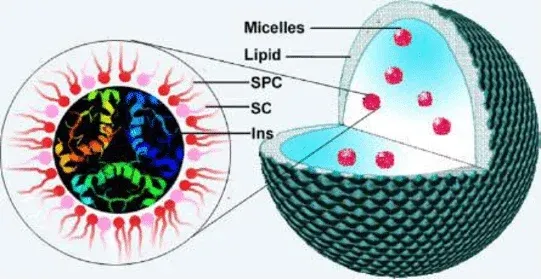
Figure None: 1 Structure of Solid Lipid Nanoparticles [7]
Compared to liposomes, SLNs have the more physical stability and it prevent issues related to breakdown of phospholipid. SLNs are composed of biocompatible and biodegradable lipids, enhanced their safety and more acceptable to the clinical approaches. Additionally, SLNs Prevent labile drugs from enzymatic and chemical breakdown, allow for controlled drug release [8]. inhaled solid lipid nanoparticles (SLNs) can extend drug release to maintain a constant concentration at the infection site [9]. Compared to oral and intravenous administration, pulmonary drug delivery has the advantages of local lung targeting, high local drug concentration and rapid onset of action, low systemic distribution and toxicity, avoided degradation in the gastrointestinal tract [10]. Nanoparticle mediated drug delivery systems are a new perspective by optimize the physical properties of the particles, such as increasing the drug solubility, drug loading efficiency and surface alterations to improve the drug release profiles and to achieve a maximum effect [4].
OVERVIEW OF SOLID LIPID NANOPARTICLES:
The term Nanoparticles is defined as the particles having a size between 1 nm and 1000 nm. Although the term "nano" is simple to define it has a wide range of applications [6]. Solid lipid nanoparticles (SLNs) are innovative colloidal drug carriers consisting of a biocompatible lipid core stabilized with surfactants, developed to enhance drug stability, and controlled release in topical applications. Compared with the traditional dosage forms, SLNs provide benefits such as improved bioavailability, prevention to the unstable drugs, reduces systemic side effects, and compatibility with both hydrophilic and lipophilic agents [12]. The interesting thing about SLNs is that they can transport a wide range of treatments. They are able to load both hydrophilic and lipophilic medicines among the small drug molecules. Solid lipid nanoparticles (SLNs) are colloidal carriers composed of a solid lipid matrix that encapsulates drug molecules, surrounded by a surfactant layer to maintain stability in aqueous media [6]. The formulation of solid lipid nanoparticles (SLNs) includes a combination of lipids, surfactants, co-surfactants, and sometimes co-solvents. Each of these components plays an important role in determining the stability, size, drug loading efficiency, and release profile of the nanoparticles. An attentively selected composition is essential to optimize the therapeutic potential of SLNs [8].
Table None: 1: Compositions of the Solid Lipid Nanoparticles:
| Component | Example | Function |
|---|---|---|
| Solid lipid | Glyceryl monostearate 2) Stearic acid 3) Tristearin 4)Cetyl palmitate |
Forms the solid lipid matrix and holds the drug. |
| Drug/Active pharmaceutical ingredient (API) | Budesonide Antibiotics 3)Antifungal drugs |
Produces the desired therapeutic effect |
| Surfactant / stabilizer | Poloxamer 188 Tween 80 Lecithin |
Stabilizes the nanoparticles and prevents aggregation |
| Aqueous phase | Purified water | Acts as the dispersion medium for the nanoparticles. |
| Co-surfactant (optional) | Sodium glycocholate or other suitable stabilizers | Improves particle stabilization and formulation properties. |
When the drug is uniformly distributed within the lipid matrix, a slower and more controlled release can be achieved. There are 3 drug incorporation models which describe drug release from SLN [12].
1) Homogenous matrix model
2) Drud enriched shell with lipid core
3) Drug enriched core with lipid shell
Drug encapsulation method is the process of incorporating the drug is uniformly dispersed throughout the lipid matrix. This usually occurs when the drug is soluble in the melted lipid during preparation or precipitates simultaneously with the lipid during cooling. The homogeneous matrix model is often achieved through high-pressure homogenization or solvent emulsification methods. This configuration provides a sustained drug release as the matrix erodes or degrades gradually, releasing the drug consistently over time. It is particularly suitable for low-dose, hydrophobic drugs that require prolonged therapeutic action [8]. Drug release from SLNs occurs through the initial release of surface-associated drug, followed by diffusion through the solid lipid matrix and degradation of the lipid, resulting in immediate or sustained drug release.
Advantages of solid lipid nanoparticles:
1)Solid lipid nanoparticles have better stability compared to liposomes
2) It improves the bioavailability of entrapped bioactive and chemical production of
Labile incorporated compound.
3) Easy to scale up and sterilize.
4) Better control over release kinetics of encapsulated compounds.
5) Enhanced bioavailability of entrapped bioactive compounds.
6) Chemical protection of labile incorporated compounds.
7) Much easier to manufacture than biopolymeric nanoparticles.
8) No special solvent required.
9) Conventional emulsion manufacturing methods applicable.
10) Raw materials essential the same as in emulsions.
11) Very high long-term stability.
12) Application versatility.
SLNs are colloidal carriers developed in the last decade as an alternative system to the existing traditional carriers (emulsions, liposomes and polymeric nanoparticles). They are a new generation of submicron-sized lipid emulsions where the liquid lipid (oil) has been substituted by a solid lipid. SLN offer unique properties such as small size, large surface area, high drug loading and the interaction of phases at the interfaces and are attractive for their potential to improve performance of pharmaceuticals, nutraceuticals and other materials [15].
ANATOMY AND PHYSIOLOGY OF THE RESPIRATORY SYSTEM:
the lungs are the primary respiratory organ of the human body, the lung is consisting of the terminal airway, alveoli and pulmonary interstitium, these can be further subdivided into two main primary regions: the conductive airway region and the respiratory region. The structure of the lung performs the main role in its ventilation function. The conductive airway comprises of the nose, pharynx, larynx, trachea, bronchial tube, bronchioles, and terminal bronchioles, And the respiratory region comprises the respiratory bronchioles, alveolar ducts, and alveolar sacs. A connective tissue stroma is present between bronchi and alveoli, in which lymphatic vessels, nerves, and blood vessels are also distributed, as well as macrophages, fibroblasts, and other immune cells. The lungs contain more than 300 million alveoli is the consisting of type I and type II pneumocytes [16]. The alveoli are coated with a layer of alveolar fluids and mucus, which is primarily composed of phospholipids and surface proteins. This phospholipid surfactant layer at the alveoli decreased the surface tension and is necessary for the maintaining of proper functioning of the gas exchange [4].
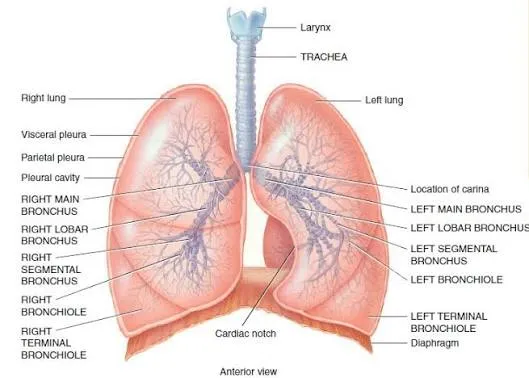
Figure None: 2 Anatomy of Lungs and Bronchial Tree (Anterior View) [17]
Alveoli consisting of type I and type II pneumocytes. An extensive capillary network in the interstitium exists between the alveoli, which has a surface area of nearly 70 m forming a blood-gas barrier that facilitate the gas exchange between the blood and alveoli. When oxygen diffuse from the alveoli to blood, it must cross the respiratory membrane consisting of the alveolar wall [16]. To maintain ideal surface tension and reduces the friction in the lung tissue, phospholipid-based surfactant proteins must be located at the alveolar surface. Pulmonary surfactant (PS) is a lipoprotein complex with have an amphipathic nature, which is released by alveolar type II (AT-II) cells in the pulmonary epithelium. Pulmonary surfactant consists of phospholipids and surfactant protein, the polymeric surfactant which affects the interaction of inhaled nanoparticles with the alveolar surface. The surfactant stabilized colloidal dispersions have been created to aid in the administration of nanoparticulate drugs to the lungs18.the mucous layer is located on the top of the ciliated layer [16] Although the airway mucus barrier provides defense against inhaled pathogens, it is often in sufficient to fully prevent their toxic impact, owing to mesh-like gaps among mucin fibres316, environmental disruptions of mucus and the adaptive mechanisms of pathogens. Various pathogens, allergens and toxins have evolved sophisticated strategies to evade and penetrate the mucosal barrier, compromising its protective function. Disruptions in MCC can lead to chronic respiratory disease conditions, including chronic obstructive pulmonary disease, cystic fibrosis, chronic bronchitis, asthma and chronic cough, increasing risks of inflammation and infection. Mucociliary clearance (MCC) is a critical defense mechanism, removing inhaled particles and pathogens from the airways. Characterizing the periciliary layer, cilia are tiny, hair-like structures emanating from ciliated epithelial cells that beat in a coordinated, wave-like manner to propel the mucus and trapped substances upward towards the throat, where they can be swallowed or expelled. It relies on the coordinated activity of hydration facilitation, mucin production and the movement of cilia. Although the airway mucus barrier [19].
METHOD USED IN PULMONARY SLNs FORMULATION:
The formulation of solid lipid nanoparticles (SLNs) involves a combination of lipids, surfactants, co-surfactants, and sometimes co-solvents. Each of these components plays a crucial role in determining the stability, size, drug loading efficiency, and release profile of the nanoparticles. A carefully selected composition is vital to optimize the therapeutic potential of SLNs [8]. The key ingredients of SLN formulations include lipids, which are in the solid state at room temperature [3]. Lipids have variety of organic compounds, such as fats, hormones surfactants, co-solvents, waxes, steroids, and phospholipids. They consist of a highly diverse assortment of molecules. Lipids exhibit solubility in organic solvents while being insoluble in water. Lipids are mostly used to facilitate drugs that do not dissolve well in water and penetrate into the body completely [20]. Surfactants are employed to enhance the colloidal stability of particles during the manufacturing process of traditional SLNs. SLNs also have different physical and chemical properties depending on the surfactant’s composition and concentration. Surfactants have two important functions: they disperse the lipid melt in the aqueous phase and sstabilize the lipid nanoparticles in dispersions after cooling. The primary considerations when employing surfactants in the formulation of solid lipid nanoparticles are their safety and compatibility with other excipients. Surfactants can enhance the permeability of epithelial cells and overcome any constraints in the absorption of drugs [20]. Co-surfactants such as PEG sometimes included to improve the flexibility of the surfactant layer and promote drug solubilization8 the selection of an active pharmaceutical ingredient (API) for pulmonary drug delivery depends on its therapeutic activity, physicochemical properties, dose requirement, and pulmonary safety. Drug such as budesonide, salbutamol, and formoterol are used for respiratory condition, The API should possess suitable solubility, stability, and formulation compatibility to achieve effective lung deposition. Particle characteristics, aerodynamic behaviour, and local tolerability are also important consideration when developing a safe and effective pulmonary drug delivery system. Excipients are the inactive ingredients are added into the pulmonary drug delivery formulations to improve drug stability, solubility, aerosolization, lung deposition, and release. Their selection depends on their dosage form. The general excipients used in any SLN formulation are solid lipids, emulsifiers, co-emulsifiers and water. The term lipid is used here in a broader sense and includes triglycerides (e.g. tristearin), partial glycerides (e.g. Imwitor), fatty acids (e.g. stearic acid), steroids (e.g. cholesterol) and waxes (e.g. cetyl palmitate). All classes of emulsifiers (with respect to charge and molecular weight) have been used to stabilize the lipid dispersion. It has been found that the combination of emulsifiers might prevent particle agglomeration more efficiently [7].
PREPARATION METHOD FOR SOLID LIPID NANOPARTICLES
1) High-pressure homogenization:
High-pressure homogenization is a commonly used method for the preparing solid lipid nanoparticles (SLNs). It involves two main approaches: hot homogenization and cold homogenization. High-pressure homogenization (HPH) is one of the popular methods among the methods that have been developed. This method can be used by industry in the manufacture of SLNs on a large scale. The pressure used in this process ranges from 100 to2000 bar, with fat content in the formula reaching 40%. There are two approaches to SLN fabrication using the HPH method, namely, hot and cold processes. In the hot homogenization process, the temperature conditions are set at 5–10 â—¦C above the melting point of the fat used. The micronutrient components or active compounds are dissolved in the melted lipid and dispersed in the aqueous surfactant phase with an Ultra-Turrax mixer, which will form a pre-emulsion. The use of heat causes the viscosity to decrease due to an increase in temperature which results in smaller and more uniform particle sizes. In this process, the quality of the premulsion affects the final product of nanoparticles. Therefore, temperature and pressure must be regulated to avoid degradation of the active ingredients contained. In the cold homogenization method, the micronutrient components or active compounds are dissolved in melted lipids and then rapidly cooled with dry ice or liquid nitrogen. The cooled fat is crushed by ball milling to produce microparticles (50–100 µm) which can be dispersed in the cold surfactant phase and form pre-suspensions. The pre-suspension is homogenized in a high-pressure reactor under cold conditions to make it a dispersion system. The HPH process is continued until nanoparticles are produced. The cold homogenization technique has been extended to solve the problem of the hot homogenization technique, especially to prevent damage to the active compounds due to the use of high temperatures [13].
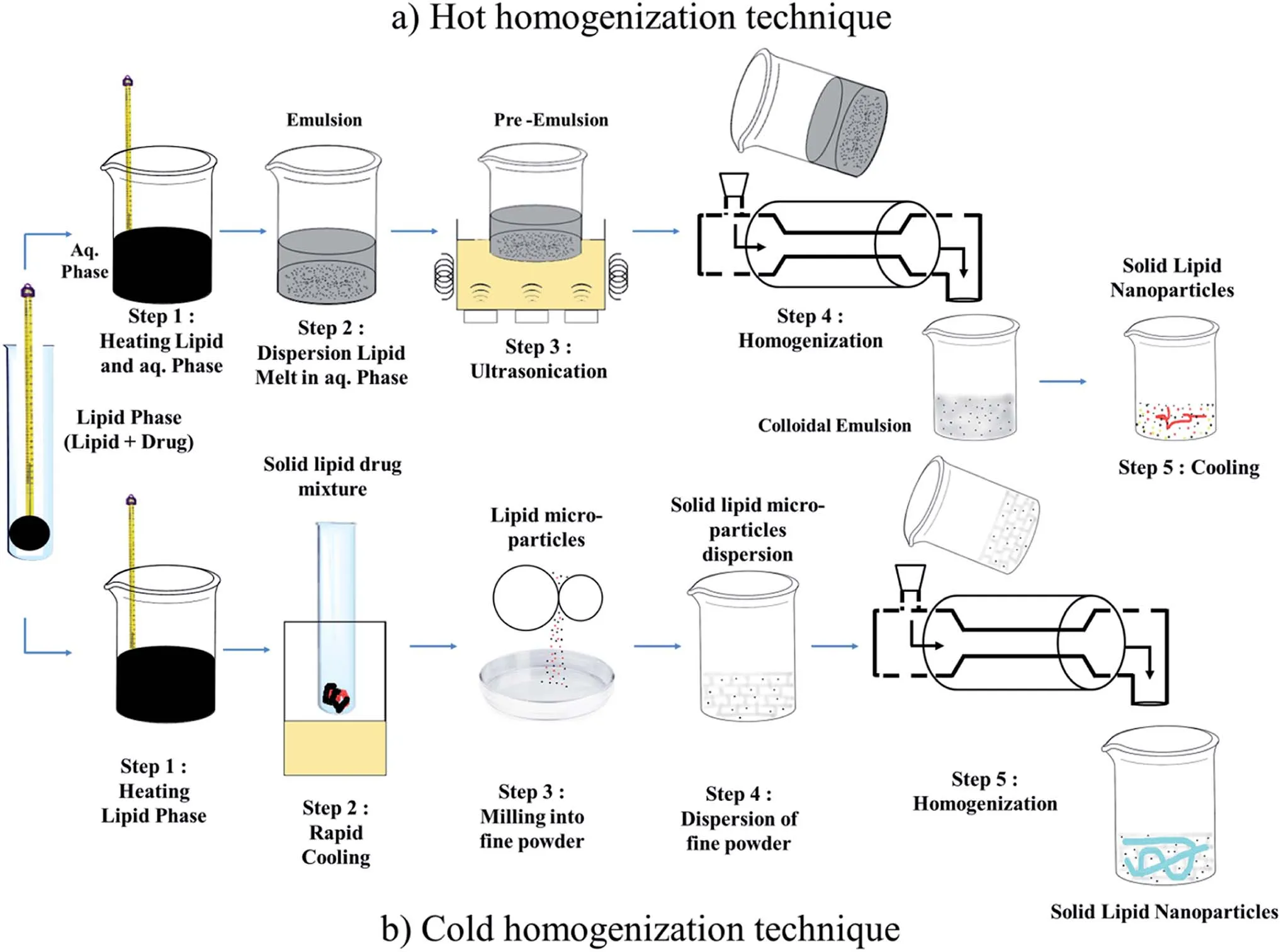
Figure None: 3 Homogenization Technique: (A) Hot Homogenization Technique and (B) Cold Homogenization Technique [3].
2) Ultrasonication:
This method is based on the principle of particle size reduction by applying sound waves. In this method, homogenization with high pressure and ultrasonication are simultaneously used to prepare SLNs with a size in the range of 80–800 nm. Some other advanced techniques have also been introduced to formulate SLNs [3].
3) Microemulsion-based preparation:
This method is based on the dilution of microemulsions. As micro-emulsions are two-phase systems composed of an inner and outer phase (e.g. o/w microemulsion). They are made by stirring an optically transparent mixture at 65-70°C, which typically composed of a low melting fatty acid (e.g. stearic acid), an emulsifier (e.g. polysorbate 20), coemulsifiers (e.g. butanol) and water. The hot microemulsion is dispersed in cold water (23°C) under stirring. SLN dispersion can be used as granulation fluid for transferring in to solid product (tablets, pellets) by granulation process, but in case of low particle content too much of water needs to be removed. High-temperature gradients facilitate rapid lipid crystallization and prevent aggregation. Due to the dilution step; achievable lipid contents are considerably lower compared with the High-pressure homogenization-based formulations [21].
4) Solvent emulsification and evaporation:
to be removed. High-temperature gradients facilitate rapid lipid crystallization and prevent aggregation. Due to the dilution step; achievable lipid contents are considerably lower compared with the High-pressure homogenization-based formulations. form an o/w emulsion. The solvent is then evaporated under reduced pressure, leading to lipid precipitation in the form of nanoparticles. This technique is simple and suitable for lipophilic drugs but has limitations due to the use of organic solvents, which may pose regulatory and safety issues [8].
5) Solvent injection method:
In this technique the solid lipid was dissolved in water-miscible solvent (e.g. ethanol, acetone, isopropanol) or a water miscible solvent mixture. Then this lipid solvent mixture was injected through an injection needle into stirred aqueous phase with or without surfactant. The resultant dispersion was then filtered with a filter paper in order to remove any excess lipid. The presence of emulsifier within the aqueous phase helps to produce lipid droplets at the site of injection and stabilize SLN until solvent diffusion was complete by reducing the surface tension between water and solvent [7].
PULMONARY DELIVERY SYSTEM AND INHALATION TECHNOLOGIES:
1) Nebulizers:
Nebulizers are essential devices in pulmonary drug delivery, transforming liquid medications into fine aerosols suitable for inhalation. They are particularly beneficial for patients who face challenges using pressurized metered-dose inhalers (pMDIs) or dry powder inhalers (DPIs). Traditional jet nebulizers operate by using compressed air to atomize the medication through a narrow orifice, producing droplets of varying sizes. Larger droplets are typically removed by baffles and recycled within the device, while smaller droplets are inhaled into the lungs. Recent advancements have led to the development of various nebulizer types, including ultrasonic and vibrating mesh nebulizer Ultrasonic nebulizers utilize high-frequency vibrations to generate aerosols but may increase the temperature of the medication, potentially affecting heat-sensitive drugs. Vibrating mesh nebulizers, on the other hand, employ a mesh with microscopic holes that vibrate to produce a consistent and fine mist, enhancing drug delivery efficiency and reducing medication waste. Innovations in formulation studies have further optimizeded [22].
2) Dry powder inhalers (DPIs):
It requires a certain level of skill because it is a flexible mechanism. The formulation is in solid form, as the word itself suggests. The solid medication is contained in a dry powder mixture in this bolus drug delivery device, which becomes fluidized when the patient inhales. It either has the active medication by itself or has a carrier powder added to the medication to improve its flow characteristics. Compared to metered dose inhalers, dry powder inhalers are more stable, easier to use, and less expensive. Hazardous propellants like CFCs are not required. They will be made for one or more doses [4].
3) Nebulised dispersion:
- Nebulizing of an aqueous colloidal dispersion or suspension is an easy delivery method that enables nanoparticle deposition in the deep lung. Nebulization of dispersed nanoparticulate offers numerous benefits for medications that are not suitable for pulmonary delivery as an aqueous solution. First, compared to micronized drug dispersions, nanoparticles can be distributed more evenly throughout 1–5 mm droplets, enabling more uniform dosage delivery and more efficient deep lung deposition due to the higher drug presence in droplets smaller than 3 mm. Studies have demonstrated that larger average administered doses and enhanced dosage homogeneity can be attained when compared to a micro particle suspension. Second, compared to micro particles, nebulized nanoparticle dispersions have been found to have less detrimental effects on nebulizer function and aerosol droplet size due to their near-solution rheology. In order to stabilize nanodispersion before being nebulized, nanodispersions for the lungs frequently include modest amounts of natural surface-active agents or, alternatively, are designed with redispersion in mind. Dry formulations may have the advantage of requiring little to no surfactant because aqueous stability is only required for the brief period of time between redispersion and nebulization [18].
4) Metered-dose inhaler:
The metered-dose inhaler called an MDI for brief, may be a pressurized inhaler that delivers medication by employing a propellant spray. It’s composed of 4 essential components: the bottom formulation (drug, propellant, excipients, etc.) the container, the metering valve, and the actuator (or mouthpiece). It’s a drug delivery device that provides the fine droplets of a medicament having a particle size of fewer than 5 micrometers. It’s used for the treatment of respiratory diseases like asthma and COPD. They will tend from suspension or solution. just in the case of suspension formulations, the substances that are insoluble within the propellant and solvent are dispersed within the suitable propellant vehicle. Particle size and the solubility of active ingredients and surfactants or dispersing agents are the important factors to be considered in formulating MDI suspension formulations [1].
CHARECTERIZATION OF PULMONARY SLNs:
Comprehensive characterization of SLNs is crucial to evaluate their physicochemical properties, predict their biological performance, and ensure reproducibility and stability.
1) Particle Size and polydispersity index:
Particle Size determines drug release behavior, cellular uptake, and biodistribution. SLNs typically range between 50–500 nm. Polydispersity Index (PDI) reflects size uniformity. A PDI below 0.3 indicates a narrow size distribution, which is ideal for pharmaceutical formulations [8].
2) Zeta potential:
Zeta potential measurement can be carried out using zeta potential analyzer or zetameter. Before measurement, SLN dispersions are diluted 50-fold with the original dispersion preparation medium for size determination and zeta potential measurement. Higher value of zeta potential may lead to disaggregation of particles in the absence of other complicating factors such as steric stabilizers or hydrophilic surface appendages. Zeta potential measurements allow predictions about the storage stability of colloidal dispersions [14].
3) Differential scanning calorimetry:
Differential scanning calorimetry (DSC) is one of the most important methods for the analysis of polymorphic changes in a lipid matrix. Structural changes in the lipid matrix provide information regarding the stability of the formulation over time. Melting and recrystallization curves are appropriate parameters to determine polymorphic changes in lipid matrices. A detailed analysis of the use of this technique in lipid-based systems is described [4].
4) X-ray diffraction (XRD):
X-ray diffraction, along with DSC, is necessary for determining the lipid lattice's crystal structure and spacing. The lattice spacing and lipid/polymer structure are affected when an API is added. Crystallinity can be mapped in conjunction with DSC, and this method reveals patterns in the spacing as well as changes in the structure of lipids and polymers. Consequently, it is prescribed to utilize the two strategies at the same time while breaking down any lipid-based details Further developed techniques for physicochemical portrayal incorporate atomic attractive reverberation (NMR), Raman spectroscopy and infrared spectroscopy. These methods are more valuable apparatuses for the portrayal of blended frameworks, where various sorts of particles may coincide (SLN, micelles, liposomes, fluid gems) [18].
5) In vitro drug release studies:
The membrane diffusion method is widely employed for the investigation of in vitro drug dissolution. Various techniques, such as the dialysis sac method, reverse dialysis sac method, and side-by-side dialysis method, are employed in numerous devices. Separation techniques are employed to isolate the dispersed nanoparticles from the continuous phase. The quantity of the drug is also assessed. Due to the small dimensions of nanoparticulate systems, it is extremely challenging to separate them from the surrounding medium. Continuous flow methods were initially developed to modify the release of oral dosages. The utilization of the United States Pharmacopeia apparatus 4 method offers numerous benefits in the restoration of the in vitro environment [20].
6) Electron microscopy:
Scanning electron microscopy (SEM) and transmission electron microscopy (TEM) provide way to directly observe nanoparticles. SEM is however better for morphological examination. TEM has a small-size limit of detection [14].
MECHANISM OF PULMONARY DEPOSITION AND DRUG RELEASE:
Drug Loading into SLNs:
Currently, the fabrication strategy of lipid nanocarriers for controlled and stimuli-responsive drug release has raised research attention for overcoming the problems associated with poorly soluble and toxic drugs. There are mainly three drug incorporation models valid for SLNs: Homogenous matrix model, Drug enriched shell-core shell model, and Drug enriched core shell mode.
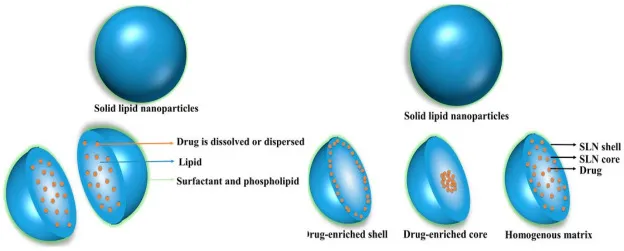
Figure None: 4 Models of Incorporation of Active Compounds into SLN15.
In homogenous matrix model, the core may consist of drug in either amorphous clusters or molecularly dispersed phase. This model is usually observed when highly lipophilic drugs are incorporated into SLN either by application of hot or cold homogenization method. In drug enriched shell model, drug is available near the shell, thus yielding a drug free lipid core. A phase separation occurs when the solution is cooled and lipid precipitates lding a drug free lipid core. A phase separation occurs when the solution is cooled and lipid precipitates out leading to drug free lipid core. During the same period, the drug re-partitions into the remaining liquid-lipid phase and drug gradually increase its concentration in the outer shell of the lipid core.
A drug-enriched core can be formulated by liquefying drug in the lipid to its saturation solubility whereby a nanoemulsion is formed. Supersaturation of the drug in lipid melt occurs during the cooling of the nanoemulsion and causes precipitation of the drug before the precipitation of lipid. Further cooling will lead not only to drug but also lipid precipitation surrounding the drug [15].
Drug release from solid lipid nanoparticles:
The drug release from the solid lipid nanoparticles (SLNs) occurs through diffusion, erosion, and breakdown of lipid matrix. The release mechanism of the lipid composition depends on the particle size, drug interaction with lipid and drug entrapment. Drugs are present on the particle surface show an initial burst release, whereas drugs encapsulated within the lipid matrix are released gradually, gives sustained or controlled drug delivery system [15].
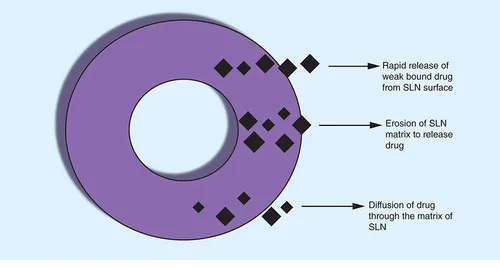
Figure None: 5 Mechanisms of Drug Release from Solid Lipid Nanoparticles [8].
THERAPEUTIC APPLICATIONS OF PULMONARY SLNs:
1) For pulmonary drug delivery:
SLNs are being explored for pulmonary delivery via nebulization or dry powder inhalers. They improve drug deposition in the lungs and protect drugs from degradation. SLNs also offer potential in the treatment of respiratory diseases like asthma, tuberculosis, and cystic fibrosis [8].
2) For lung cancer chemotherapy:
SLN can be proposed as carriers of anticancer drugs in lung cancer treatment or peptide drugs to improve their bioavailability. Assessment of inhaled radio-labeled SLN bio distribution has been described and the data showed an important and significant uptake of the radio-labeled SLN into the lymphatic after inhalation [14].
3) For pulmonary tuberculosis:
In a recent study, antitubercular drugs (rifampicin, isoniazid and pyrazinamide) were incorporated into various formulations of solid lipid particles ranged from 1.1–2.1 μm and formulations were nebulized to guinea pigs by mouth for direct pulmonary delivery (Pandey et al., 2005a and 2005b). Nebulization of solid lipid particles carrying antitubercular drugs was observed to be successful in improving drug bioavailability and reducing the dosing frequency for better management of pulmonary tuberculosis.
4) For other respiratory applications:
The lungs offer a high surface area for drug absorption by avoiding first-pass effects. Rapid drug absorption by aerosolization of drugs (in the 1-3 μm size range) occurs since the walls of alveoli in the deep lung are extremely thin. Lymphatic drainage plays an important role in the uptake of particulates in the respiratory system.
5) Gene delivery vector in pulmonary drug delivery system:
Solid lipid nanoparticles (SLNs) have also been investigated as potential carrier for genetic material, including DNA, plasmid DNA, and other nucleic acids. Their ability to encapsulate and protect genetic materials makes them promising candidates for gene delivery applications. Surface modification with cell- penetrating peptides, such as HIV-1 TAT peptide, has been explored to improve cellular uptake and gene transfer efficiency. Furthermore, lipid-nucleic acid nanoparticles, known as genospheres, has been developed for targeted gene delivery. These nanoparticles can be surface-modified using antibody-lipopolymer conjugates to improve targeting specificity. Such development indicates the potential of lipid-based nanoparticles for pulmonary gene delivery and other lung-targeted therapeutic applications [16].
RECENT ADVANCES IN PULMONARY SLNs TECHNOLOGY:
Solid Lipid Nanoparticles (SLNs) have involved significantly since their inception with continuous research leading to innovative adaptations and advanced drug delivery platform. These developments aim to overcome the limitations associated with conventional SLNs, such as low drug-loading capacity, drug expulsion during storage and physical instability. Recent advances have improved their performance in terms of drug encapsulation, release profiles, targeting and therapeutic potential
1) Hybrid lipid nanoparticles: hybrid lipid nanoparticles are among the promising innovation is lipid-based drug delivery system. These systems combine solid lipid with liquid lipids (oils) to form nanostructured lipid carriers (NLCs). NLCs offer improved drug-loading capacity, better physical stability and minimized drug leakage compared to conventional SLNs. The incorporation of liquid lipid disrupts the highly ordered crystalline structure of solid lipid creating imperfections that accommodate drug molecules. These systems offer potential for developing advanced pulmonary drug delivery formulations with improved drug loading and release characteristics.
2) Advanced lipid-based delivery system: The incorporation of polymers or inorganic materials into lipid-based nanoparticles has been investigated to enhances their functionality, including responsiveness to pH, temperature and magnetic fields. Such modifications may provide opportunities foe developing targeted and stimuli-responsive pulmonary drug delivery system.
3) Development of inhalable nanomedicines: Inhaled nanomedicine is an emerging field in pulmonary drug delivery, with research focusing on nanoparticle-based formulations to improve pulmonary drug deposition and prolong drug residence time in the lungs. Lipid-based nanoparticles, including SLNs have potential applications in delivery therapeutics agent directly to the respiratory tract. These systems may improve drug stability, provide controlled drug release and enhance localized therapeutics therapeutic effects [22,8].
FUTURE PERSPECTIVES OF SLNs IN PULMONARY DRUG DELIVERY:
Despite the promising developments in pulmonary drug delivery, several challenges remain in achieving effective drug deposition, prolonged lung residence and improved patient adherence. Future developments are expected to focus on optimizing formulation strategies and inhaler designs to improve pulmonary and therapeutic effectiveness.
1) Improvement in pulmonary drug deposition: Future research should focus on optimizing SLN formulations and inhalation devices to improve drug deposition in the lungs. Appropriate formulation characteristics and aerosolization properties are essential for achieving effective pulmonary delivery and minimizing drug loss.
2) Development of controlled-release formulation: Extending drug residence time in the lungs is an important objective for pulmonary drug delivery. SLNs offer potential for sustained and controlled drug release, which may reduce dosing frequency and improve patient adherence. The development of once-daily formulations from drug that traditionally required twice-daily administration may provide additional therapeutic benefits.
3) Targeted and stimuli-responsive drug delivery: Emerging approaches such as PEGylation for molecular protection, protease inhibitors and receptor mediated targeting offer promising opportunities for improving pulmonary drug delivery. Similarly, the development of stimuli-responsive lipid-based nanoparticles may provide opportunities for achieving controlled and targeted drug release in the lung.
4) Clinical translation and regulatory challenges: Although several nanocarrier-based formulations have demonstrated promising preclinical results, their clinical translation remains limited. Challenges associated with large-scale production, batch-to-batch reproducibility, long term stability, pulmonary toxicity and regulatory compliance need to be addressed. Further investigations involving safety, efficacy and good manufacturing practices (GMP) are essential for the successful clinical development inhalable SLN formulations.
5) Future therapeutic applications: With increasing interest in localized and targeted drug delivery, SLNs may offer opportunities for pulmonary administration of antibiotics, anti-inflammatory agents, anticancer drug and genetic materials. Further research is required to establish their therapeutics effectiveness and long-term safety in the treatment of respiratory diseases [22,8].
CONCLUSION:
In conclusion, Solid Lipid Nanoparticles (SLNs) have emerged as promising nanocarriers for pulmonary drug delivery due to their potential to improve drug stability, provide controlled and sustained drug release, enhance lung targeting and reduce systemic toxicity. Recent advances in formulation design, including lipid composition, particle size optimization, surface modification and improved drug-loading capacity, have contributed to the development of advanced lipid-based delivery systems. Furthermore, advancement in inhalation technologies and aerosol formulations offer opportunities for improved pulmonary deposition and drug delivery efficiency. Despite these developments, challenges related to formulation stability, aerosolization pulmonary safety, large-scale manufacturing and clinical translation remain. Future research is essential to optimize inhalable SLN formulations, improve targeted lung delivery and establish their long-term safety and therapeutic efficacy for the treatment of respiratory disease.
Ethical Approval: Not applicable
Acknowledgement: None
Conflicts of interests: There are no conflict-of-interest
Funding: Nil
Authors Contribution
All the authors have contributed equally
Source of Support: Not Applicable
Informed Consent Statement: Not Applicable
Data Availability Statement: The data presented in this review article are available within the article and its cited references.
REFERENCES



Tanuja Rajesh Aadhe, Anil Balajirao Panchal, Dr. Sampat Dnyaneshwar Navale, Solid Lipid Nanoparticles for Pulmonary Drug Delivery: Recent Advances in Formulation Design, Inhalation Technologies, Lung Targeting and Clinical Translation, Int. J. Sci. R. Tech., 2026, 3 (11), 1227-1238. https://doi.org/10.5281/zenodo.24491962
 10.5281/zenodo.24491962